
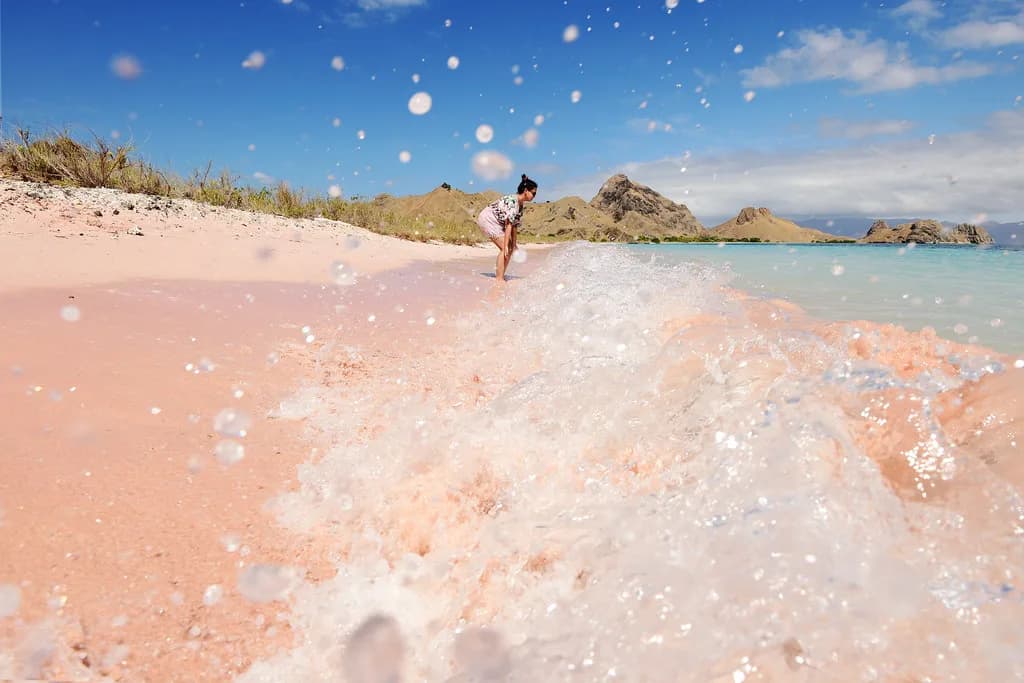
Pink Beach (Pantai Merah) in Komodo National Park: How to Visit from Labuan Bajo
Pink Beach (Pantai Merah) is a short, narrow cove on the southeastern coast of Komodo Island, inside Komodo National Park, and it is reached only by boat from Labuan Bajo on Flores. There is no road in, no resort and no way to arrive on your own, so the real planning decision is not whether to go but whether you go by day trip, liveaboard or private charter. This guide covers which beach your route actually includes, how arrival times differ between the three options, why the sand is pink, and how long to budget on the sand.
What Pantai Merah actually is
Pink Beach is a small sheltered cove rather than a long resort shoreline: one guide describes it as a narrow stretch of sand roughly 250 m long, set between green hills and calm water. That scale matters when you plan, because the beach absorbs a crowd quickly and an hour can feel like plenty once boats begin to cluster. Treat it as a swimming and snorkeling stop inside a bigger park route, not as a beach day with amenities to fill an afternoon.
The cove sits inside Komodo National Park, the protected area between Sumbawa and Flores that is best known for its Komodo dragons. Pink Beach is one of several stops that boats string together on the same loop, rather than a standalone destination with its own harbor or jetty. For the wider set of land-based and boat-based stops around the gateway town, see the Labuan Bajo Attractions collection before you fix an itinerary.
Where Pink Beach sits on the park route
On the standard day loop, Pink Beach falls between the Padar Island viewpoint hike and the dragon ranger station at Loh Liang on Komodo Island, with Taka Makassar and Manta Point often following later in the day. Knowing that sequence helps you judge any itinerary you are quoted: if Pink Beach is listed fourth or fifth, you will probably land there near midday along with most of the fleet. Read the Padar Island, Labuan Bajo guide separately if you want to understand the hike that usually precedes the beach.
Rinca island is the other main dragon stop in the park and sometimes substitutes for or complements Komodo Island on shorter routes. If your operator offers both, ask which ranger station you actually walk and how much time is left for the beach afterward. The Rinca Island from Labuan Bajo guide sets out what that stop involves.
Which 'Pink Beach' is on your route
More than one beach in the park gets marketed as Pink Beach, and only the main one on Komodo Island carries the strong blush; a boat that pulls up somewhere plainly white may still call the stop Pink Beach. Similar pink-tinged beaches exist on Padar and in Lombok, so the name alone does not tell you which shore you will stand on. The practical test is simple: before you pay, ask the operator to name the island and the stop on the confirmed route, and check that the answer is the Komodo Island cove.
How you get there: three ways from Labuan Bajo
Every option starts at the harbor in Labuan Bajo, where boats leave for the park in the morning. If you are unsure where to meet your crew or how the piers are laid out, the Labuan Bajo waterfront guide explains the seafront before an early departure.
The shared day trip is how most visitors see the beach. One operator publishes a schedule with hotel pickup at 06:30, departure around 07:00 and a Padar hike before landing at Pink Beach from 10:00 to 11:00, then Komodo Island for the dragons and a return to town between 16:15 and 17:00. That same operator lists the day trip from IDR 1,450,000 per person with snorkel gear, lunch, a towel and a guide included, so treat those timings and that figure as that company's published product and confirm your own booking's details in writing.
A liveaboard sleeps inside the park, which is the whole point: you reach the sand before the day boats arrive from town. The same operator describes landing at 09:30 on the second morning of its three-day, two-night trip, with the reef and sand far quieter than at midday, and lists that trip from IDR 6.5M per person across nine cabins. A private charter works on the same logic in reverse, letting your group set the order so the beach comes first thing.
Day-trip timing versus an early landing
The timing trade-off is the most useful thing to understand before booking. Day boats tend to follow the same pattern, arriving late morning and leaving mid-afternoon, so by noon the cove can hold dozens of anchored boats and footprints in every direction. Overnight boats and charters can be on the sand in the early morning or stay into the evening, which is when the place feels like the quiet anchorage it is.
If you only have one day, the shared trip is still the sensible choice, because it bundles the beach with Padar and the dragons on a single run. Accept the crowd as part of the package rather than paying for a private boat you do not need. Readers weighing the cost against an overnight should compare the two formats before committing, since the liveaboard premium buys quiet and light rather than extra stops.
Why the sand is pink
The color comes from the mix: white sand formed from broken coral calcium carbonate, blended with tiny red fragments of foraminifera, a marine organism whose shells wash ashore from the surrounding reef. Because the tint is a blend rather than a uniform dye, some stretches read as soft rose and others look nearly white. It is strongest where the sand is wet, so a wave washing over your feet or a scoop in your hand shows more color than the dry surface.
Light matters as much as moisture. Harsh midday sun washes the blush out, while early morning and late afternoon show it best, which is one more argument for arriving on an overnight boat. If your only slot is midday, look at the wet sand at the waterline rather than the dry upper beach.
Swimming and snorkeling from the sand
The reef begins a few meters off the beach, so you walk in from the sand and are over coral almost immediately, with plenty of fish in the shallows. That easy access is the real reason to stop here, more than the view from the boat. Snorkel gear is typically included on both day trips and liveaboards, and a well-fitting personal mask still makes the hour more comfortable.
The water is calm close to shore, which suits casual swimmers and families, while stronger currents farther out mean you should stay in the sheltered zone unless you are with a guide. Visibility is described as often excellent, though no source here gives a reliable month-by-month window, so ask your operator what conditions to expect for your dates.
Facilities are minimal to nonexistent: no lifeguards, and historically no shops, resorts or cafes, though small local businesses have begun appearing at the eastern end. Plan on bringing what you need and carrying it back out. On the published day-trip schedule the beach slot runs about an hour, which is enough for a swim and a snorkel but not for a long lazy afternoon.
How long to allow, and what the stop does not include
Budget roughly an hour on the sand on a shared day trip, and treat anything longer as a bonus granted by your route rather than a promise. On a liveaboard or charter you can stretch that to a couple of hours by arriving early, but the cove is small enough that the extra time is best spent in the water. The stop has no entrance gate or ticket desk of its own, because access is governed by park entry rather than by the beach.
Park entry fees are charged separately from whatever you pay the tour operator, and published sources do not agree on amounts, so do not assume your quoted tour price covers them. Ask your operator exactly which fees are included and what you pay on the day, in rupiah. That is one of the few details worth confirming twice before departure.
Pink Beach is not a place to build a whole day around, and it is not a beach you can reach for a sunset swim on a whim. It is one stop on a boat route that also carries the park's headline sights. Set expectations accordingly and the hour on the sand will land well.
Nearby stops that share the same route
The standard loop pairs Pink Beach with the Padar viewpoint, the Komodo dragons at Loh Liang, the Taka Makassar sandbar and Manta Point. If your time is short, prioritize the dragons and the Padar viewpoint, since those are the stops with no substitute elsewhere in the park, and treat the beach as the relaxed middle of the day.
Back in town, the land-based sights are easy to fold into the days either side of your boat trip. Puncak Waringin in Labuan Bajo is the hillside viewpoint above the harbor and a natural first-evening stop, while Pede Beach in Labuan Bajo is the closest stretch of sand you can reach without a boat. Neither replaces Pantai Merah, but both fill a half-day without another crossing.
Day trip, liveaboard or charter: which gets you to Pantai Merah?
Choose the shared day trip if you have one day and want the beach bundled with Padar and the dragons; accept a late-morning arrival and a crowded cove. Choose a liveaboard or private charter if the pink sand at quiet, low light is the point of the trip, and you are willing to pay for the earlier landing. Either way, confirm which beach your route includes, ask what the park fees add on top, and verify current schedules and prices directly with the operator before you book.