
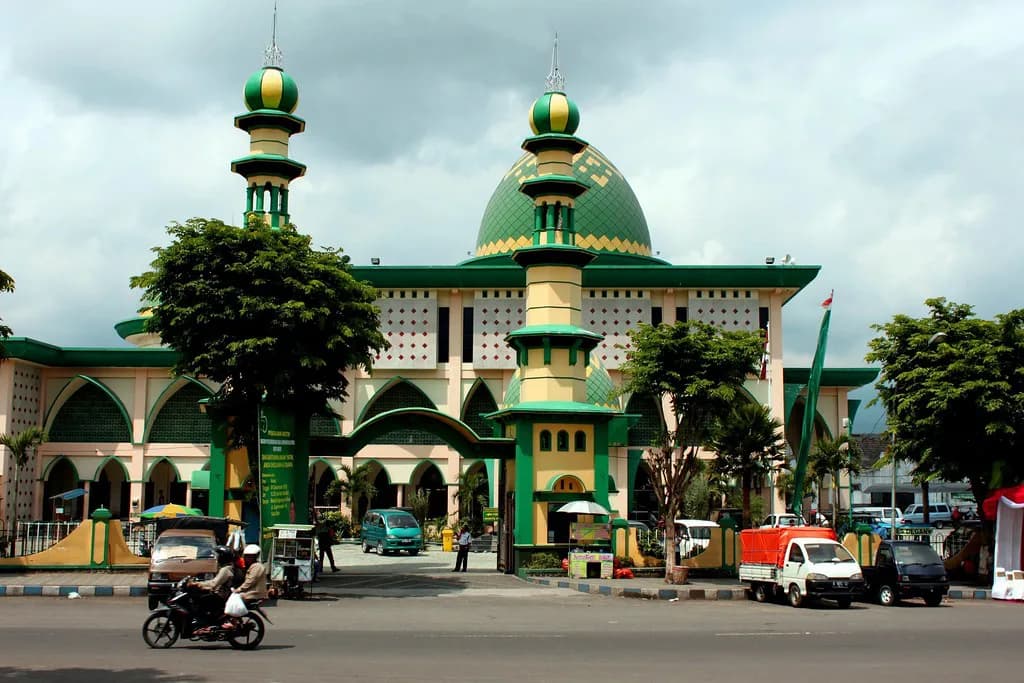
Masjid Agung Malang: What to See at the 1890 Grand Mosque
Masjid Agung Malang is worth a short stop, not a half day: plan roughly 20 to 40 minutes for the retained 1890 prayer hall, the raised floor levels and the tombs behind the mihrab. It is a working congregational mosque in the Klojen city center, a few minutes on foot from the alun-alun, so you visit around prayers rather than on a museum schedule. This page covers where it stands, how to reach it, what to actually look at inside, and what to confirm before setting out.
What and where Masjid Agung Malang is
The mosque stands at Jalan Merdeka Barat No. 3, Kelurahan Kauman, Kecamatan Klojen, in Kota Malang, East Java, immediately west of the city's central alun-alun. The mosque's own site describes it as the main mosque of the city and notes the original name, Masjid Jami'. Treat it as a functioning religious and community site with study groups, a radio station and school programs, not as a sealed heritage interior.
For orientation, the mosque's official site places a Bank Mandiri building (formerly Bank Bumi Daya) directly to the south and the Jiwasraya insurance office to the north. Those two facades are your best landmarks, because the mosque frontage is easy to walk past in the busy commercial grid around the square. Look for the low, wide roof set back from the street rather than a towering dome.
How to get there and where to be dropped off
Because the mosque sits in the Klojen center, the practical approach is to arrive by ride-hailing car or taxi and walk the last stretch from the alun-alun area. Ask the driver for Jalan Merdeka Barat near the bank building on the south side, which puts you at the corner rather than in a one-way loop. Distances are short here, but central Malang traffic can turn a two-kilometer hop into a slow crawl, so build in slack.
The mosque's site publishes a contact phone number and email address, which is the sensible way to confirm access for non-worshippers and any changes to visiting before you travel. It does not publish visitor opening hours or an entry ticket on its pages, so do not plan around a stated schedule. Friday midday is the busiest congregational prayer of the week, so aim for mid-morning or mid-afternoon on another day if you want to look around quietly.
How much time to allow
Allow 20 to 40 minutes if you want the facade, the old hall and the floor levels without hurrying. Add time if prayers are in progress, since you will wait at the edge rather than walk through the prayer space. This is a single-building visit, so pair it with the square and the surrounding streets rather than treating it as a standalone morning.
Visitors often overestimate what is inside: there is no exhibition wing, no ticket desk and no guided route. The reward is architectural and atmospheric, which means a slow ten minutes looking at the roof structure can be worth more than an hour of circling. If you are short on time in the city, this fits neatly into a walk that starts at the alun-alun.
The two architectural layers to look for
The mosque was founded in 1890 on roughly 3,000 square meters of state land, with a second phase running from 15 March to 13 September 1903 according to the official site. The original square hall, steel-structured with a two-tier tajug roof, has been kept in place. Look up first: the stacked Javanese roof is the oldest surviving gesture in the building.
The second layer is Arab-influenced: a dome on the minaret and arched openings at the doors and windows. The official site describes the building as carrying both Javanese and Arab architectural styles, which is why the silhouette reads differently from the street than from inside the hall. Walk the exterior once before you enter so you can match the arches to the interior openings.
The raised floor and the mihrab
The detail most short listings miss is the floor. The mosque's site explains that the sacred area sits about 105 centimeters above the surrounding ground, a step-up you feel as soon as you cross the threshold, and the mihrab at the front is raised again above that. Read the levels as a hierarchy rather than as decoration: each rise marks a more sacred zone.
Behind the mihrab, the site notes that tombs of the founders' ancestors are still kept in place. That is unusual enough to be the reason to walk to the front of the hall rather than stopping at the entrance. Keep your voice low and stay clear of anyone praying; the tombs are part of a living religious space, not an exhibit.
Heritage status: what is settled and what is not
A 2017 Universitas Gadjah Mada thesis examined the mosque as a potential heritage building and observed that it did not then hold formal cagar budaya status, with no local regulation in place at the time of writing. In other words, the mosque's historical importance is well documented, but its legal designation was unresolved. Do not repeat "heritage mosque" as a settled official label without checking whether the city has since acted.
That gap matters for visitors mainly as an expectation-setter: you are seeing a preserved but actively used building, not a curated monument with labels and a route. The same thesis notes growing visitor numbers as one pressure behind renovations, which explains the mix of old fabric and newer finishes. Look for the original square hall and roof as the core sight, and treat later additions as layers rather than intrusions.
Nearby options around the alun-alun and Klojen
The mosque's position one block off the central square makes it an easy add-on to a walk through the old commercial heart of Malang. The city's Tugu area and its monument are short rides away if you want to continue on foot through the colonial-era streetscape. For a broader set of choices in the city, the Malang Attractions: 14 Visitor Guides collection covers the surrounding sights.
If you are building an evening around the visit, Malang night paradise sits in Kec. Blimbing to the north of the center and works as a separate outing rather than a walk from the mosque. Closer in, an old-school stop for coffee and ice cream on Jalan Jenderal Basuki Rahmat fits naturally before or after. Both are best treated as their own stops with their own confirmed details.
Where to confirm access before you go
Check with the mosque directly on visiting hours, access for non-Muslim visitors and any ceremony-related changes, using the phone number or email published on its site. If a large event is listed on its calendar, expect the hall to be busy and adjust your timing rather than turning up mid-program. The mosque's Instagram account is the faster channel for day-to-day notices.
Ticket prices are not the issue here: the official site publishes no entry fee, and none of the sources consulted gives one, so do not budget for a ticket and instead confirm on arrival whether any donation is customary. Third-party listings such as Atourin carry a mosque page, but treat its practical details as secondary to the mosque's own channels. One quick message before you go saves a wasted trip.
Is the mosque worth fitting into a Malang day?
Yes, if you are already in central Malang: 20 to 40 minutes buys you a genuine 1890 hall, a readable floor hierarchy and founder tombs you will not find in a standard city listing. It is not a destination in its own right, so anchor it to a walk around the alun-alun and the Klojen streets. Skip it if you want curated interpretation or a fixed opening schedule.
Before you go, confirm access and timing through the mosque's published contact channels, since no official visitor hours or ticket are published. Then treat the visit as a quiet pause in a working religious site, and the building will reward the attention.
Explore more Malang guides
Frequently Asked Questions
Why is it called Masjid Agung rather than Masjid Jami?
The mosque's official site explains that it was originally named Masjid Jami' and now carries the Masjid Agung Jami' name as the city's main congregational mosque. Agung signals its status as the principal mosque of Kota Malang, while Jami' refers to the Friday congregational function. The two names appear interchangeably in listings.
Can non-Muslim visitors go inside?
No source consulted states a formal visitor policy, so ask the mosque directly through the phone number or email on its official site before you go. Outside prayer times is the more considerate window, and modest dress and quiet behavior are expected in any active prayer hall. Treat permission as something you confirm rather than assume.