
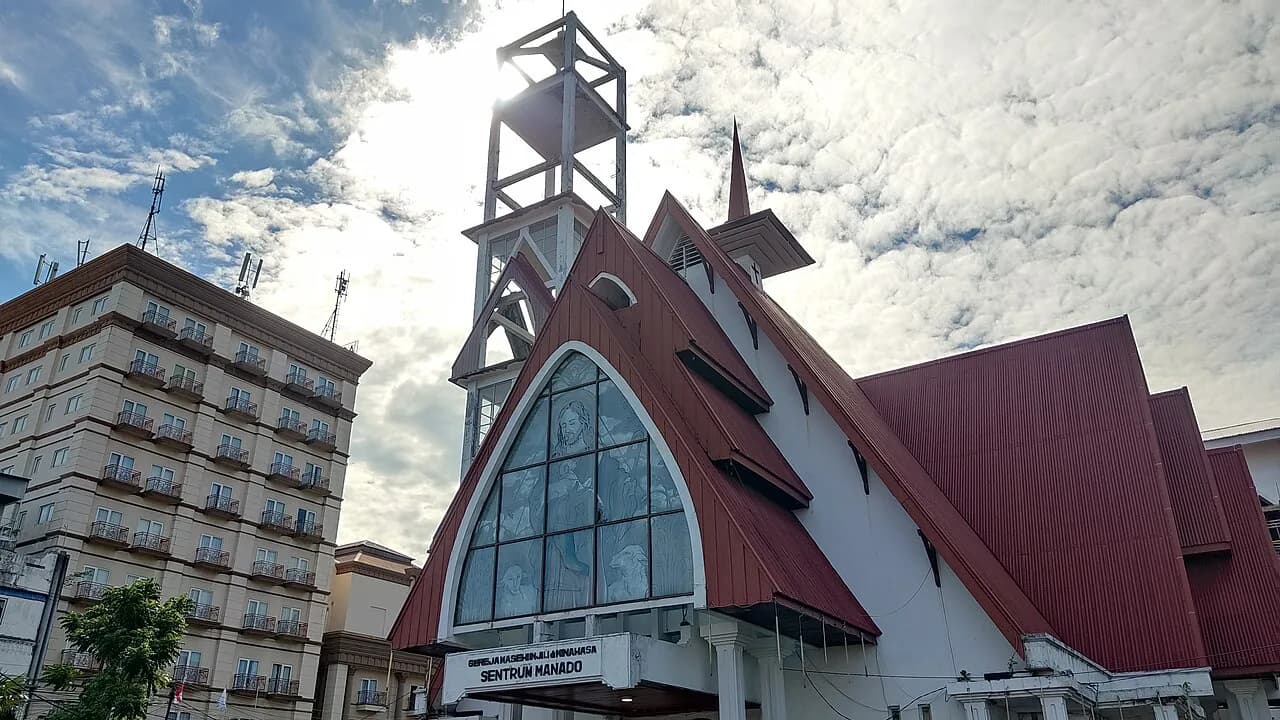
Gereja Sentrum Manado: What to See at Manado's Oldest Church

Gereja Sentrum Manado is worth a short stop if you want to see where old Manado began: an active GMIM congregation in Kelurahan Lawangirung, Kecamatan Wenang, with a founding story that reaches back to the VOC era. Plan on roughly 30 to 45 minutes for the church itself, plus whatever time you give the surrounding old-center streets.
The key distinction is between the congregation and the building. The sources date the church's founding to 1677, but that does not mean today's structure was standing then, and it is not presented as a museum with posted visitor hours. This page covers where it sits, how to approach it from downtown, the 1677 story, what you can reasonably look at, and where to confirm service times before you go.
What Gereja Sentrum Manado is
This is a working Protestant church, not a heritage site with a ticket booth. It belongs to GMIM, the Evangelical Christian Church in Minahasa, and sits in Kelurahan Lawangirung, Kecamatan Wenang, which the sources describe as the former center of Manado city. Expect a place of worship first and a historical landmark second, and behave accordingly if a service or gathering is under way.
The congregation's own channels are the best place to see what is happening at the church now, since the posts reflect current activity rather than a fixed visitor program. If you want to attend a service rather than simply look at the exterior, treat the congregation as your source of truth. The Atourin listing also collects basic destination information for the church, though it is a third-party aggregator rather than the operator.
Where it sits: Lawangirung and Wenang
Lawangirung sits in the Wenang district, and the sources tie that area directly to the historic core of Manado under the VOC. That location explains the church's setting: it was planted where the colonial town's administration and population were concentrated, not on the edge of the modern city. Reading the church as part of that old center makes the stop more intelligible than viewing it as an isolated monument.
Modern downtown Manado has shifted, so the church now reads as part of the older street grid rather than the commercial center. If you are building a short walk around the area, pair the church with the city's other central sights rather than expecting a single dense heritage quarter. The broader Manado Attractions guide sets out the options if you want to plan a half day rather than one stop.
How to get there from central Manado
Ride-hailing is the simplest approach: set your pickup and drop-off in the app using the church name plus Lawangirung or Wenang as the district, and confirm the pin with the driver before you set off. Ride-hailing apps and metered taxis are the usual way travelers get around Manado. Traffic in the immediate center is slow rather than paralysing, so budget extra minutes for short distances at busy times.
If you are already in the old center, walking is realistic for most travelers, since the church sits within the district the sources identify as the historical heart of the city. Wear something you can walk in and keep an eye on the heat rather than planning a long approach on foot from distant neighborhoods. For a sense of how the old center connects to the waterfront and market areas, the Pasar Bersehati guide covers a nearby anchor point in Kelurahan Calaca.
The 1677 founding story
The founding marker most sources use is 1677, when the VOC placed Pdt. Zacharias Cohen at Manado at the request of Ds. Montanus. That is the date to quote when someone asks how old the church is, and it describes the establishment of the congregation and its ministry rather than the construction date of the present building. Keep that distinction in mind so you do not repeat the common slip of calling today's structure a seventeenth-century original.
The subsequent history includes damage during the Second World War, with Okezone reporting that the church was bombed in that period and later rebuilt and returned to active use. Details beyond that are not established by the sources here, so treat any more elaborate wartime account you hear on site with caution unless a plaque or the congregation confirms it. What matters for a visitor is that the building you see is a later structure carrying a much older institutional history.
Wikipedia's entry is the most compact narrative summary of the colonial-era origin and the Lawangirung setting, and it is a useful pre-visit read if you want the timeline straight before you arrive. Cross-check any specific date you plan to repeat against the congregation's own material, since institutional histories get retold with small variations.
What to see on a visit
Look at the building as an active church rather than an exhibit: the exterior massing, the entrance, and any memorial or dedication markers you can see from accessible areas. The sources do not describe interior furnishings or a visitor route in detail, so go without a checklist and let what is actually open to you set the pace. If doors are shut for a service or a private event, the exterior and the setting are the visit.
The surrounding street grid is part of the experience, because the church's significance comes from sitting in what the sources call the former center of Manado. Walk a block or two in each direction to register how the old core sits against the modern city, and note that this is a living neighborhood rather than a preserved heritage zone. That context is what turns a five-minute photo stop into something closer to half an hour.
How long to allow and what to combine
Thirty to forty-five minutes covers the church and a short walk around Lawangirung; add time if you are attending a service, and add travel time for Manado's center. Keep the stop modest and combine it with a second nearby sight rather than stretching it. Benteng Moraya is a separate fort attraction outside the immediate center that works as a pairing if you have a driver for the day.
Closer in spirit is Ban Hin Kiong Temple in Manado, the city's well-known Chinese temple, which gives you a contrasting look at Manado's layered religious geography in the same trip. If you want a market stop instead, Pasar 45 in Manado is the central option, and Taman Kesatuan Bangsa in Manado gives you an open square to break up the walking. Each of these is a short ride from the Wenang area rather than a walk you should assume.
If you would rather end the day by the water, Pantai Malalayang is a coastal stretch on the southern edge of the city and needs a car or ride-hailing trip to reach. Use it as an evening add-on rather than trying to fold it into the same short walk as the church.
Practical visiting notes
Service days and times are not published in any source here, so do not plan around a schedule you found in a blog post. Confirm directly with GMIM Sentrum Manado through its Instagram account or Facebook page before you build your day around attending a service. The same channels are the place to ask whether you can step inside outside worship hours.
Entry fees, opening hours and any closure rules for ceremonies or events are not confirmed for this church, so check before you travel rather than assuming a tourist-style schedule. Atourin's destination page compiles basic visitor information and is worth a look, but confirm anything time-sensitive with the congregation itself. A single check the day before is usually enough.
Is Gereja Sentrum Manado worth the stop?
Yes, if you treat it as a short, context-rich stop in old Manado rather than a headline attraction. The 1677 founding date and the Lawangirung setting give the church its weight, and 30 to 45 minutes is enough to see the building and read the streets around it.
The one thing to verify before you go is the worship schedule, since this is a working GMIM congregation and the sources here do not publish service times. Ask through its social channels, then slot the church into a morning with one nearby sight rather than a full day.
Frequently Asked Questions
What year was Gereja Sentrum Manado founded?
The founding is dated to 1677, when the VOC placed Pdt. Zacharias Cohen at Manado at the request of Ds. Montanus. That date refers to the establishment of the congregation and its ministry, not to the age of the current building.
Is the current building the original 1677 structure?
No source here supports that. The church was damaged in the Second World War according to Okezone, and the structure you see today is a later building carrying a much older institutional history. Ask on site or check the congregation's material if you want construction specifics.
Can I visit inside, or only look at the exterior?
No source here confirms visitor access outside worship. The church is an active GMIM congregation, so message GMIM Sentrum Manado on Instagram or Facebook to ask about stepping inside and about service days and times before you plan around it.