
Masjid Raya Makassar: How to Visit Makassar's Great Mosque

Masjid Raya Makassar deserves about one to two hours of a Makassar day, not a half-day detour. It is the city's landmark congregational mosque in Bontoala, north of the Losari waterfront, and its value to a visitor lies in the rebuilt architecture, the scale of the prayer hall, and the chance to see a working mosque rather than a museum piece. This page covers where it stands, how to reach it, what to look at, how the building changed, and which nearby stops fit naturally afterward.
One thing to settle early: the mosque circulates under two street references. A South Sulawesi MUI mosque directory lists it on Jalan Bulusaraung, and a booking listing gives the fuller address as Jl. Bulu Saraung, Bontoala, Kecamatan Bontoala, Makassar, Sulawesi Selatan. A news feature instead places it at Jalan Masjid Raya in Bontoala. Treat Jalan Bulusaraung as the address to hand a driver and Jalan Masjid Raya as a landmark reference used in local coverage, since both point into the same Bontoala neighborhood.
Where the Great Mosque sits in Makassar
Bontoala is an inner-city district just north of the old harbor quarter, so the mosque sits within the dense, low-rise fabric of central Makassar rather than out on a highway. That makes it a realistic stop between the Losari seafront and the Fort Rotterdam area, with short app-ride hops rather than long transfers. If you are staying around Losari Beach, plan the mosque as a morning or late-afternoon outing and build the rest of the day around it.
Do not expect a dedicated rail or bus connection named after the mosque; sources describe the location but publish no transit line or stop. The practical approach is a ride-hailing car or a private driver who can be given the street address in writing. Indonesian addresses often rely on neighborhood and district names more than house numbers, so confirm Bontoala with the driver as well. For the wider set of city sights around it, the Makassar Attractions: 6 Visitor Guides overview is a reasonable place to compare options.
Allow extra time for the last kilometer in daytime traffic, because Bontoala's streets carry local commerce and school traffic rather than tourist coaches. Ask to be dropped at the main gate rather than on the nearest arterial road, and note the gate you used so you can be picked up in the same place. A pin dropped on the map before you leave your hotel avoids a conversation about which of the two street names is correct.
What you actually see inside
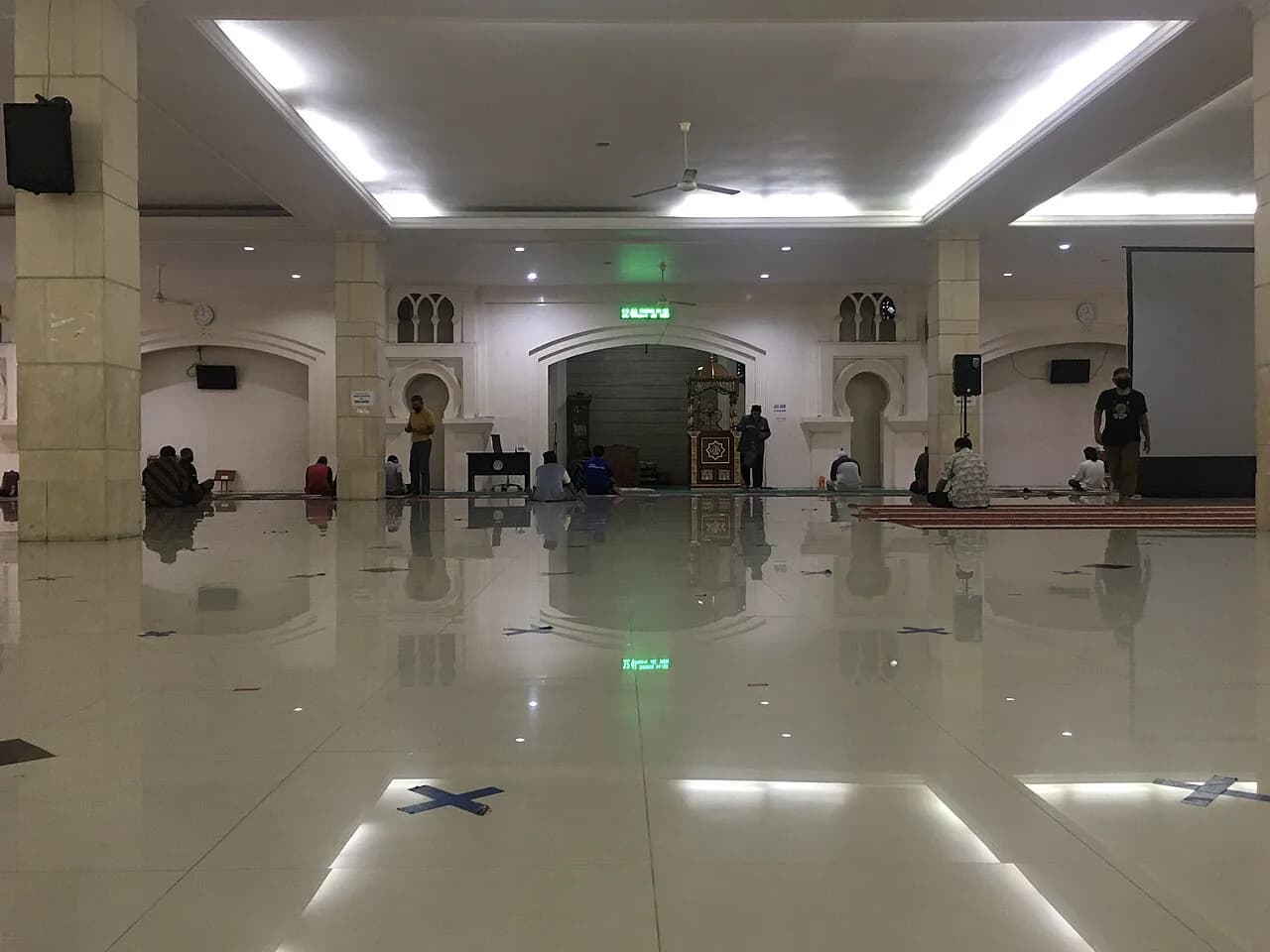
The current building is a two-story mosque on Jalan Bulusaraung, with two towers reported at 66.66 meters and a reported capacity of about 10,000 worshippers. Read those numbers as published figures rather than measurements you can check on site; the visual impression of height and volume is what matters during a visit.
Look for the pair of towers framing the facade, the broad courtyard, and the way the building handles a large Friday crowd. The trip listing notes roughly 80 percent local building materials, a library, and an office of the Majelis Ulama Indonesia for South Sulawesi inside the complex, so parts of the building serve administrative and religious functions rather than visitors. The courtyard is a working prayer space: it fills and empties with the daily prayers, and visitors should expect to give way rather than treat it as a monument to walk through at will.
The building's story in brief
The mosque began as a design competition. According to a news feature, a committee formed in 1947 under Kyai Haji Mukhtar Lutfi, with the architect Muh Soebardjo winning the competition with an aircraft-shaped design, and construction officially starting in 1948 before the building was inaugurated on 27 May 1949. That early form was replaced entirely: the mosque was demolished on 9 October 1999 and the present building was inaugurated on 25 May 2005. Understanding that timeline explains why photographs from the 1950s show nothing like what stands there now.
The site itself has a longer history than the building. The mosque stands on land that was once a football field, reported at 13,912 square meters and donated for the mosque's construction, which is why the compound feels more open than its Bontoala neighbors. The same history records that Indonesia's first president, Soekarno, spoke here in 1957, a detail that gives the courtyard a small place in the national story. An ANTARA photo caption also describes the mosque as a religious-tourism object that draws many visitors, particularly during Ramadan.
How long to allow, and when to go
A booking listing recommends one to two hours, and that range fits: an hour covers the exterior, courtyard and a respectful look at the hall, while two hours lets you sit with the space and read the explanatory material. The mosque is busiest around the five daily prayers and especially on Friday, when the courtyard and surrounding streets take the overflow. If you want a quieter look at the architecture, aim between prayer times rather than arriving as the call to prayer begins.
Whether non-Muslim visitors may enter the prayer hall is not stated in any published source here, so ask a caretaker at the entrance rather than assuming either way. Many Indonesian mosques welcome respectful visitors to the courtyard and allow a look inside outside prayer times, but the decision rests with the people running the building on the day. Asking first also tells you where to leave shoes and which route to take around the hall.
Hours, tickets and what to confirm
One third-party booking page shows opening hours of 4:00 to 21:00, but that is a commercial listing rather than a schedule published by the mosque, so treat it as an indication and check the posted visiting window at the gate. No source establishes an entry ticket price, and a working city mosque of this kind typically does not sell admission in the way a museum does. If any donation or arrangement is requested on site, confirm what it covers before handing over money.
There is no evidence in the form of a published calendar of closures, ceremony restrictions or guided-tour times for this mosque, so build flexibility into your plan rather than a fixed slot. If the mosque is your main reason for the trip across town, message your hotel or driver the day before and ask whether anything unusual is scheduled. That single check is more useful than any online timetable.
Nearby stops that fit the same trip
Fort Rotterdam Makassar is the natural pairing, a short ride southwest toward the old harbor and a compact, walkable compound that balances the mosque's religious function with colonial-era history. Doing the mosque first and the fort second works well because the fort's grounds are a substantial stop in their own right. If you only have one free morning in the city, these two together give you the clearest sense of Makassar's layers.
The Losari Beach, Makassar waterfront is the other easy add-on, especially in the late afternoon when the seafront fills with food stalls and families. It also solves the practical problem of where to eat after a mosque visit, since the waterfront area has far more choice than the lanes around Bontoala. Keep the order flexible: mosque, then fort or waterfront, depending on how much daylight you have left.
If your interests run to Makassar's older layers, the museum Kota Makassar collection and the reconstructed Gowa Sultanate site at Fort Somba Opu are both reasonable further stops, though each needs its own transport leg. The Masjid 99 Kubah out at the CPI area is a different kind of visit altogether, a new landmark built for photographs rather than congregational history, and better saved for a separate outing.
Is Masjid Raya Makassar worth the stop?
Yes, if you are already spending a day in central Makassar. The mosque gives you a working religious building with a genuinely unusual modern rebuild, two towers worth seeing against the sky, and an easy link to Fort Rotterdam and the Losari waterfront. It does not justify crossing the city in heavy traffic on its own unless you have a specific interest in Indonesian mosque architecture or the Soekarno-era story attached to the site.
Plan for one to two hours, arrive between prayer times, hand your driver the Jalan Bulusaraung address, and confirm the visiting window at the gate rather than trusting a booking page. Pair it with the fort or the waterfront and you have a solid half-day in the city without turning the mosque into a checklist item.