
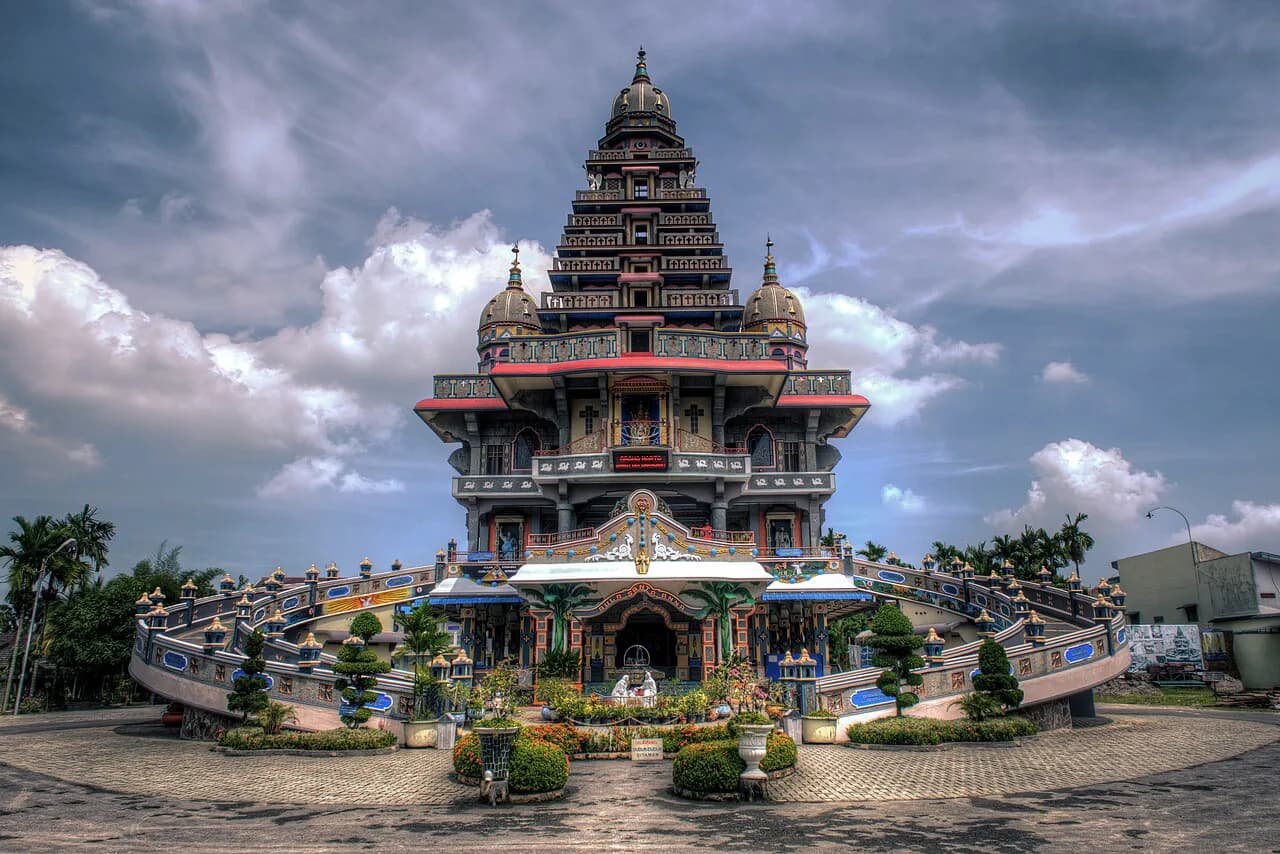
Graha Maria Annai Velangkanni: What to See at Medan's Indo-Mogul Shrine

Graha Maria Annai Velangkanni is worth about an hour of your Medan schedule, and most of that hour happens outside. The Catholic shrine in Tanjung Selamat is a short stop with an outsized visual payoff: tiered towers, domes and ramps that visitors routinely mistake for a Hindu temple until they spot the crosses. This guide covers where it sits, how to reach it, what to look at, the etiquette visitors report, and which nearby sights pair sensibly with it.
Where Graha Maria Annai Velangkanni sits: Jalan Sakura III, Tanjung Selamat
The shrine stands at Jalan Sakura III No. 7 in Tanjung Selamat, within Medan Tuntungan district on the city's southern edge, according to the shrine's own contact page. The same page gives the postal address as Medan 20134, North Sumatra, and places the site in the Taman Sakura Indah area. Use that street address when you brief a driver rather than a generic Medan pin, because Tanjung Selamat is a distinct neighborhood rather than a central-city landmark.
DetikSumut, drawing on the shrine's official site, places the complex in Kecamatan Medan Tuntungan and notes it was founded in 2005 on what was then the outskirts of the city. That peripheral setting explains the layout: a freestanding compound with a gate, forecourt and multi-level facade rather than a church squeezed onto a city block. Plan your transport around a suburban destination, not a downtown one.
Getting there from central Medan: landmarks beat street numbers
The shrine's contact page offers two landmarks more useful than the street address alone: the junction known as Pajak Melati and the Asam Kumbang crocodile farm. It describes the site as close to both and easy to reach, passed by plenty of traffic. Give a driver those two names alongside Jalan Sakura III and you remove most of the guesswork.
No verified travel times or ride-hail fares from central Medan to Tanjung Selamat are published here, so treat any number you see elsewhere as unconfirmed. Check the live estimate in your ride-hailing app at the moment you order, and allow a buffer rather than planning a tight connection afterward. A private car arranged through your hotel works the same way: agree the destination in writing before you set off.
If you are coming from the historic core, the Maimun Palace in Medan is a common starting point for a southern run, and pairing the two means one continuous car hire rather than two pickups. Confirm the route with your driver at the outset; the shrine's own site publishes no shuttle or public-transport connection.
Why a Catholic shrine looks like a temple
The building is a Catholic shrine dedicated to Our Lady of Good Health, known in Tamil as Annai Velangkanni Arokia Matha, and DetikSumut traces the devotion to the Velankanni shrine in India. The architectural language is deliberately mixed: the source describes an Indo-Mughal synthesis with rich ornament and a distinctive color palette, and notes the structure reads as temple-like at first glance. That mismatch is the reason to come.
DetikSumut itemizes the borrowed elements: seven tiered towers with three domes representing Hindu architecture, a gate crowned with a traditional Batak house form, and Christian symbolism layered through the whole. Look for crosses on a facade that otherwise resembles a South Indian temple, and for the lotus motif visitors single out as a Buddhist touch. Knowing the sources behind each element turns a photo stop into a short lesson in how Medan's communities borrow from one another.
The backdrop is Tamil Catholic immigration to the Deli Serdang plantations, which DetikSumut recounts from the shrine's own account of nineteenth-century estate workers from Pondicherry and Tamil Nadu. That context explains why a devotion rooted in coastal India took architectural form on Medan's edge. Medan also holds an older Hindu temple in the center, and the Sri Mariamman Temple, Medan is a working Tamil place of worship rather than a shrine quoting temple forms; seeing both clarifies what is borrowed and what is devotional.
What to see outside first: gate, towers, domes and ramps
Start at the main gate, where DetikSumut describes a Batak house form set above the entrance with relief carvings. That gate sets the pattern for the visit: local Sumatran references framing an Indian-derived devotion. Read the carvings before you walk through, because the interior is where photography restrictions begin.
Two curved staircases climb the left and right of the facade to the upper level, and DetikSumut notes they are as functional as they are theatrical. Visitors writing on the Wanderlog listing consistently name the ramps and tiered silhouette as the highlight, which is why the exterior deserves the larger share of your time. Walk the forecourt slowly, then climb one side for the view back over the compound.
DetikSumut describes a two-level arrangement: a meeting space at ground level and the place of worship on the floor above, topped by towers and domes. The vertical climb is part of the visit rather than an optional extra. If stairs are difficult for someone in your group, the forecourt and gate still deliver the architecture at ground level.
Inside: murals, sculptures, stained glass and the surviving Bibles
The Wanderlog listing describes murals, sculptures and stained glass windows inside, contributing to what reviewers call a serene atmosphere. Because the same reviews report that photography is not permitted inside the building, budget your photos for the approach and facade. Look rather than frame once you cross the threshold.
A specific detail comes from DetikSumut, again citing the shrine's own account: a room holding construction funds burned on 2 November 2002, yet the money, two Bibles and a hymn book survived undamaged. The two Bibles and hymn book are now kept to the left of the entrance to the Annai Velangkanni chapel. Ask a volunteer or staff member to point them out if the chapel is open.
DetikSumut also mentions a natural spring beneath the statue of Velangkanni, which it says was tested by the local water utility laboratory and found free of bacteria. Treat that as background on the site's devotional story rather than a reason to drink from it. The 2005 founding date on the same page gives a rough sense of how young the complex is next to Medan's colonial-era landmarks.
Visitor etiquette: shoes off, cameras down, wraps available
Visitors writing on the Wanderlog listing report that shoes must be removed before entering the building and that no photography or videography is allowed inside. They also note wrap skirts are available on site for women whose legs are not covered by a long skirt or trousers. These are visitor reports rather than a published rule sheet, so treat them as a strong indication and watch what others do at the door.
The shrine's contact page gives phone numbers and an email address but posts no visitor code of conduct, so if a detail matters to your group, call ahead using the listed contact. The same page lists a landline and the rector's name, useful for confirming whether the chapel will be accessible on your date. A two-minute call saves a wasted trip.
How long to allow, and pacing around prayer times
Plan on roughly an hour: fifteen to twenty minutes on the forecourt and stairs, then a quieter stretch inside. The site is compact, and reviewers on Wanderlog frame it as a worthwhile short stop rather than a half-day destination. That makes it well suited to slotting between larger Medan sights instead of anchoring a day.
Because this is an active Catholic shrine, time your arrival around services rather than a fixed sightseeing window. The shrine's website carries a Mass schedule section, but those times are not reproduced here, so check the schedule page yourself before fixing a time. If a Mass is underway when you arrive, wait outside and enjoy the exterior rather than entering mid-service.
No verified opening hours or entry fee apply here, so both are questions the shrine's own office can answer, and the contact page lists phone numbers for exactly that purpose. Do not rely on third-party listings for either detail.
Nearby options to pair with the shrine
Tanjung Selamat sits south of the center, so the sensible pairings are sights you pass on the way in or out rather than a full city tour afterward. If you are heading back toward the historic core, the Maimun Palace (Istana Maimun), Medan and the open ground at Lapangan Merdeka Medan cluster conveniently together. Both reward a look even on a short pass.
Museum-minded travelers can add the Museum Gedung Arca, Medan to a southern loop, while the museum Negeri Sumatera Utara in the Teladan Barat area covers the province's ethnography in more depth. Both are indoor stops that pair well with the shrine's outdoor focus, and each needs its own travel leg.
Closer to the center, the Vihara Gunung Timur in Medan is another house of worship with layered Chinese, Buddhist and local influences, and the contrast with the shrine's Indo-Mogul vocabulary is sharp. Market lovers can browse Pasar Ikan Lama in Medan or Pasar Horas, Medan for textiles and food respectively. If you arrive by train, the railway station is the natural anchor for these central stops.
Is the shrine worth the detour south?
Yes, if you have a spare hour and a car already heading that way; no, if you would be crossing Medan solely for it. The architecture is genuinely unusual, the setting is calm, and the story behind it is more interesting than most city stops. Set expectations at a short, photogenic visit rather than a headline attraction.
Before you go, confirm the day's Mass schedule and check current visitor arrangements with the shrine office by phone, since hours and access rules are not published in the sources used here. Then hand your driver the address at Jalan Sakura III No. 7 along with the Pajak Melati and Asam Kumbang landmarks. That combination gets you there without a wrong turn.
Frequently Asked Questions
Is Graha Maria Annai Velangkanni free to enter?
The shrine does not publish an entry fee on its contact page, and no verified price appears in the sources used here. Treat it as a place of worship rather than a ticketed attraction and confirm directly with the shrine office by phone if you want certainty before traveling.
What are the opening hours of Graha Maria Annai Velangkanni?
No verified opening hours are published in the material available here, and the shrine's contact page does not list them. Check the shrine's own website and call the listed number before setting out, since access can shift around services.