
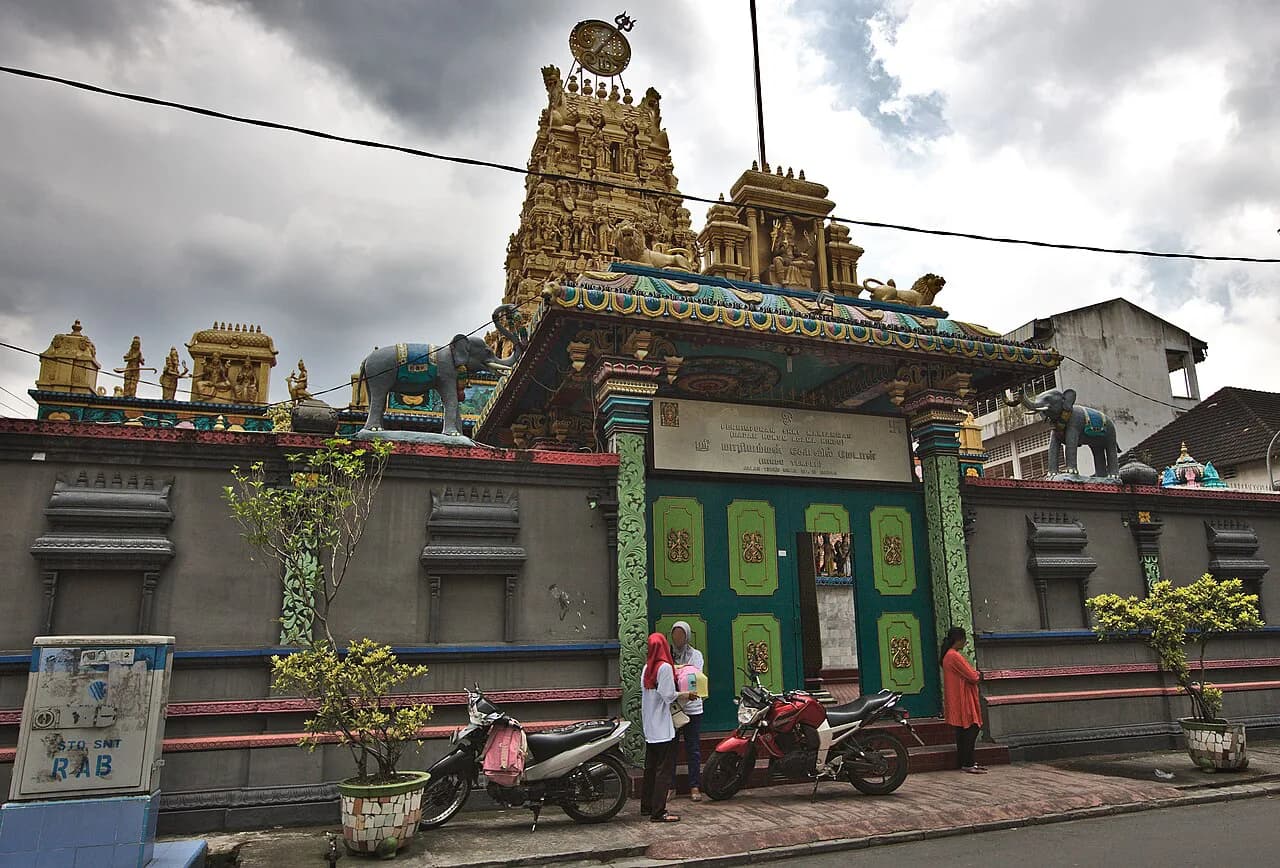
Sri Mariamman Temple (Kuil Sri Mariamman), Medan: A Visitor's Guide

Sri Mariamman Temple in Medan, usually signed Kuil Sri Mariamman, is a compact working Hindu shrine rather than a museum piece. Allow roughly 30 to 45 minutes: enough time to read the gopuram, walk the shrines and sit with the atmosphere, but not enough to justify building a whole morning around it. This guide covers where the temple sits, how to get there in Medan traffic, what to look at inside, and how to slot it into a wider loop of the city.
Search results for Sri Mariamman Temple are dominated by the famous Singapore temple on South Bridge Road, founded in 1827 and now a national monument. That is a different building in a different country, and its hours and camera charges do not apply here. This page stays on the Medan temple and points you to local signage or a phone call for anything that changes, such as opening times or entry rules.
What and where Sri Mariamman Temple (Kuil Sri Mariamman) is in Medan
This is an active Tamil-Hindu house of worship in Medan, North Sumatra's capital, serving the city's Indian community rather than courting tourists. Expect a walled compound, a decorated entrance tower and a handful of interior shrines, sized for devotion rather than crowds. Unlike the Singapore namesake, it has no national-monument status and no published visitor program.
Use the surrounding neighborhood as your navigation anchor: ask a driver for Kuil Sri Mariamman and the nearest major street or landmark you have noted, because small temples can be hard to pin on mapping apps. Save the address in Indonesian and show it on your phone rather than pronouncing it. For the wider set of stops in the city, see the Medan Attractions: 12 Visitor Guides overview before you fix a route.
Mariamman is a Tamil goddess associated with protection and healing, and her shrines appear across South India and parts of Southeast Asia. Knowing that shapes what you are looking at: this is a place of petition and thanks, not a gallery. Keep your voice low and your camera out of active prayer areas.
How to get there: Grab, Gojek and what to tell the driver
Grab and Gojek both operate in Medan, and a car is easier than a scooter if you are headed somewhere unfamiliar in the heat. Set the temple as your destination in the app and confirm the pin against the map before you request, since small shrines sometimes sit slightly off the marked point. Pay in the app and avoid negotiating at the curb.
Medan traffic is genuinely slow in the middle of the day, so build slack into any plan that chains several stops together. If you are coming from the Medan railway station area, a ride-hailing car is straightforward; walk out to a main road rather than asking the driver to thread into the station forecourt. Bluebird taxis are the other reliable metered option if you prefer hailing on the street.
Tell the driver the temple name and the cross street or landmark you have written down, and ask to be dropped at the gate rather than the far end of the road. If you are combining stops, sequence the temple first and the bigger sights after, because a small shrine is easy to cut short when you are running behind.
The gopuram and temple gate: what the tower shows you
The entrance tower, or gopuram, is the visual signature of a South Indian temple, and Sri Mariamman's is carved with deities and mythological figures stacked in tiers. Gopurams are traditionally pyramidal, tapering upward, and built to mark the passage from the street into sacred space. Read it from the base up rather than snapping one photo and walking in.
Look for Murugan, a major Tamil deity, and Krishna, usually shown blue-skinned with a flute, among the figures often carved on Mariamman temple towers. You do not need to identify every carving; picking out two or three makes the gateway legible. Beneath the tower, heavy wooden doors often mark the threshold, and their size is deliberate, a reminder of scale before you step through.
The tower is best photographed in soft morning or late-afternoon light, when the carvings stop flattening into shadow. If worshippers are entering, step to the side and let them pass before you frame a shot. A phone camera is usually enough; there is no need to carry a large lens into a small compound.
Inside the temple: the main hall and Mariamman's shrine
Tamil temples typically follow a familiar pattern: a central prayer area with the main shrine, flanked by secondary shrines to other deities, with smaller free-standing dome-roofed shrines clustering nearby. Look at the ceilings as well as the statues, since paintwork often carries as much detail as the sculpture. Check the actual Medan layout on arrival rather than assuming the Singapore arrangement.
Offerings you may see, such as fruit and leaves, are chosen for what they symbolize rather than decoration, so do not move or photograph them close up. Priests may be mid-ritual when you arrive, and that is the point of the place. Stand back, keep your phone down, and let the service finish.
Because this is Medan and not Singapore, do not transfer facts from the better-known temple: the founding date, the South Bridge Road address and the published visiting windows all belong to the Singapore building. Check locally for anything specific to this compound.
Etiquette that shapes the visit
Shoes come off before you enter the shrine areas, so wear footwear that slips on and off easily and expect to leave it at the entrance. Modest clothing covering shoulders and knees is the safe default at an active temple. Keep voices low and avoid photographing worshippers without asking.
At many Mariamman temples, devotees circle the shrines clockwise an odd number of times as a devotional act. You do not have to copy it, but do not cut across someone mid-circuit. If a hall is closed off or a curtain is drawn, that is a signal to wait rather than peek.
How much time to allow, and when to come
Budget 30 to 45 minutes for the temple itself, which is realistic for a small urban shrine with a handful of halls. Add 15 to 20 minutes for traffic on either side, because Medan's roads eat time unpredictably. Treating it as a short stop is what keeps a day of city sightseeing workable.
Evening is often when ritual activity picks up at Hindu temples, with priests, worshippers and music, while midday tends to be quieter and hotter. If you want atmosphere rather than empty halls, aim for late afternoon and be prepared to observe from the edge. If you want unhurried looking, go earlier, and confirm the temple's own open periods first.
Festival periods bring crowds and colour, and Hindu temples in Singapore and elsewhere mark Deepavali with special observances; some Mariamman temples hold a fire-walking ceremony shortly before the festival. Those traditions are associated with the goddess but are not confirmed for Medan on any given year. If your trip overlaps a festival, contact the temple directly before planning around it.
Hours, entry cost and camera rules: how to confirm before you go
No reliable published schedule for the Medan temple's opening hours, entry charge or camera fee is available, so check before you travel rather than trusting a figure from a search result. The commonly quoted charges belong to the Singapore temple, where admission is listed as free or a small fee with a camera. Read on-site signage or ask your hotel to call ahead on the day you plan to visit.
A quick call, or a message through your accommodation, is the most dependable check for whether the compound is open to visitors that morning. Ask specifically about photography, since devotional spaces often restrict it during services. If you cannot confirm, plan the temple as a flexible stop and keep a backup nearby.
What's nearby in Medan to pair with the stop
Because the temple is short, build the rest of the outing around Medan's heritage core: the Maimun Palace in Medan, the colonial-era streets and the city's markets all make natural companions for a half day. Maimun Palace (Istana Maimun), Medan is the obvious anchor for anyone interested in the city's royal and architectural history.
For a market-oriented loop, Pasar Ikan Lama in Medan and Pasar Horas in Medan are both established stops where you can browse fabrics and goods between sights. Pairing one with the temple keeps you in a compact area rather than crossing the city twice.
If you are building a religious-sites thread, Graha Maria Annai Velangkanni is Medan's well-known Catholic pilgrimage church and makes a striking contrast with the Hindu shrine; the two are usually visited on separate outings. Add Vihara Gunung Timur in Medan for the city's Chinese-Buddhist side.
Museum lovers can round out a city day at Museum Gedung Arca in Medan or Museum Negeri Sumatera Utara, both of which give context the temple alone cannot. Neither is next door, so group them by traffic rather than by map distance.
Lapangan Merdeka Medan, the city's main square with its Tugu Proklamasi monument, works as a late-afternoon finish once the temple visit is done. From there, ordering a car onward is easy and you avoid hunting for one outside the temple gate.
Is the Medan temple worth the stop?
Yes, if you set expectations correctly: Sri Mariamman Temple is a 30-to-45-minute cultural stop, not a destination in its own right. It rewards travelers curious about Medan's Indian community and South Indian temple form, especially when combined with the palace, markets or a museum in the same half day.
Before you go, confirm opening hours and photography rules directly with the temple or through your hotel, since no dependable published schedule exists for this site. Build the visit into a route rather than crossing town for it alone, and let the surrounding Medan stops carry the rest of the outing.