
Museum Bali (Bali Provincial State Museum), Denpasar: A Practical Visitor Guide
Museum Bali is worth 60 to 90 minutes of a Denpasar stop, and it is the single best introduction to Balinese material culture if you only have time for one museum in the city. It is the oldest museum on the island, an ethnographic collection on Jalan Mayor Wisnu just east of Puputan Badung square, and it is compact enough to fit between breakfast and lunch. This guide covers where it sits, how to reach it from the main south Bali bases, how the compound is laid out, what each pavilion holds, and what else is within walking distance.
Where Museum Bali sits in Denpasar
The museum occupies a walled lot on Jalan Mayor Wisnu, on the east side of Lapangan Puputan Badung and just south of Pura Jagatnatha, in the administrative heart of Denpasar. That puts it within a few minutes' walk of the square's open lawn and the white shrine of the city temple, so the three sights combine naturally into one stop. Use Puputan Badung as your landmark: drivers know the square, and the museum entrance is on its eastern edge. Address and phone contact details are listed by Bali.com, and the Denpasar city tourism department also publishes a short article on the museum.
If you are weighing a Denpasar day, the museum pairs well with the Bajra Sandhi Monument in Renon, a short drive south and a very different kind of sight, and with the Pasar Badung and Pasar Kumbasari markets west of the river. Treat the museum as the anchor and the rest as add-ons rather than trying to see everything in one push. The city rewards a slower loop around the square rather than a checklist.

How to get there from Sanur, Kuta, Seminyak and Ubud
From Sanur, the museum is the easiest of the south Bali bases to reach, a straightforward drive northwest into the city center. From Kuta, Seminyak and Canggu, plan on a rip through Denpasar's arterial roads that can stretch well beyond what a map suggests once school runs and market traffic build; mid-morning is usually calmer than late afternoon. From Ubud, the run down through the city can take considerably longer than the straight-line distance implies. Use a ride-hailing app, a Bluebird taxi or a private driver rather than trying to navigate the one-way streets yourself.
Most visitors arrive by car or scooter and are dropped at the gate on Jalan Mayor Wisnu. Give the driver the landmark rather than a pin, agree on a pickup time, and allow a few minutes for a ride to be accepted, since the museum frontage is not a busy pickup point. From a Nusa Dua or Jimbaran resort, this is realistically a half-day outing rather than a quick detour.
The compound layout: jaba, jaba tengah and jeroan
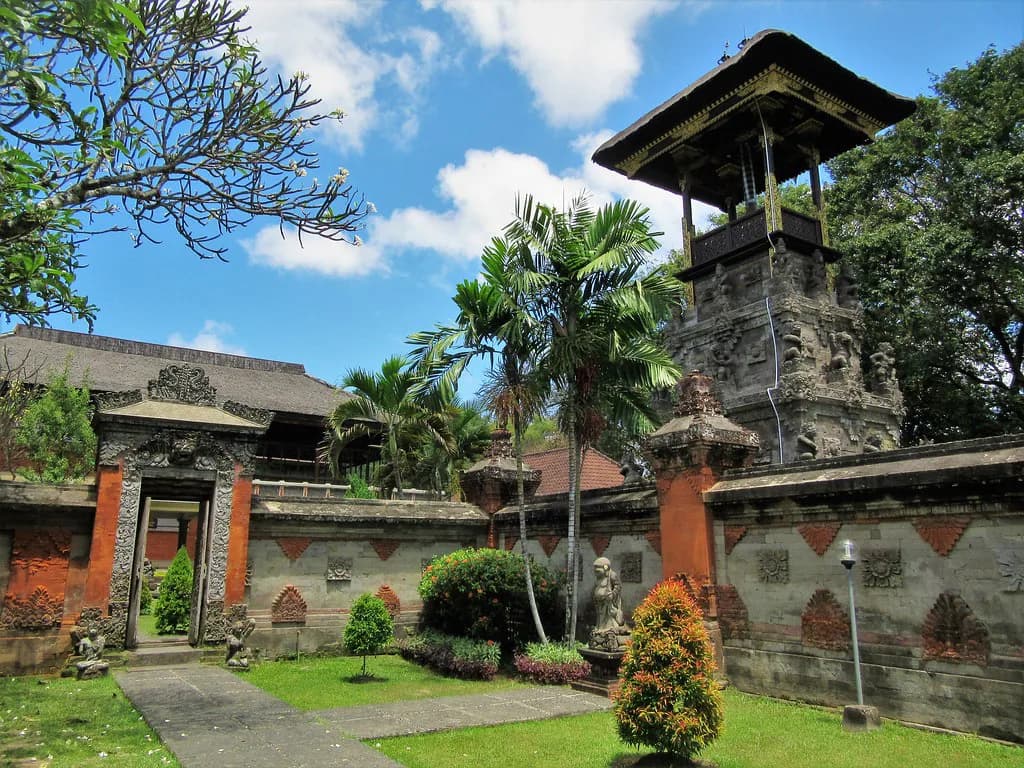
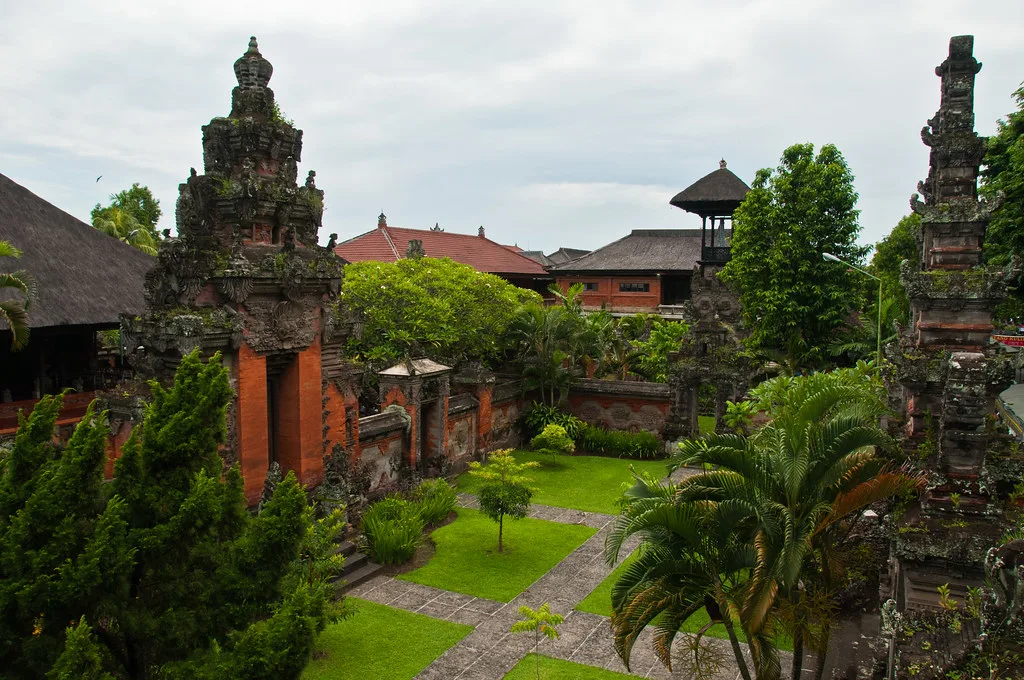
Museum Bali is built as a Balinese temple compound, not a modern gallery block. According to the Denpasar tourism department, the site covers roughly 2,600 square meters across three walled courtyards, the outer jaba, the middle jaba tengah and the inner jeroan, each separated by walls and gateways of the candi bentar and candi kurung types. Knowing this before you walk in turns the museum from a set of display cases into a legible piece of architecture.
The same source traces the museum's origin to 1910, when W. F. J. Kroon, then assistant resident for South Bali, proposed an ethnographic museum to protect Balinese cultural objects, with plans drawn up by German architect Curt Grundler working alongside Balinese undagi, or traditional builders, including I Gusti Ketut Rai and I Gusti Ketut Gede Kandel. The museum opened officially on 8 December 1932. The German artist Walter Spies is also associated with the museum's early development, though specific attributions are best checked against the museum's own signage rather than relying on secondary accounts.
What each pavilion holds
Three main exhibition buildings sit in the inner courtyard, each styled after a different region of Bali. Gedung Tabanan holds the prehistory, history and fine-art collections; Gedung Karangasem, built in an East Bali architectural style, displays items related to the Panca Yadnya, the five categories of Balinese Hindu ritual offerings; and Gedung Buleleng, in North Bali style, is given over to traditional textiles. Prioritize Tabanan if you care about art and old artifacts, Buleleng if textiles and weaving interest you.
Bali.com describes the collections more broadly as paintings, artifacts, statues and inscriptions, alongside Bronze Age weapons, religious relics and musical instruments, plus ceramics, porcelain, agricultural tools and shadow puppets. Since early 2000, the provincial government has added pavilions used as a library, a restoration space and a theatre. Labeling is limited and uneven across the halls, so a guide or a good printed overview genuinely changes how much you get out of the objects.
Architectural details worth pausing for
Walk slowly through the courtyards before heading for the display halls. The Balai kulkul, a tower for the wooden kentongan slit drum, stands just south of the jaba tengah, and in the northwest corner the Balai Bengong was historically a resting place for the royal family when they wanted to observe activity outside the palace. In front of Gedung Tabanan there is a beji, a bathing place once used by the royal household. The roofs are thatched in ijuk, black sugar-palm fiber, a material traditionally reserved for temple buildings in Bali.
How much time to budget
Allow 60 to 90 minutes if you read the main labels and walk the courtyards; 45 minutes is enough for a brisk pass through the pavilions and the garden. The museum is small and will not fill a half-day on its own, so pair it with Puputan Badung and the city temple for a comfortable morning.
For a culture-focused half-day, add the Bajra Sandhi Monument in Renon and finish at Pasar Badung or Pasar Kumbasari for a sense of how the city actually shops. That combination gives you a rounded picture of Denpasar without turning the day into a forced march.
Tickets and opening hours
According to the Denpasar tourism department, the museum is open Sunday to Thursday from 08.00 to 15.00, Friday from 08.00 to 12.30, and closed on Saturdays and public holidays. Treat those times as subject to change and confirm before you go, especially around Balinese holidays. The museum's Instagram account, under the name Sahabat Museum Bali, is one place to watch for short-notice notices.
Ticket prices are not published in the sources checked for this guide, so plan to pay at the gate in Indonesian rupiah and confirm the current fee when you arrive. Some blog accounts cite amounts under 20,000 IDR, but those figures are dated and should not be relied on. Cash is the safe assumption; card facilities, if any, should not be assumed.
Practical realities: heat, labels and guides
The pavilions are open-fronted rather than air-conditioned, and Denpasar gets hot by midday, so an early-morning visit is noticeably more comfortable. Exhibit labels are limited in English, which is why a local guide or a short pre-read pays off more here than at a large modern museum. Photography is generally permitted without flash, but follow whatever signage is posted inside.
If you only want a quick orientation, the courtyard architecture and one or two pavilions are enough. If you want context on Balinese ritual and craft, budget the full 90 minutes and consider hiring a guide at the entrance, and arrive before the heat peaks either way.
What's within walking distance
Puputan Badung square is directly west, an open green with a monument to the 1906 mass ritual suicide, and Pura Jagatnatha stands immediately north of the museum with its distinctive white shrine. Both are free to walk through and take only a few minutes each, and together they make the museum feel part of a coherent civic center rather than an isolated stop.
A short drive or a twenty-minute walk west across the river, Pasar Badung and Pasar Kumbasari give you the market side of the city, and Pura Maospahit, one of Denpasar's oldest temples, is a small detour worth making if you are tracing the city's older layers. None of these is large; together they round out an unhurried Denpasar day.
Museum Bali versus other museums in Bali
If you can only visit one museum in Bali and you are based in Ubud, Museum Puri Lukisan or the Neka Art Museum will usually make more sense for art, while Museum Pasifika in Nusa Dua covers Asia-Pacific painting at a larger scale. Museum Bali, by contrast, is the one for Balinese ethnography, architecture and ritual objects, and it is the natural choice if you are spending any time in Denpasar.
The SAKA Museum in Jimbaran, opened in 2024 and focused on Nyepi, is a strong modern counterpoint to the older collection here. Which one you pick comes down to whether you want history in a temple compound or contemporary exhibition design; Museum Bali is the better fit if your time is limited to Denpasar.
Should you build Denpasar around Museum Bali?
Yes, if you want a compact, inexpensive and genuinely Balinese introduction to the island's material culture. Build a morning around the museum, Puputan Badung and Pura Jagatnatha, Denpasar, arrive early, and confirm the day's opening hours before you set out. Check the ticket price at the gate in rupiah rather than trusting older figures online.
Skip it only if you are chasing beaches and on Bali for a very short stay, in which case a single Ubud art museum may serve you better. Otherwise the museum gives you a grounding in Balinese craft and ritual that makes the rest of the island easier to read.
Frequently Asked Questions
Is Bali Museum open on Saturdays?
The Denpasar tourism department lists the museum as closed on Saturdays and public holidays, open Sunday to Thursday from 08.00 to 15.00 and Friday from 08.00 to 12.30. Confirm before you travel, as those times can change around Balinese holidays.
How much is the entrance fee for Museum Bali?
Current ticket prices are not published in the sources checked for this guide, so ask at the gate and pay in Indonesian rupiah. Figures circulating online are out of date and should not be treated as current.
Is there anything worth seeing in Denpasar besides the museum?
Puputan Badung square and Pura Jagatnatha are immediately next to the museum, and the Bajra Sandhi Monument in Renon and the Pasar Badung and Pasar Kumbasari markets are short drives away. Together they make a solid half-day in the city center.