
Pura Maospahit in Denpasar: What to See at Bali's Red-Brick Majapahit Temple

Pura Maospahit is a short stop, not a headline Bali attraction: plan on roughly 30 to 45 minutes unless you get talking with people on site. It is a Hindu-Balinese temple in the Pemecutan area of Denpasar, built in a bare red-brick style that points back to the Majapahit Empire. This page covers where it sits, how to reach it from south Bali or central Denpasar, what to look at in each compound, and which details you have to confirm on the ground rather than trust to a guidebook.
What Pura Maospahit actually is
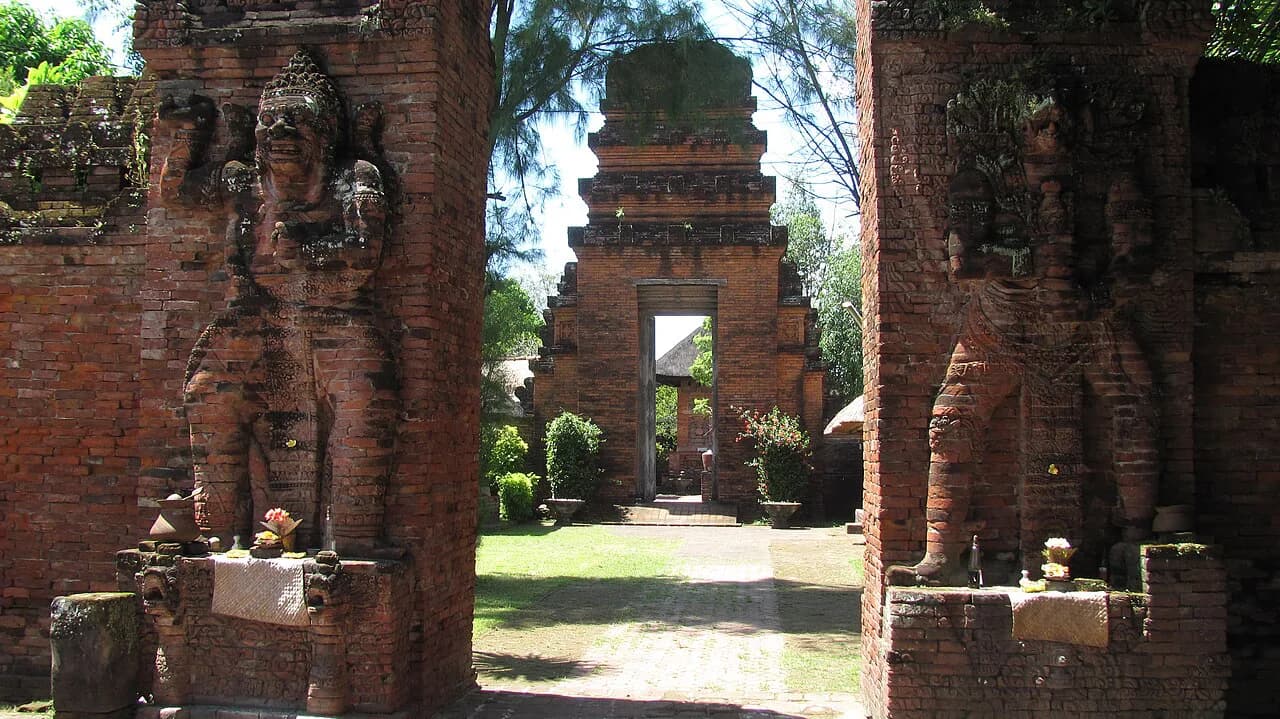
The temple stands in Pemecutan, a neighborhood of Denpasar, and its defining feature is architecture rather than scale. Now! Bali describes thick, stocky red-brick outer and dividing walls, a candi bentar split gate between compounds and a tiered kori Agung doorway that recall the structures of Trowulan, the Majapahit heartland in East Java. In other words, you come here for the masonry and the carvings, not for a sprawling complex or a view.
Its historical setting is the Majapahit entry into Bali in 1343, after which the island's southern kingdoms, including Badung, rose in regional importance. A source of uncertainty: founded dates differ between write-ups, with some placing the complex centuries earlier, and the dating of its main shrine is openly described as varying. Treat any single construction year you read online as an estimate rather than a fact.
Where it is and how to get there
The listed address is Jalan Sutomo No. 6, Pemecutan Kaja, Denpasar Utara, in North Denpasar, which is the reference to give a driver. That address comes from travel listings rather than a temple-published notice, so confirm the pin against your ride-hailing app before you set off. Pemecutan sits inland from the beach strips of Kuta and Seminyak, so this is a Denpasar-side stop rather than something you fold into a beach day.
For transport, Grab or Gojek, a Bluebird taxi or a hired private driver all work, and app cars are the simplest option if you already have data. Build slack into the plan: the ride from south Bali crosses some of the island's busiest roads, so a quoted app time is optimistic at peak hours. From central Denpasar the hop is short, which makes it easy to combine with other stops in the same trip.
If you want a broader map of what else the city holds, our Denpasar Attractions guide covers the main sights, and this temple fits as one compact piece of that picture rather than a half-day on its own.
The three compounds, in the order you walk them
Balinese temples typically unfold in layers, and Pura Maospahit reads that way: an outer and central compound divided by the candi bentar, then the inner jeroan reached through the tiered kori Agung. Knowing the sequence helps, because the best carving is not at the street entrance but on and around the transition points between compounds. Walk slowly through the gates rather than straight past them to the shrines.
The candi bentar separating the outer and central compounds carries large brick depictions of Bima and Garuda, and the pillars of the dividing wall are carved with figures identified as Cangkara, Indra, Yama, Kwera and Waruna. These guardian carvings are the reason to linger at the middle threshold, since they are easy to miss if you are following a guide at speed. The tiered kori Agung doorway beyond is itself the other piece worth a long look.
Inside the jeroan, the shrines sit on square bases decorated with classical Majapahit iconography, which is where the East Java connection becomes most obvious. One of the principal buildings is known as Gedong Candi Raras Maospahit. Balinese tradition credits it to the legendary figure Kebo Iwa, and that attribution circulates widely, but it is legend rather than documented fact and the dates attached to it vary.
Getting more out of a short visit
Visitors have reported QR codes on site with English explanations, which lets you read about individual shrines without booking anything in advance. That is a listing-level report rather than an official promise, so treat it as a bonus and not the basis of your plan. If the codes are gone or unreadable, the carvings still stand on their own.
People at the temple grounds have also been described as willing to explain the architecture and walk visitors through less obvious corners. A short conversation often yields more than any sign, and it is the main reason this stop rewards a slower pace. Keep your questions about the building and its history rather than about ceremony schedules you have not confirmed.
Hours, entry and ceremony closures: what to confirm
No reliable source here publishes opening hours, an entry fee or a ticketing procedure for Pura Maospahit, so do not build a schedule around a number you saw in a blog. Because it is an active place of worship, it can also be closed to visitors when a ceremony is underway, and those days are not published in any consistent form. Check on arrival, or ask your hotel or driver to call ahead the same morning.
Across town, that is the one practical reminder worth acting on: confirm hours and access the morning you plan to go, since nothing published lets you plan around them. A quick question at your accommodation saves a wasted ride.
Should Pura Maospahit be on your Denpasar list?
Yes, if old brickwork and Majapahit-style carving interest you and you already have a reason to be in Denpasar; no, if you are choosing between this and Bali's famous sea temples on a short first trip. It is a modest, low-key site that suits a 30- to 45-minute stop folded into a city day.
To build that day, pair it with the Museum Bali (Bali Provincial State Museum), Denpasar, which deepens the historical context, or the Bajra Sandhi Monument in Denpasar if you want a landmark with more room to walk. Nearby, Pura Jagatnatha, Denpasar sits in the city center and works as a second temple stop if you want to compare styles.
Explore more Denpasar guides
Frequently Asked Questions
Can I visit Pura Maospahit without a guide?
Yes. Visitors have reported English-language QR code information on site, so you can read about the shrines independently. If those codes are unavailable, the candi bentar carvings and the kori Agung doorway are the highlights to find on your own.
How does Pura Maospahit compare with Bali's sea temples?
It is smaller and far less visited, and it is inland in Denpasar rather than on the coast. You come for red-brick Majapahit-style architecture and carving detail, not for sunset views or a large complex. If you have one temple slot only, the famous sea temples are the more spectacular choice.