
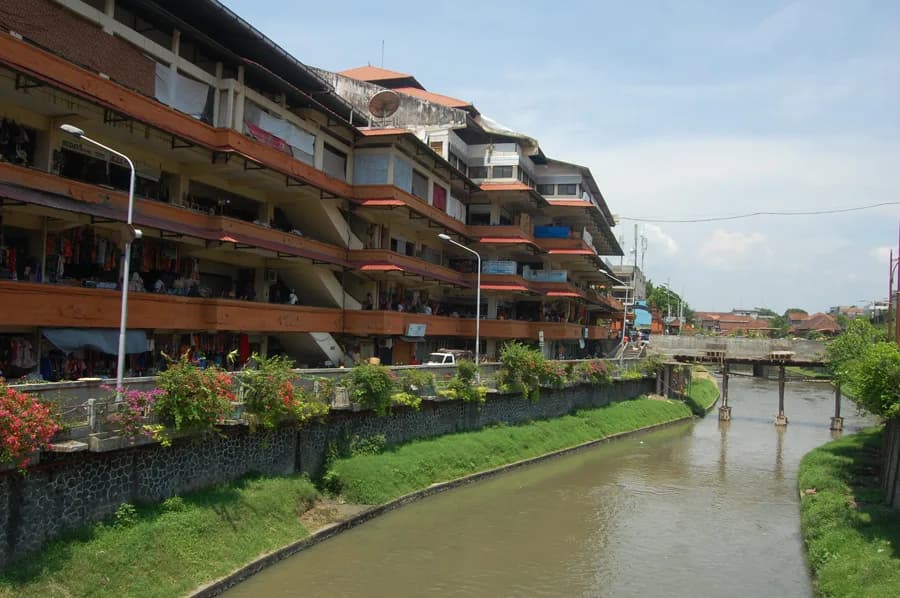
Pasar Kumbasari in Denpasar: A Practical Guide to Bali's Souvenir Market

Pasar Kumbasari is worth two hours of a Denpasar day if you want Balinese crafts at local prices rather than beachside markup. Plan on one to three hours depending on how hard you bargain, and go in expecting a working wholesale-leaning market rather than a polished tourist arcade. This guide covers where the market sits, how to arrive, what sells on each floor, and how it compares with Pasar Badung across the river.
What Pasar Kumbasari actually is
Pasar Kumbasari is a four-storey market in central Denpasar, on Jalan Gajah Mada, the city's traditional shopping spine. It sits across the Badung river from Pasar Badung, and the two are usually treated as a single market errand. The building was formerly known as Peken Payuk, the pot market, and locally made pots and kitchenware are still among its staple goods.
The practical distinction matters: Pasar Badung handles fresh produce and everyday shopping, while Kumbasari leans heavily toward crafts, cloth and souvenirs. One travel guide describes Kumbasari as mostly aimed at locals, with lower prices than beachside shops and haggling expected. Read it as a wholesale source that hotel gift shops draw from, not a curated gallery row.
Where it is and how to get there
The address is Jalan Gajah Mada in the Pemecutan and Dauh Puri Kangin area of Denpasar, within walking distance of the city's main traditional shopping street. If you are coming from south Bali, count on a long drive into the city rather than a quick hop, and time your arrival after the morning commute. Ride-hailing apps such as Grab and Gojek work well for the drop-off, and metered Bluebird taxis are the other straightforward option, since driving yourself means hunting for parking.
If you are building a Denpasar day around the market, the city's other sights sit within a short ride of Jalan Gajah Mada. Our Denpasar Attractions guide maps the museum, monuments and squares so you can group them with a market stop instead of crossing town twice.
Shopping floor by floor
Head straight to the second level for gifts: one guide describes a large hall of obligatory souvenirs mixed with shops selling handmade items from across the island. The third floor is where paintings cluster; the same guide points to two art shops, DewanggaArt Shop in Block C and Kresna Ayu in Block A, for classical and contemporary work at modest prices. Ground-floor stalls keep the pots, kitchenware and household goods that gave the market its old nickname.
Come late in the day and the ground floor changes character, with rows of food stalls setting up for evening snacking. A local market account also notes staples such as rice, vegetables and spices alongside Balinese clothing, endek woven cloth, kebaya, carvings, paintings, sandals and bags. That mix is the honest picture: this is a general market with a strong craft wing, not a single-purpose souvenir hall.
The market's own social account posts updates from traders on Jalan Gajah Mada, which is the fastest way to see what is currently on the floors. Check it before a special trip if you are chasing a particular craft.
What to buy and how bargaining works
Expect batik and endek cloth, wood carvings, silver jewellery, rattan bags, paper parasols, shell and paper crafts, and cheap t-shirts. One guide puts the selection at four floors with more than a thousand stalls, which is a useful scale reference rather than a number to plan around. Prices here tend to undercut the beachside shops because the market serves locals and resellers first.
Bargaining is expected and unhurried, so opening with a low counter and settling somewhere in the middle is normal practice. Rushing the exchange usually costs you the better price, which is the main trade-off against treating this as a quick souvenir sweep. Vendors quote in Indonesian rupiah, and small notes make the transaction easier. Specific asking prices vary by stall and season, so treat any figure you hear as a starting point rather than a fixed rate.
How long to allow and what to expect
A focused pass for gifts takes about an hour if you know what you want; a slow haggle across the second and third floors can fill half a day. Heat and crowds build through the middle of the day, and the evening food stalls are a reason to arrive later rather than earlier. Treat the market as a two-hour block inside a longer Denpasar day.
If you want a calmer cultural stop nearby, the Museum Bali (Bali Provincial State Museum), Denpasar pairs naturally with a market visit because both are central and compact. It gives context to the carvings and textiles you have just seen for sale, and it breaks up a hot shopping morning.
Parking and practical constraints
Parking is the most common friction point. One walking guide states that parking is not allowed at the market area, with alternatives at Pasar Badung or around Jalan Kartini, and lists IDR 1,000 for a motorbike and IDR 2,000 for a car. Treat those fees as indicative and subject to change.
For most visitors the simpler answer is to be dropped off and collected on Jalan Gajah Mada rather than to self-drive into the market blocks. If you do bring a vehicle, park once and walk between Kumbasari and Pasar Badung instead of moving the car. Carry small rupiah notes for parking and stalls alike.
Opening hours and how to confirm them
One walking guide lists the market as open daily from 9am to 7pm, but hours around Balinese holidays and market maintenance are not published in a single authoritative place. Use that window as a planning baseline and verify before a long trip across town.
Note also that Pasar Badung's well-publicized round-the-clock operation does not automatically apply to Kumbasari; the two are separate buildings with separate rhythms. A local market account is the most current check on whether stalls are trading and whether evening food vendors are set up.
Nearby: Pasar Badung, Taman Kumba and the rest of Denpasar
Pasar Badung sits right across the river and is the better stop for fresh produce, spices and everyday shopping, so pair the two rather than choosing one. A small recreation park, Taman Kumba, is close by and gives you somewhere to sit between market rounds. Together they make a compact morning or late-afternoon loop on foot.
If you have time for one more stop, the Bajra Sandhi Monument in Denpasar is a short ride away and works as a counterpoint to a shopping morning. Build it into the same day rather than making a separate trip into the city.
Is Pasar Kumbasari worth the stop?
Yes, if you want Balinese crafts and cloth at local-customer prices and are willing to bargain at an unhurried pace. Skip it if you expect air-conditioned retail or fixed price tags, and go to the beachside shops instead. Pair it with Pasar Badung across the river and allow a relaxed two hours.
Explore more Denpasar guides
Frequently Asked Questions
Is Pasar Kumbasari the same as Pasar Badung?
No. They are separate buildings on opposite banks of the Badung river in central Denpasar. Pasar Badung is the fresh-produce and everyday market, while Kumbasari focuses on crafts, cloth, carvings and souvenirs, with evening food stalls on its ground floor.
Do I need a ticket to enter Pasar Kumbasari?
It is a working market rather than a ticketed attraction, so you walk in and shop. Stallholders set their own prices and expect bargaining, and there is no published admission charge to plan around.
Can I park at Pasar Kumbasari?
A walking guide reports that parking is not allowed in the market area, with alternatives at Pasar Badung or around Jalan Kartini for a small motorbike or car fee. The simplest approach is a ride-hailing drop-off on Jalan Gajah Mada.
What is the best time of day to visit?
One guide lists 9am to 7pm as the daily window; the evening brings the ground-floor food stalls. Confirm current hours before a long trip across town.