
Pura Jagatnatha, Denpasar: A Practical Visitor's Guide

Pura Jagatnatha needs roughly 20 to 30 minutes of your day, not a half-day. It is a compact courtyard temple in the center of Denpasar, a few steps from the open lawn of Lapangan Puputan Badung, and you can see its main structures on a short loop. This guide covers where the temple sits, how to reach it, which buildings to pick out inside, and what to pair with the stop.
Treat the visit as a city-center stop rather than a destination in itself. The temple is commonly described as standing on Jalan Mayor Wisnu, east of Lapangan Puputan Badung and north of Museum Bali, which puts three stops within a few minutes of each other. That clustering is the reason to come here at all.
Where Pura Jagatnatha is in Denpasar
The temple stands in the administrative heart of Denpasar, on Jalan Mayor Wisnu. It is commonly described as sitting east of Lapangan Puputan Badung, north of Museum Bali, and facing the Kodam IX/Udayana headquarters, so any driver who knows the square will find it. Use the square or the museum as your landmark rather than a house number.
Because it is in the middle of the city, the temple is easy to fold into a broader look at Denpasar rather than a separate excursion. The square, the provincial museum, and the market area all sit within walking distance of each other. If you are building a day around central Denpasar, this is one of the anchors to plan around, and the wider Denpasar Attractions: 7 Visitor Guides collection shows how the pieces fit.

What kind of temple it is
Pura Agung Jagatnatha is Denpasar's state Hindu temple, dedicated to God in the manifestation of Hyang Jagat Natha, the ruler of the universe. The name comes from Sanskrit, where natha carries senses of both king and protection. That framing matters for what you are looking at: this is a civic temple built for public worship, not a single family or clan shrine.
A local government account describes the temple as a place of general worship open to Hindus regardless of origin or soroh, which is why worshippers arrive from across Bali rather than from one neighborhood. The practical result for a visitor is a working temple with steady devotional traffic rather than a museum piece.
Getting there from south Bali and around Denpasar
From the south Bali beach areas, plan on a ride-hailing car or a metered taxi rather than trying to navigate public transport. Ride-hailing apps and metered taxis are the usual way to reach central Denpasar from Canggu, Seminyak, Kuta, Sanur or the airport. Ask to be dropped at Lapangan Puputan Badung or Museum Bali, then walk the last minute to the temple gate.
Traffic is the variable that decides your timing, not distance. The run from Kuta or Seminyak crosses the busiest north-south corridors, so a trip that looks short on a map can stretch considerably in the late afternoon. Build in a buffer if you have a fixed next stop, and consider going early in the day when the center is calmer.
Within central Denpasar, walking links the temple, the square and the museum, since they sit within a few hundred feet of each other. Ride-hailing pickups around the square can be slow at peak times, so walk a block away from the main frontage before ordering a car. Drivers generally know the square by name, which makes it a reliable meeting point.
What to see inside
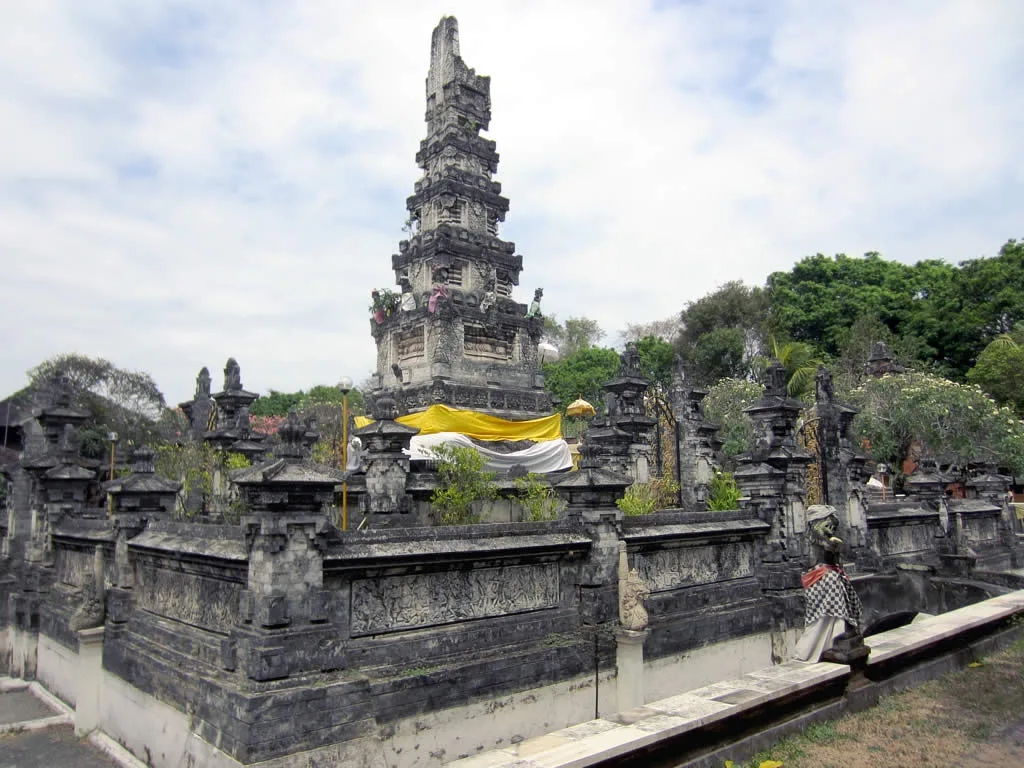
The centerpiece is the tall Padmasana shrine, an empty-seat tower symbolizing the universe, standing in the middle of a clear-water lotus pond. No source fixes its exact height, though estimates put it near 15 meters, so treat any precise figure you hear as approximate. Look for the yellow emblem at the top; the local account notes the original applied gold was stolen and the symbol is now finished in gold-colored paint.
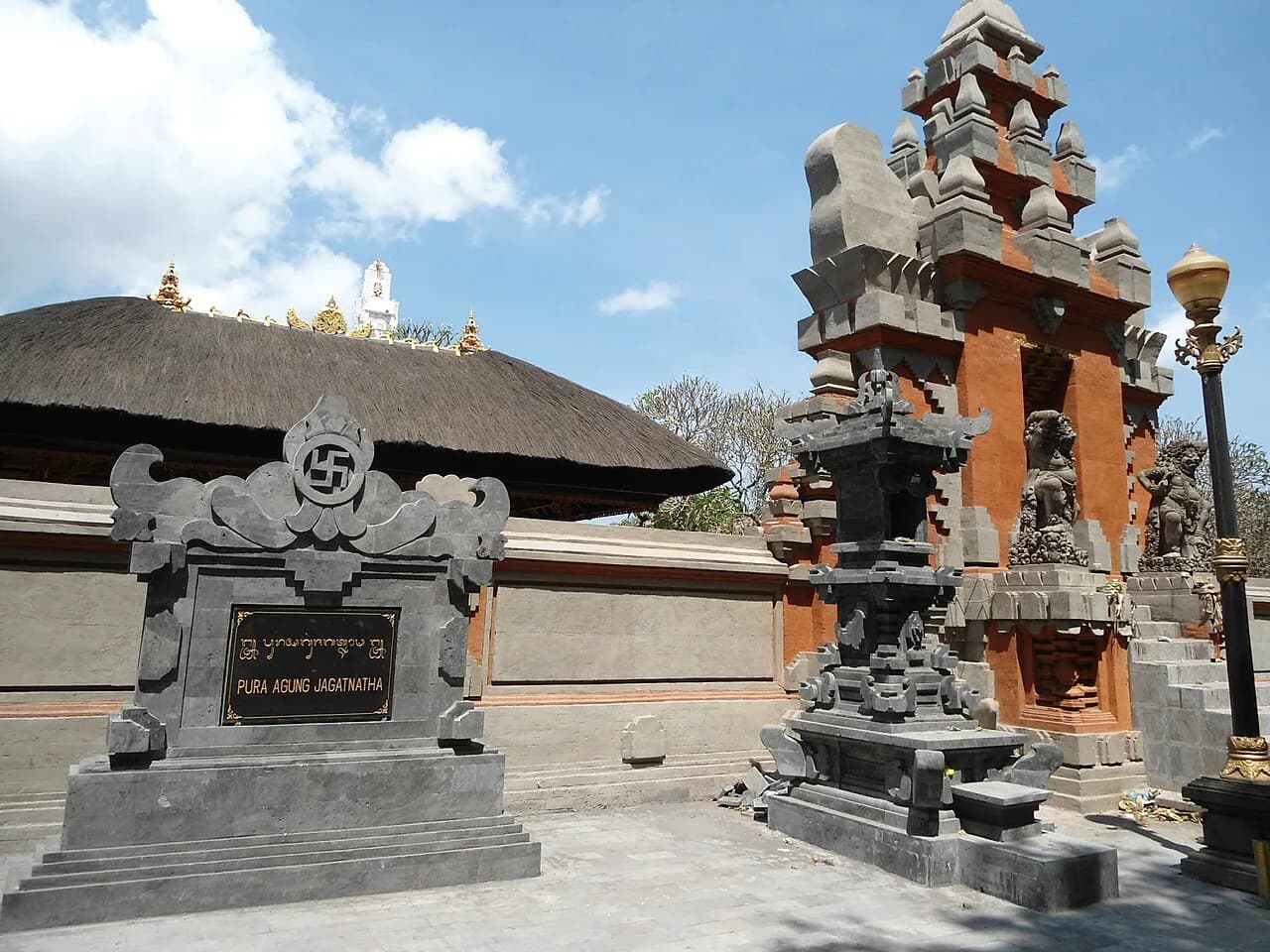
Two smaller shrines called Tajuk flank the Padmasana at front left and right, and a shrine for Ratu Niang sits to the northeast, near a bodi tree. Around the courtyard you can also pick out the bale kulkul, the wooden slit-drum tower used to sound announcements, along with the bale gong, the pamiyosan, and the towering kori Agung gate. Two Panglurah shrines stand outside the main enclosure.
The pond is worth a slow pass. Lotus flowers grow in it and it shelters freshwater fish, which gives the courtyard a quieter feel than the traffic outside suggests. Keep to the edges when people are praying, since worshippers take priority around the shrines.
Layout and pacing: how long to allow
The temple is a single compact courtyard, so there is no long route to walk. Most visitors will cover the Padmasana, the flanking shrines, the pond and the outer gate in about 20 to 30 minutes, including time to sit and take it in. If you are attending worship, allow closer to 45 minutes.
The efficient plan is to arrive at the square, visit the temple first while it is quiet, then cross to Museum Bali (Bali Provincial State Museum), Denpasar to see its collections and architecture. That sequencing keeps you indoors at the museum during the hottest part of the day and avoids doubling back across the square. Set aside a half day for the combined stop rather than trying to rush both.
When it is busiest
Worship at Pura Jagatnatha follows the Balinese lunar calendar. The local account says devotees come for prayers on Purnama and Tilem, the full-moon and dark-moon days, and on major religious holidays, with the annual piodalan held on Purnama Sasih Kelima. It adds that the main three-day worship period is led by a number of priests from Denpasar and the surrounding area.
The trade-off is atmosphere against access. On those days the courtyard fills with worshippers in ceremonial dress and the temple feels alive in a way a quiet weekday visit cannot match, but the shrines are busy and casual sightseeing is out of place. If you want a calm look at the architecture, choose an ordinary day; if you want to understand the temple as a working place of worship, come on a Purnama or Tilem and keep a respectful distance.
Access can also shift around ceremony days, and the temple's management has not published a fixed visitor schedule. Confirm on the day before you travel across town, particularly around Galungan, Kuningan and the piodalan period. A phone call to your hotel or driver is usually enough to find out whether the courtyard is open to casual visitors.
Entry and practical details
No reliable source states an entry fee or formal opening hours for Pura Jagatnatha, so plan on confirming both on site. The temple's listing on Atourin covers location and access basics, but check the gate signage or ask your hotel for the current situation rather than relying on a figure you read elsewhere. As a working state temple, it is generally treated as a place of worship first, which shapes how visitors are received.
Expect to be asked to wear a sarong and sash if you go inside, as at any Balinese pura, and look for a rental or loan point near the entrance rather than assuming you must buy one. Behavior matters more than the ticket question: keep voices low near the shrines, do not stand in front of people praying, and step around offerings on the ground.
Nearby: pairing the temple with central Denpasar
Lapangan Puputan Badung is the obvious pairing, a broad green square with monuments and open space right beside the temple. It gives you somewhere to sit after the courtyard and makes a natural orientation point for the rest of the center. It is also the easiest place for a driver to collect you.
Museum Bali, immediately south of the temple, is the strongest second stop for anyone interested in Balinese architecture and collections. The two together make a logical pair, with the temple as the short visit and the museum as the longer one. Check the museum's own published hours before you go, since they change independently of the temple.
If you have more time in the center, the Bajra Sandhi Monument in Denpasar is a separate stop a short drive away and worth considering on another day rather than squeezing into the same morning. Closer in, the Pasar Badung in Denpasar market area gives a look at everyday city commerce within walking distance of the square.
Should you add Pura Jagatnatha to your Denpasar stop?
Yes, if you are already in central Denpasar for the museum or the square. The temple costs you half an hour, sits steps from both, and gives you a clear look at a state pura with a distinctive Padmasana tower and lotus pond. It is not worth a dedicated trip from the beach areas on its own.
Build the visit around a morning arrival, confirm entry conditions on the day, and treat Purnama and Tilem as either the reason to come or the reason to postpone, depending on what you want from the stop. Pair it with Museum Bali and the square, and leave the rest of Denpasar for another trip.
Explore more Denpasar guides
Frequently Asked Questions
Is Pura Jagatnatha free to enter?
No source confirms a ticket price or states that entry is free, so plan to check at the gate or ask your hotel before you go. As a state temple used for public worship, visitors are usually received as guests rather than ticket buyers, but confirm on the day.
What time does Pura Jagatnatha open?
Published opening hours are not available, so there is no reliable time to quote. The temple is an active place of worship and is busiest around Purnama, Tilem and major holidays. Ask on site or through your accommodation for the current visitor window before traveling across town.
Is Pura Jagatnatha the same as Jagannath Puri in India?
No. Pura Jagatnatha in Denpasar is a Balinese Hindu state temple dedicated to Hyang Jagat Natha, the ruler of the universe, and shares a name root rather than a connection with the Indian temple in Puri, Odisha. The Balinese pura follows Balinese temple architecture and ritual.