
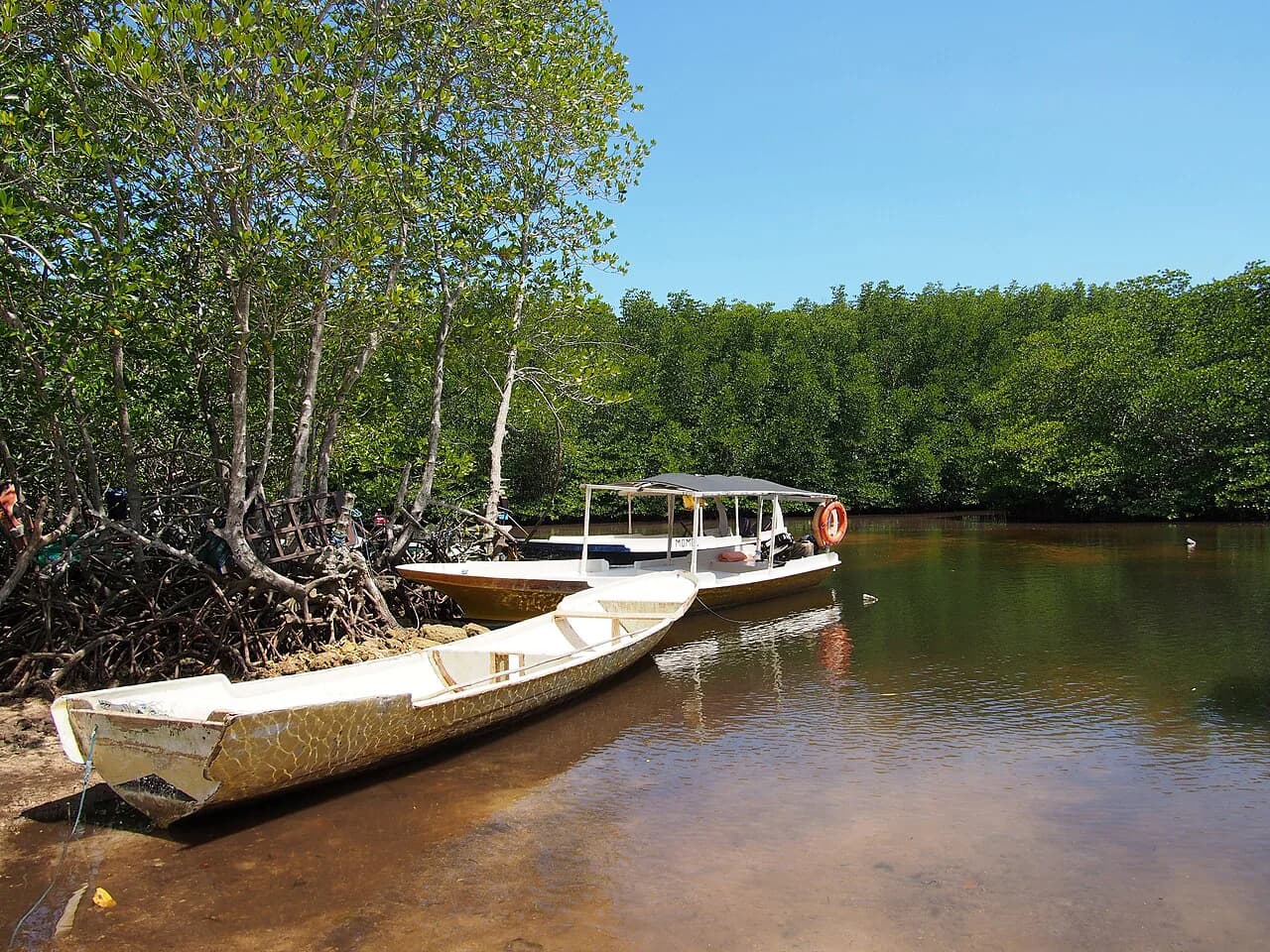
Mangrove Forest Nusa Lembongan: Visiting Mangrove Point

The mangrove forest at Mangrove Point is worth about an hour or two of your Nusa Lembongan day if you want a quiet, flat-water counterpoint to the island's surf beaches. It is not a jungle hike: you see it from a traditional boat, a kayak or a stand-up paddleboard, moving through narrow channels rather than walking a trail. This page covers where the forest sits, how to reach it, what the different craft involve and what to look for.
Treat it as a stop on a loop rather than a standalone half day. Most visitors pair the mangroves with the crossing to Nusa Ceningan and the beaches on Lembongan's west and south coasts, which keeps transport simple and the day varied.
Where the mangrove forest sits on Nusa Lembongan
The forest covers the northeast corner of Nusa Lembongan, where the island faces Nusa Ceningan across a shallow, sheltered channel. The site is signed and known as Mangrove Point, and the water between the two islands is where most of the paddling and boat routes run.
That position explains why the forest is here at all: the northeast corner takes the brunt of coastal energy and the mangrove roots hold the shoreline together, sheltering the coast behind them. Travelfish notes the forest's environmental role in protecting this stretch, which is a useful frame when you are deciding whether the detour earns its slot in your day.
Practically, you are heading for the island's northern edge, not its beach strips. If you are staying around Jungut Batu or Mushroom Bay, the mangrove is on the opposite side of the island, so plan it as a one-way leg rather than a stroll from your hotel.
How to get there from the harbor and west-coast beaches
From the main arrival point at Jungut Batu, the usual approach is a scooter, a private car or a hired driver along the island's lanes to the northeast coast. Roads on Lembongan are narrow and often rough, so allow more time than the distance suggests and avoid squeezing the ride into a tight ferry connection.
Many visitors reach the mangrove as part of a longer island circuit that continues over the Yellow Bridge into Nusa Ceningan. Doing it that way means one transport arrangement covers both islands, which is simpler than returning to your guesthouse between stops.
If you would rather not drive, ask your accommodation to arrange a driver for a half day and include the mangrove as one stop. Confirm the route and the waiting time with the driver before you set off, since the mangrove visit itself runs on the water and the driver will need to wait at the jetty area.
What a mangrove tour actually is: boat, kayak or paddle
The traditional-boat option is the least effort: a local skipper poles or motors you through the channels while you sit and look. It suits mixed groups, anyone who would rather not paddle, and anyone short on time, because the skipper knows the passages and the turnaround.
Kayaks and stand-up paddleboards put you at water level and let you choose your own pace through the maze of connected channels. Reviewers describe the forests as linked like a maze, and note that with little or no current the paddling is calm rather than strenuous, which makes it a realistic option for beginners.
The trade-off is control versus convenience. A guided boat covers more ground and requires no skill, while a kayak or paddle gives you quiet corners and the freedom to stop, but you need to stay aware of the channel edges and follow whatever route the rental operator marks out.
Some operators sell the mangrove as part of a combined package with other stops, and at least one product is marketed around a one-hour mangrove tour with kayak, paddle or boat options. Read the inclusions line carefully so you know which craft you are actually booking and whether transport is part of it.
How long the visit takes end to end
Budget roughly one hour on the water and another hour for getting there, sorting out a boat or kayak, and getting back on the road. That makes the mangrove a comfortable half-day stop when combined with the Ceningan crossing, or a tight standalone outing if you are squeezing it between other plans.
The one-hour tour format is a reasonable benchmark for the water portion, but treat it as the shape of the experience rather than a guaranteed timetable. Ask the operator or the on-site booth how long their route runs and where it turns around before you commit, especially if you have a ferry to catch.
Mornings are the practical choice for most itineraries: the water is usually calmer, the light is better for seeing into the channels, and you leave the afternoon free for the west-coast beaches. Nothing in the operator listings confirms fixed departure times, so set your own schedule with whoever takes you out.
What you actually see in the channels
The appeal is the layout as much as the wildlife: a grid of narrow, tree-lined channels where the canopy closes overhead and the open sea disappears behind you. Because the passages connect, a guide or a marked route matters, and drifting quietly is part of the point rather than dead time between sights.
Ceningan Divers lists species recorded in the mangroves between Nusa Ceningan and Nusa Lembongan, including the Asian water monitor, the crab-eating frog, the common mudskipper, fiddler crabs and the Asian vine snake. Treat that as a list of possibilities to watch for, not a checklist you are owed on the day.
Look at the mud rather than the canopy if you want results: mudskippers and fiddler crabs work the exposed banks, while monitors are more often spotted moving through the roots. Keep your hands and paddle inside the craft and let the skipper or guide position you for a closer look.
Tickets, hours and booking: what to confirm
The published sources do not give a confirmed ticket price, opening hours or operating days for the mangrove, and rates for boats and kayaks are usually quoted in Indonesian rupiah by whoever runs the trip. Rather than rely on an old figure, ask at the on-site booth at Mangrove Point or check with your accommodation or tour operator when you book.
When you ask, get the answer in writing or repeat it back: whether the price is per person or per boat, how long the trip runs, whether a life jacket and paddles are included, and whether transport from your hotel is part of the deal. Those four details decide whether a cheap-looking quote is actually cheaper.
What's nearby: Ceningan, the Yellow Bridge and the rest of the day
The mangrove sits naturally at the start or end of a Nusa Ceningan loop. Cross the Yellow Bridge on foot or by scooter, follow the Ceningan lanes to the cliff viewpoints on its west side, and come back through the mangroves while the light is still good.
On the Lembongan side, the south coast beaches round out the day. Sandy Bay Beach, Nusa Lembongan is a short run from the island's southern lanes and works well as an afternoon stop after a morning on the water, with Dream Beach, Nusa Lembongan close enough to combine if you are moving by scooter.
Devil's Tear Nusa Lembongan, on the same southern stretch, is the usual sunset finish, though it draws a crowd. If you want a calmer end to the day, Mushroom Bay Nusa Lembongan and Jungut Batu beach Nusa Lembongan both give you somewhere to sit and eat without chasing the viewpoint traffic.
For a quieter alternative near the mangrove end of the island, Song Lambung Beach Nusa Lembongan and Tamarind Beach, Nusa Lembongan sit on the north-facing coast and make easy add-ons before you head back west.
Common mistakes to avoid
The biggest mismatch is expecting a walk. There is no trail through the forest here; the visit happens on the water, and arriving in shoes you do not mind getting wet or barefoot-ready makes boarding and disembarking far easier.
The second is treating the mangrove as a five-minute photo stop. The channels are the experience, and cutting the ride short to rush to the next beach usually means you miss the quiet middle section where the wildlife is. Give it the full hour on the water and build the rest of the day around that.
Finally, do not assume the mangrove doubles as a beach or snorkel stop. It is a sheltered, shallow forest, and the island's swimming and surf spots are elsewhere; plan the two as separate stops rather than expecting one to serve both.
Should the mangrove forest make your Lembongan shortlist?
Yes, if you have a spare morning and want something calm and genuinely different from the island's beaches. Skip it if your trip is built around surf and sunsets and your time on Lembongan is only one night, because the round trip eats into a short stay.
Book on arrival rather than in advance, since the sources do not confirm prices or schedules and local arrangements are easy to make once you are on the island. Then slot the mangrove into a Ceningan loop and finish on the south coast.