
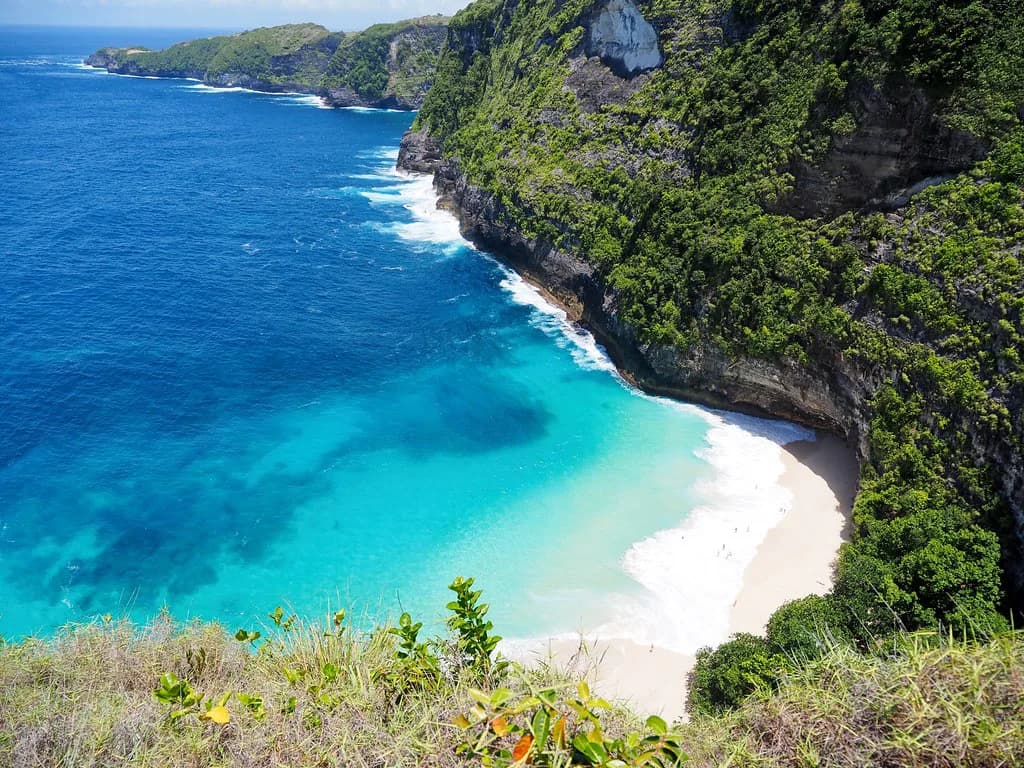
Kelingking Beach: The T-Rex Viewpoint and the Hike Down
Kelingking Beach is worth the trip for the clifftop view alone, even if you never set foot on the sand. The headland on Nusa Penida's southwest coast drops away in a green spine shaped like a T-Rex, with white sand and turquoise water on both sides, and the main viewpoint is only minutes from the car park. This page covers where the beach sits, how to reach it from Bali or Nusa Lembongan, how much time to give the viewpoint versus the descent, what the entrance costs, and the status of the stalled lift.
Where Kelingking Beach sits on Nusa Penida
Kelingking Beach, or Pantai Kelingking, is on the south-west coast of Nusa Penida, the island off Bali's south-east coast in Klungkung Regency. The nearest village is Bunga Mekar, and the approach road runs through it before ending at the parking area above the cliff. Google Maps labels the formation T-Rex Bay, which is why the name turns up in searches for the same place.
Because it sits on the west coast, Kelingking pairs naturally with the other western stops rather than the eastern beaches. Travelers coming from Nusa Lembongan usually cross first and then drive, while those based on Penida itself can reach the car park directly. Either way, the last stretch is a narrow island road, so build in more time than the distance suggests.
Why the T-Rex headland is famous
The fame comes from the shape: a narrow limestone promontory covered in green, curving down to a beach that looks almost unreachable from above. The viewpoint at the top delivers the panorama straight away, over water clear enough that manta rays are sometimes visible below. It is one of the most photographed landscapes in Indonesia, and the images have driven most of Nusa Penida's tourism growth.
The headland has picked up outside recognition as well, with Nusa Penida travel blogs reporting a place among Tripadvisor's top beaches and a ranking in The World's 50 Best Beaches in 2024. That reputation is the reason the car park fills early and the ridgeline gets crowded by mid-morning. If you want the classic shot without a queue behind you, the timing matters more than the route.
How to get to Kelingking Beach from Bali or Lembongan
From Bali, the usual route is a fast boat from Sanur to Nusa Penida, then a road transfer across the island to the west coast. From Nusa Lembongan, the crossing is a short hop of roughly a quarter of an hour, followed by about 45 to 60 minutes by road. Boat timetables and fares change with operators and season, so confirm your crossing when you book rather than relying on a published schedule.
Many visitors skip the logistics entirely by booking a day tour that bundles the boat, the driver and the west-coast stops. That costs more than arranging each leg yourself but removes the risk of missing a connection at the end of a long day. If you are staying on Penida or Lembongan rather than Bali, you avoid the double crossing and get to the viewpoint before the Bali day-trippers arrive.
Driver or scooter on Penida's west-coast roads
The roads to Kelingking are narrow, steep in places and busy with tour vans, which makes a private driver the calmer choice for most visitors. A scooter gives you flexibility and costs less, but it puts you on the same tight corners in unfamiliar traffic with gear and heat to manage. If you are not an experienced rider at home, the driver is the better trade.
Whichever you choose, plan the day around daylight. The site itself is open land with no gate, but the warungs and parking area operate from around sunrise to sunset, and starting the descent late in the afternoon is a bad idea. Aim to be at the car park in the morning, both for the light and for the space.
The clifftop viewpoint: layout, ridgeline and timing
The viewpoint is a short walk from the car park, so this is not a demanding visit in itself. Most people spend an hour or two at the top, moving between the main platform and the fenced viewpoints along the edge. The headline panorama needs no effort beyond the walk in.
The real crowd-beating move is to walk a little further along the cliff to the right as you face the ocean, where quieter viewpoints open up away from the main platform. Early morning or late afternoon gives the best light and the thinnest crowds. Arriving at opening time is the difference between a photo and a photo of other people's phones.
The hike down to the sand
The descent follows the spine of the headland on a steep, uneven path with sections of bamboo handrail, and it is a scramble in places rather than a walk. Fit visitors typically take 30 to 60 minutes going down and longer coming back up in the heat, so allow at least two hours for the round trip plus time on the beach. Treat those figures as estimates, not guarantees, and turn around if the ground is wet.
Going down is not the hard part. The climb back up in midday heat is where people run out of water, so start early, carry more than you think you need, and avoid the descent in rain. Proper shoes make a real difference on the loose sections.
Why swimming at the bottom is a bad idea
The beach at the base faces the open ocean, with powerful waves and strong currents and no lifeguards on duty. Swimming is not recommended at any time, and paddling at the water's edge is enough for most people who make the climb down. The reward is the setting, not the water.
That open-ocean exposure is also why the descent should be skipped after rain, when the rock gets slick. The same conditions that make the view dramatic make the bottom unpredictable. A judgment call at the top is cheaper than one at the bottom.
Entrance fees and parking, paid in cash
As of late 2026, entry is 25,000 IDR per person at a ticket booth at the site entrance, with parking extra at 5,000 IDR for a scooter and 10,000 IDR for a car. Bring rupiah in small notes, since the booth is a cash operation and you do not want to be hunting for an ATM at the cliff. Fees are set locally and can change, so confirm the current amount before you set out.
The glass lift and the announced stairway
Construction of a panoramic glass lift began in 2024, was suspended by local authorities on 31 October 2025, and in November 2025 the Bali governor called for it to be dismantled. In September 2026 the investor won its case against the provincial government in the administrative court, but the province is appealing and no work has restarted. The unfinished shaft and crane are still on site, and the only way down today is on foot.
Separately, in October 2026 the Klungkung regency announced a permanent stairway to replace the current path, with a target of finishing in about six months. That is an announced plan, not a built structure, and no opening date or ticket arrangement has been published. Plan your visit as a walking descent and check the latest position before you travel if the stairs matter to your decision.
Is Kelingking worth it if you skip the hike?
Yes. The viewpoint delivers the image most people came for, and the walk from the car park is short and easy. If you are unsteady on steep ground, short on time, or visiting after rain, staying on top is a perfectly good visit rather than a compromise. Plenty of day-trippers never leave the rim and still get the full panorama.
How long to allow at Kelingking
For the viewpoint alone, budget one to two hours including the walk in and out and time at the edge. Add the descent and you are looking at two to three hours at the site, more if you linger on the sand. Build the drive in separately, because Penida's west-coast roads eat time.
What to pair with Kelingking on the west coast
Kelingking is usually combined with Broken Beach and Angel's Billabong in the same west-coast loop, finishing with a swim at Crystal Bay. If you have a second day, the east coast adds Diamond Beach and the Atuh cliffs, which is a separate drive rather than a quick add-on. Grouping stops by coast is the single biggest time saver on Penida.
On the east side, Diamond Beach, Nusa Penida and the Atuh cliffs deserve their own half-day rather than a rushed stop between western viewpoints. Crossing the island twice in one day is possible but leaves little time at either end.
Viewpoint only, or all the way down?
Decide before you arrive: the viewpoint if you want the view with minimal effort, the full descent only if you are steady on steep ground, carrying water and starting early. Either way, come in the morning, bring small rupiah notes for the booth and parking, and give the west-coast roads more time than the map suggests. Then check current fees and the lift or stairway situation with the site before you go.
Explore more Nusa Penida guides
Frequently Asked Questions
Can you swim at Kelingking Beach?
Swimming is not recommended. The beach faces the open ocean with powerful waves and strong currents and no lifeguards, so most visitors who make the descent paddle at the edge rather than go in.
Is Kelingking Beach open, and does it have opening hours?
The site is open land and has no official gate or closing time. In practice the parking area and warungs are staffed from around sunrise to sunset, and the descent should not be started in the afternoon or after rain.
Do I need cash at Kelingking Beach?
Yes. The entrance booth and the parking charge are paid in cash in rupiah, so bring small notes. Amounts are set locally and can change, so confirm the current fee before you travel.