
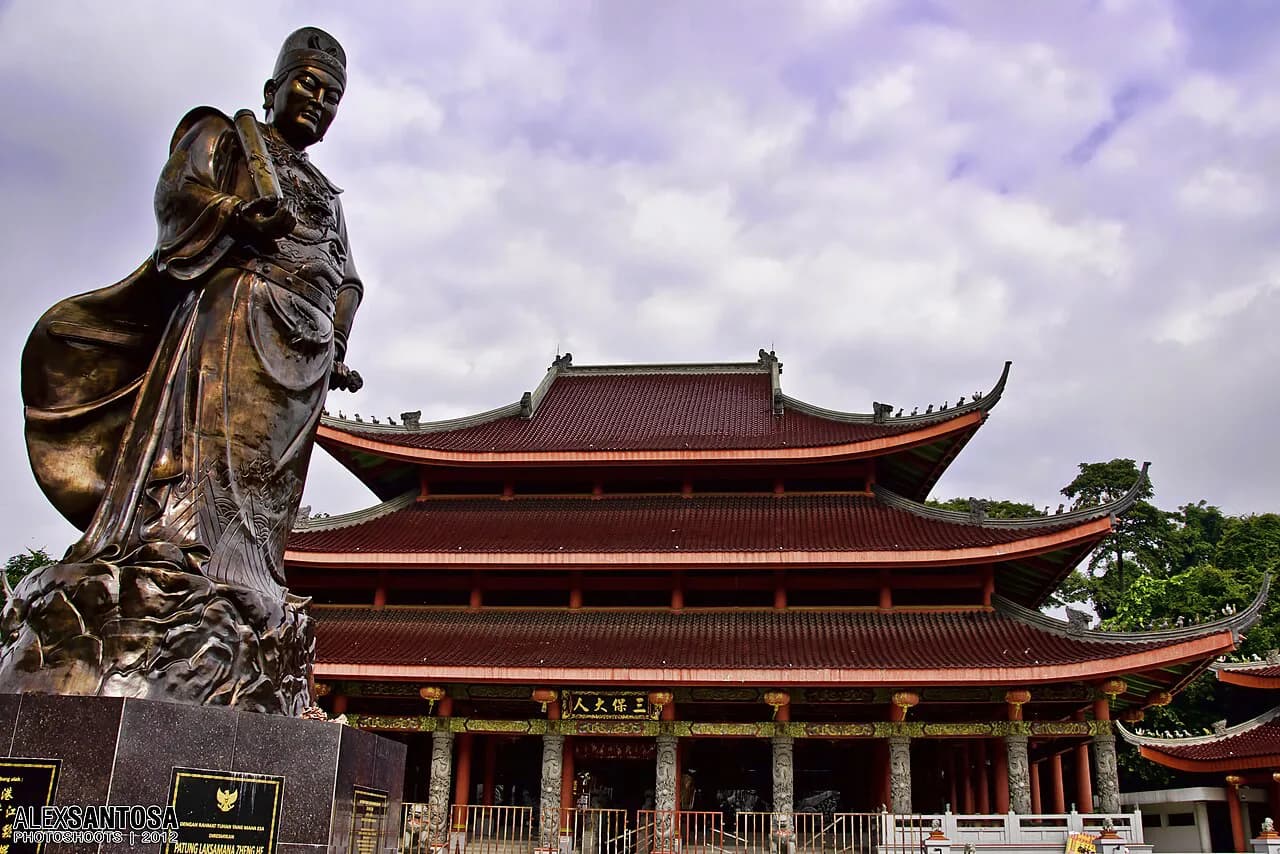
Gedung Batu (Sam Poo Kong) in Semarang: What You'll See and How Long to Allow

Gedung Batu is the local name for Kelenteng Sam Poo Kong, the Chinese temple complex in Simongan, west Semarang, and one visit covers the whole site in about 60 to 90 minutes. This guide sticks to that single place: its overlapping names, the cave at its center, the individual shrine buildings, and how to reach it from central Semarang.
Sources describe the site in different terms, so it helps to know what you are walking into before you arrive. The page sorts out the naming, the Cheng Ho story behind the cave, and which practical details still need checking with the operator.
What Gedung Batu actually is
Gedung Batu, Kelenteng Sam Poo Kong, and San Bao Dong all point to the same temple complex in Simongan, on the western side of Semarang. Locals most often say Gedung Batu, a nod to the large rock cave at the heart of the site, while signage and tourism materials usually use Sam Poo Kong. If a driver or a map app seems to send you somewhere different under each name, you are still heading to one destination.
The Central Java provincial tourism office calls it the oldest Chinese temple in Semarang, set on a site of roughly 1,020 square meters with Chinese and Javanese architectural elements dating to the 14th century. That description is the most official summary of the place available, and it frames the complex as both a worship site and a heritage stop.
Some material refers to a mosque on this spot, but the sources disagree about the site's past function, and describing it today as a mosque would be misleading. Treat Gedung Batu as a Chinese temple complex with a layered history, and read any mosque reference as part of that history rather than a description of what you will walk through.
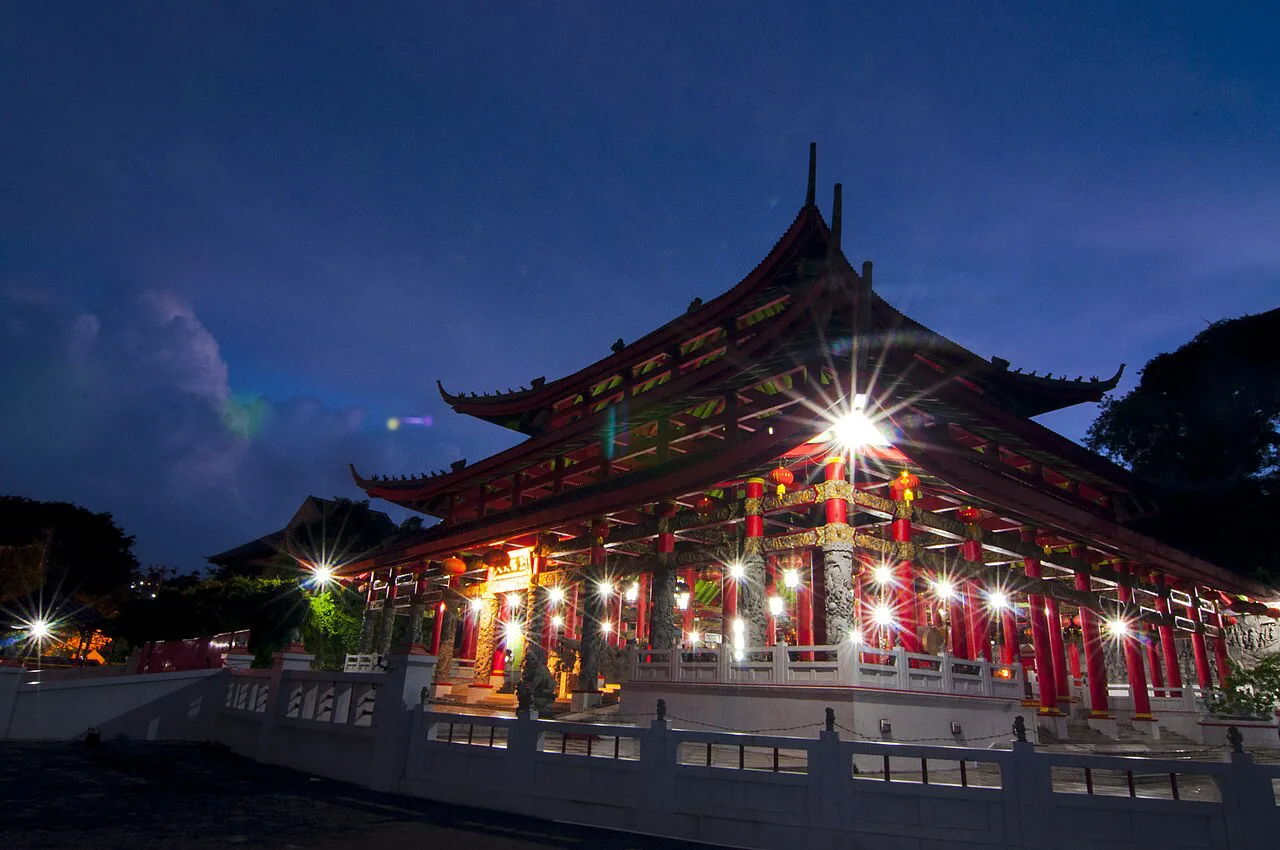

Where it is: Simongan, Semarang Barat
The complex sits at Jalan Simongan Raya No. 129 in Bongsari, Semarang Barat, in the Simongan area southwest of the city center. A useful landmark is the Banjir Kanal Barat bridge, which local descriptions place close to the site; if your driver knows the bridge, you are nearly there.
Because the temple now sits well inside the built-up city, it surprises visitors who expect a coastal setting. Local accounts explain the shift through sedimentation: the north Java shoreline moved north over centuries, leaving a site that was once near the water sitting in an inland neighborhood. That context explains why the complex is where it is, even though the approach feels ordinary.
Simongan sits west of the city center, so it works best as its own stop rather than something folded into a walk around Kota Lama. Plan it as its own outing and pair it with other stops if you have a car or driver for the day.
The Cheng Ho backstory in brief
The story attached to the site centers on Admiral Cheng Ho, also written Zheng He, the Chinese Muslim explorer whose fleet passed through the north Java coast in the early 15th century. One widely repeated account places the fleet's stop around 1406, when a crew member named Wang Jing Hong fell ill and was cared for in a cave at Simongan. That cave became the origin point for the temple.
The name San Bao Dong is usually translated as Cave of Three Protections, linking the cave directly to Cheng Ho's honorific title. Wang Jing Hong is said to have stayed on after recovering, married locally, and helped spread Chinese customs in the area. Treat these as tradition rather than documented chronology, since they come from secondary write-ups.
The provincial tourism office adds a later chapter. It states that the temple and cave collapsed in a landslide in 1704 and were rebuilt about 20 years later at a different location closer to the city center. Treat the dating as the provincial listing's account rather than an independently verified chronology.
How the complex is laid out
The site is a cluster of separate buildings rather than one hall, so it rewards a slow loop instead of a quick photo stop. The cave shrine, often called Gua Sam Poo Kong, is the focal point, though it reads more like a large chamber with an altar than a deep natural cavern. Start there, then work outward through the smaller shrines.
Around the cave, the named buildings include Kelenteng Thao Tee Kong, dedicated to the Earth deity, and Kelenteng Kyai Juru Mudi, built to honor Wang Jing Hong. Two more, Kelenteng Kyai Jangkar and Kelenteng Kyai Cundrik Bumi, are described as holding objects treated as sacred: an anchor associated with Cheng Ho's ship and a collection of traditional weapons. Matching each name to its building keeps the walk from blurring into a row of altars.
What to look at inside
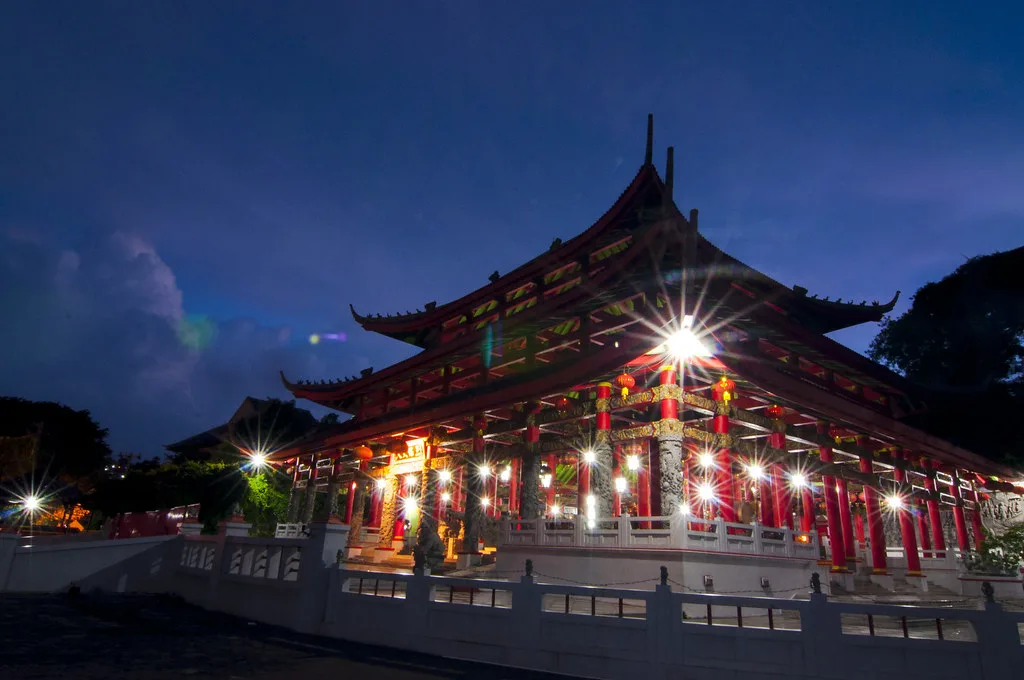
Architecturally, expect deep red walls, gold accents, and three-tiered East Asian roofs, with dragon and cloud ornament worked into the detailing. The provincial tourism office singles out the red paint and layered roof as typical of the style, and that is the visual signature most visitors remember. Look up at the roofline before you step into the cave area.
The local-Javanese layer is subtler but real: the provincial source describes the architecture as a blend of Chinese and Javanese styles, and other accounts say some rituals use Javanese language. Look for roof forms and structural details that do not read as purely Chinese. This mixing is why the site is often described as a symbol of cultural acculturation rather than an imported temple dropped into Java.
Inside the cave, an altar and statues of Sam Po Tay Djien are the main things to see, and the space serves Tridharma worshippers, meaning Buddhist, Taoist, and Confucian practice combined. You are moving through an active worship site, so keep to the edges when someone is praying. The statues and altar are the emotional center of the whole complex.
Getting there from central Semarang
A private car or a ride-hailing app such as Grab or Gojek is the simplest way to reach Simongan, because the temple sits off the main tourist circuit and the address is easy for a driver to enter. Give the driver both the street address and the name Sam Poo Kong, since some know the temple by the local Gedung Batu name.
Public transport is possible in principle, and local write-ups mention reaching the site by private vehicle or public transport without naming specific routes. Because no source confirms which lines or stops currently serve Simongan, check a live transit app or ask your hotel before relying on buses. If you have already booked a driver for a west Semarang day, adding this stop costs little extra.
For the wider set of Semarang sights and how they group geographically, the Semarang Attractions: 12 Visitor Guides page is a sensible place to plan the rest of the day around this visit.
How much time to allow and when to go
Budget roughly 60 to 90 minutes for a full walk-through: the cave, the four named shrines, and a pass along the ornamented rooflines. A fast visit covers the main hall and cave in about 30 minutes, but you will skip the smaller buildings that give the complex its character. Photographers should plan on the longer end.
Morning is generally the more comfortable window in Semarang, and arriving early also means fewer people moving through the narrow cave area. The sources consulted do not state current crowd patterns or the best visiting hours, so treat that as a reasonable habit rather than a confirmed rule. If your schedule is flexible, slot the temple before lunch and keep the afternoon for other stops.
Ceremonies and festival periods change the atmosphere and may affect access to parts of the complex, and no reliable schedule of closures for this site appears in the sources reviewed here. If your visit coincides with Chinese New Year or a Cheng Ho commemoration period, confirm access with the temple directly rather than assuming normal visitor flow.
Tickets, hours, and what to verify
No source reviewed for this page confirms current opening hours, ticket prices, parking fees, or photography rules for Gedung Batu, so none are quoted here. The provincial tourism listing for the temple is the most official place to start, and it points readers toward the local tourism information center for current details. Check there, or call the temple, shortly before you go.
Expect some kind of visitor arrangement at the entrance, since the complex is presented as a tourism destination as well as a place of worship, but do not budget a specific rupiah figure from this page. Ask your driver or hotel what the current entry arrangement is, and carry small cash in case a donation or entrance fee is collected on site.
Because the site is an active Tridharma place of worship, behave as you would in any working temple and follow posted instructions inside the cave and shrine halls. Photography rules are not confirmed by the sources, so watch for signs or ask a staff member before using a flash near the altars.
Nearby stops beyond west Semarang
Gedung Batu pairs well with a couple of other stops if you have a car. Lawang Sewu is the classic central landmark to combine with a temple visit, though it is across town rather than next door, so sequence it before or after rather than trying to walk between them.
On the city's southern edge, Brown Canyon is a former quarry site that draws photographers and works as a second stop on a half-day loop with a driver, though it is clear across town from Simongan. It is a landscape stop rather than a heritage one, so it suits travelers who want variety after a temple visit.
If you are stringing together Chinese-heritage sites, Klenteng Tay Kak Sie in the old Chinatown area is the other temple most often mentioned alongside Sam Poo Kong, and it fits naturally into a walk around Pecinan.
Travelers with a full day and their own transport sometimes add Marina Beach on the north side of the city for a sunset stop, a longer drive from Simongan that balances a morning at the temple with an evening by the water.
Is Gedung Batu worth adding to your Semarang plans?
Yes, if you want one compact heritage stop that is different from Semarang's Dutch colonial sights and easy to reach by car or ride-hailing app. The cave, the four named shrines, and the mixed Chinese-Javanese architecture give you a specific story in about an hour, a fair return for a short detour west of the center.
Skip it if your time in Semarang is very tight and you are prioritizing the old town, or if you want a large, landscaped temple complex; this is a working neighborhood shrine rather than a monument. Before you go, confirm current hours and any entry arrangement through the provincial tourism listing, and treat the Cheng Ho stories as tradition that adds context rather than verified history.