
Kuta, Bali: A Candid Neighborhood Guide for US Travelers
Book Kuta if you want the cheapest beds in south Bali, a long surf beach at the doorstep and a base close to Ngurah Rai International Airport; skip it if you came for Balinese culture or quiet. It is the island's original tourist resort town, and it still reads that way: built up in places, busy at night, and easy on the budget relative to the rest of the south coast. This guide covers what Kuta actually is, who it fits, how to get in and around, and the specific venues worth your time.
What Kuta, Bali actually is
Kuta is the strip of south coast where Bali's modern tourism scene first exploded, and it remains its most famous tourist hub. Travel writers tend to agree that parts of it are overdeveloped while conceding it has strong resorts, a lively nightlife scene and plenty of attractions. Think of it less as a cultural destination and more as a practical, affordable beach base.
The comparison that lands best is a beach resort town with a backpacker pulse: cheap food, cheap rooms, surfboards for hire and bars that run late. One long-term writer puts it bluntly, describing Kuta as similar to a bigger Khao San Road with even more tourists spending days and nights there. If that image appeals, you will be fine; if it sounds exhausting, you already have your answer.
What Kuta does not offer much of is local Balinese culture, which is exactly why a hands-on workshop run by a Balinese woman from a rural village stands out in this district. Set your expectations accordingly and treat the town as logistics plus beach, not as a cultural classroom.
Who Kuta suits and who it does not
Kuta suits families and couples trying to stretch their money further, surfers who want a long beach break, and travelers who plan to be out on day trips from morning to night and only need a cheap bed. It also suits anyone flying in or out of Ngurah Rai International Airport who wants minimal transfer hassle on arrival day.
It does not suit travelers whose main goal is Balinese temples, rice-field scenery or silence. If culture is the point of your trip, look at Ubud, Bali instead, where daily life and temple grounds are the draw rather than an add-on. If you want a calmer beach base with a promenade, Sanur is the better fit.
Kuta also fails the quiet test. One traveler who stayed several days noted that the crowds and the evening traffic make it a place to sleep rather than linger, and recommended treating it as a launchpad while heading out elsewhere each morning. That framing is the honest one: Kuta works best as a base, not as the whole trip.
Where Kuta sits and how to get there
Kuta occupies the south coast near the airport, which makes it one of the most convenient landing spots on the island. Sources note easy access from Kuta to the airport, to the southern beaches, to the port at Sanur for boats to Nusa Penida and Nusa Lembongan, and to Ubud, Seminyak and Canggu. That web of connections is the district's single strongest argument.
From the airport, arrange a transfer through your hotel or a ride-hailing app rather than negotiating at the exit. Do not expect published travel times to hold: no reliable schedule exists for the airport road, and the beach road jams in the evening. Build slack into any same-day connection, especially an onward fast boat from Sanur.
From Ubud, Seminyak or Canggu, a private car and driver is the least stressful option with luggage, and it is how most visitors move between south Bali districts. Confirm the price and the vehicle in writing before you get in, and check current details with your hotel if you are connecting to a flight.
Getting around Kuta: apps, taxis and the evening jam
Inside Kuta, Grab and Gojek are the default for short hops, with metered taxis as a fallback where apps struggle to reach you. Scooter rental is common and cheap, but only take one if you are genuinely comfortable in heavy, unpredictable traffic. A private car and driver makes sense for day trips out rather than for dinner two streets away.
Plan around the evening traffic rather than fighting it. Kuta Beach road is one-way, and one traveler reports that between 7 and 10 PM it jams regardless, partly because motorbike riders ignore the one-way rule. If you have a dinner reservation or a sunset plan, leave earlier than feels necessary or walk.
Walking is underrated here because the beachfront strip and the mall cluster are close together, and on foot you bypass the worst of the gridlock. Save the vehicle for airport runs and day trips out of the district.
Kuta Beach: surf, sunset and crowds
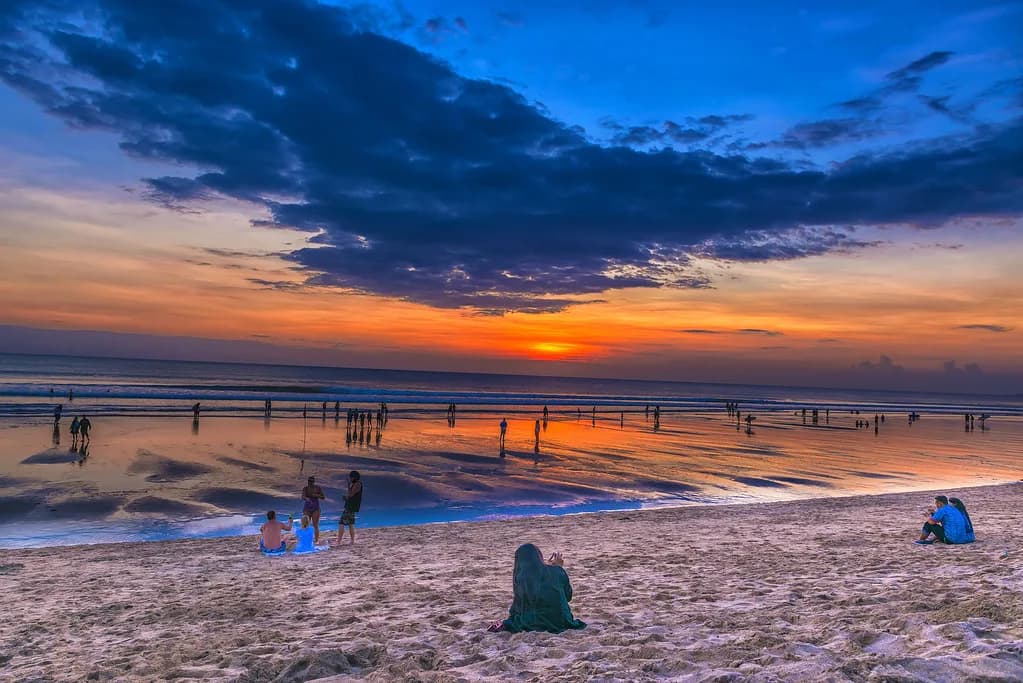
Kuta Beach is a long, wide stretch of sand that doubles as Bali's best-known learn-to-surf venue, with lessons and board hire available along the shore. It is also where the district's crowds concentrate, especially toward sunset, so arrive early if you want space on the sand.
The beach is best treated as a morning and late-afternoon venue: surf when the light is soft, retreat during the middle of the day, then come back for the sunset. Do not expect a secluded cove. This is a working resort beach with vendors, learners and spectators, and that energy is the point.
Waterbom Bali: the anchor of a full day
Waterbom Bali is the district's strongest single attraction and the main reason many visitors come down to Kuta at all. The park packs in near-vertical drops, twisting tube slides, a lazy river, several pools and a children's water play area, with gazebos, loungers and shaded rest areas for people sitting out a ride.
Two practical points shape your day: there is a large food court and a swim-up bar on site, so you do not need to leave for lunch, and the park closes at 6pm. Arrive at opening to get a full day out of it, and check the official site for current ticket prices before you go.
Ride highlights include Climax, where a capsule floor drops away beneath you, and Boomerang, a two-person tube slide that sends you up a near-vertical wall before splashing down. Neither is compulsory. The park suits families, couples and groups equally, which is why it absorbs a whole day rather than an afternoon.
Other things to do in and around Kuta
Beyond the water park, the strongest stop for context is Experience Bali Culture, a two-hour workshop run by a Balinese woman named Komang. The first half covers Balinese beliefs and village life, and the second is hands-on: trying jamu, making daily offerings and posing in traditional dress. One caveat from a reviewer: a section on shamans and black magic may be too much for young children.
For shopping and air conditioning, Beachwalk shopping mall is the big central complex, useful for souvenirs and for escaping the midday heat. Azul Beach Club covers the lounging-and-cocktails slot, and Pura Vihara Dharmayana is a Chinese-style temple in the district worth a short stop if you want a break from commercial Kuta.
If you want more structured sightseeing across the island, the wider catalog of Bali Attractions is a better starting point than trying to fill every day inside Kuta itself. Several of the district's headline draws, including a Kecak fire dance performance at Discovery Mall and a dinner-and-dance evening at Bali Mandira, run on their own schedules, so confirm times with the venue rather than assuming a nightly show.
Where to eat and drink in Kuta
Dewi Sri Food Centre is the local-dishes stop, a cluster of stalls where you eat cheaply and quickly rather than settling in for a long meal. It is the right choice when you want Balinese and Indonesian food without a resort markup.
For a slower meal, Azul Beach Club and the Waterbom food court cover two very different moods, and Beachwalk's dining floor fills the mall-dinner gap on a rainy evening. Budget travelers should note that Kuta's whole appeal is inexpensive eating and drinking relative to the rest of south Bali, so there is no need to default to hotel restaurants.
Where to stay in Kuta
The trade-off is location versus price. Hard Rock Hotel Bali sits directly in front of Kuta Beach with a large pool and a memorabilia-heavy theme, which puts the sand at your doorstep at a higher rate. Eden Kuta Bali is the budget counterpoint, with pool access at a much lower nightly cost. Neither figure should be trusted from a blog post, so check current rates directly.
Beachfront resorts cluster along the sand, while cheaper guesthouses and homestays sit a few streets inland, which is where the district's reputation for very cheap accommodation comes from. Staying inland and walking to the beach is a reasonable trade if you are out on day trips most of the time.
Kuta or Kuta Utara: don't book the wrong district
Kuta proper is the resort strip around Kuta Beach and its immediate streets. Kuta Utara is a separate administrative area to the north that contains Canggu, Pererenan, Kerobokan, Tibubeneng and Tumbak Bayuh, each with its own character and beach. Listings often say Kuta Utara when they mean Canggu, so read the map before you pay.
If you booked expecting surf, cafes and rice-field edges, you probably want Canggu or Pererenan rather than Kuta beachfront, and a Canggu Bali Guide will match the trip you actually planned. Conversely, if you want the beach road, the water park and the airport on your doorstep, stay in Kuta proper and ignore the northern listings.
Kuta versus Seminyak for a south Bali base
Kuta and Seminyak sit on the same stretch of coast and get compared constantly. Kuta is the budget-first, beach-and-nightlife version, with cheap rooms, surf lessons and a busy one-way beach road; Seminyak is the more polished, design-led version with a similar beach and higher prices.
Choose Kuta if the plan involves early starts out of the district, a water-park day, and spending money on activities rather than on the room. Choose Seminyak if your priority is restaurants, boutiques and a slower pace in the evenings. There is no universal winner, only a fit with how you actually spend your days.
Costs in Kuta: cheap for south Bali
Kuta has a fair claim to being the most budget-friendly area in south Bali, with accommodation, food, drinks and surf hire all pitched lower than in neighboring districts. General travel writing supports this as a broad characterization, but specific figures vary by season and by operator, so the honest move is to compare live rates rather than plan around a quoted number.
Attractions are the exception: Waterbom, beach clubs and organized activities price themselves well above street level. Check official ticket pages for those before you commit, because they are where a cheap Kuta trip can quietly become an expensive one.
Is Kuta safe at night?
One traveler's account is worth reading as a caution rather than a verdict: that writer reports robberies in Kuta, approaches from people selling drugs, and drunken tourists losing their temper, and advises care when out late. Another describes the area as more of an exception to Bali's generally calm reputation. These are individual impressions, not statistics.
Treat that as a reason to stay aware on late nights and to keep valuables close, not as a reason to cancel. For anything current, rely on your own government's travel advisory and your hotel's advice instead of blog posts, including this one.
Should you book Kuta or look north?
Book Kuta if the math favors cheap beds, a surf beach within walking distance and a base close to the airport and the Sanur port for island boats. Skip it if you want Balinese culture, quiet evenings or a polished restaurant scene, and look at Ubud for culture or Seminyak for polish.
If you do stay, structure your days outward: one full day at Waterbom, one beach-and-surf day, and the rest on day trips, returning after the evening jam has peaked. That is how Kuta works best, and it is how its most candid chroniclers use it.
Explore more Bali guides
Frequently Asked Questions
What is the main street in Kuta, Bali?
Jalan Legian runs parallel to the beach through the Kuta and Legian area, and the beachfront road known as Kuta Beach road carries much of the evening traffic. It is one-way, and it jams between roughly 7 and 10 PM according to one traveler's account, so walk or leave early if you have plans.
Which is better, Kuta or Seminyak?
They serve different trips. Kuta is the budget-first option with a surf beach, the water park and busy nightlife, while Seminyak is more polished and restaurant-focused at higher prices. Pick Kuta if you want to spend on activities rather than the room, and Seminyak if dining and a calmer evening matter more.
Do they speak English in Bali?
In Kuta specifically, English is widely used in hotels, restaurants, surf schools and shops because the district is built around international tourism. It is still worth learning a few Indonesian phrases for markets and local warungs, and for anywhere you go outside the main resort strips.