
Goa Gajah: Visiting Bali's Elephant Cave Near Ubud
Goa Gajah, the so-called Elephant Cave, is a compact cave temple near Bedulu, roughly a 10-minute drive from central Ubud, and 60 to 90 minutes is enough to see the cave, the bathing pools and the lower path. It rewards atmosphere over scale: the carved face at the entrance, the incense-heavy chamber behind it and the mossy fountains outside matter more than square footage. This page covers where the site sits, how to reach it, what is inside, and whether it earns a slot on your Ubud days.
Two things surprise first-time visitors: there are no elephants here despite the name, and the cave itself is small enough to walk through in a couple of minutes. Plan your timing and transport rather than your photo list.
What Goa Gajah Actually Is
Goa Gajah is an active Balinese temple site built around a man-made cave cut into a rock wall, with a mix of Hindu and Buddhist carvings on the grounds. Estimates for its origin span roughly the 9th to 11th centuries, with one archaeologist estimate putting the cave around 1022 AD, and old Javanese inscriptions on the cave walls have helped establish that dating. The cave was known mainly to locals until a young Dutch visitor publicized it in 1923.
The site is identified as Pura Goa Gajah and sits in Gianyar regency near Bedulu village, on the road between Ubud and the Gianyar area. Expect a working place of worship rather than a museum, so keep your voice low and step around anyone mid-ritual at the pools.
Where It Sits Relative to Ubud
The practical landmark is the large parking area and the row of souvenir stalls that signal the entrance, two kilometers before Bedulu village when approaching from the south. Coming from Ubud, the turn is at Teges, then a right toward Bedulu. If your driver knows the site by name that is enough; if you are self-driving, watch for the stalls rather than a monument sign.
Distance from Ubud is short, but the road is narrow and shared with scooters, dogs and trucks that seem too wide for the lane, so treat the drive as 10 to 20 minutes depending on traffic. For a wider look at how this stop fits with other Ubud-side sights, see the Bali Attractions: 6 Visitor Guides collection.
How to Get There: Driver or Scooter
A private driver is the lower-stress choice if you are not confident on a scooter, and a half-day hire lets you pair Goa Gajah with nearby stops without reparking. One visitor reported paying about 300,000 IDR for a half day with a driver who waited in the lot; treat that as a bargaining reference point, not a fixed rate, and agree on price and duration before you set off.
On a scooter, expect a small parking fee at the site, reported at around 5,000 IDR, plus attendants offering sarong rentals even if you brought your own. Have small notes ready, and wear shoes you do not mind getting muddy because the walkways slick up after rain.
The Demon-Mouth Entrance
You approach a rock face carved with bulging eyes, fangs and a black opening where a mouth should be, then duck through it into the cave. The face is generally read as a protective guardian, a common device on Balinese temple architecture, though exactly who it depicts is still argued. Suggested identities include the mythical builder Kebo Iwo, the witch Rangda and Shiva Pasupati.
The name is a separate puzzle. One explanation points to the elephant-headed god Ganesha carved inside; another cites a 1365 Javanese text mentioning a hermitage near the Elephant River, likely the Petanu nearby; a third holds that early visitors mistook the demon head for an elephant.
Inside the T-Shaped Cave
The chamber is roughly two meters high and one meter wide, shaped like a T, with fifteen niches cut into the walls. At the end of the left branch stands a four-armed Ganesha statue about a meter tall; at the end of the right branch sit three linga, the Shiva fertility symbols. Incense smoke and dim light make it feel smaller than the dimensions suggest.
Those niches are cited as evidence the cave was not designed as a temple in the conventional sense but as a meditation or retreat space. Keep a phone light handy if you want to read the carvings, and give way to anyone praying.
Bathing Pools, Fountains and the Hariti Statue
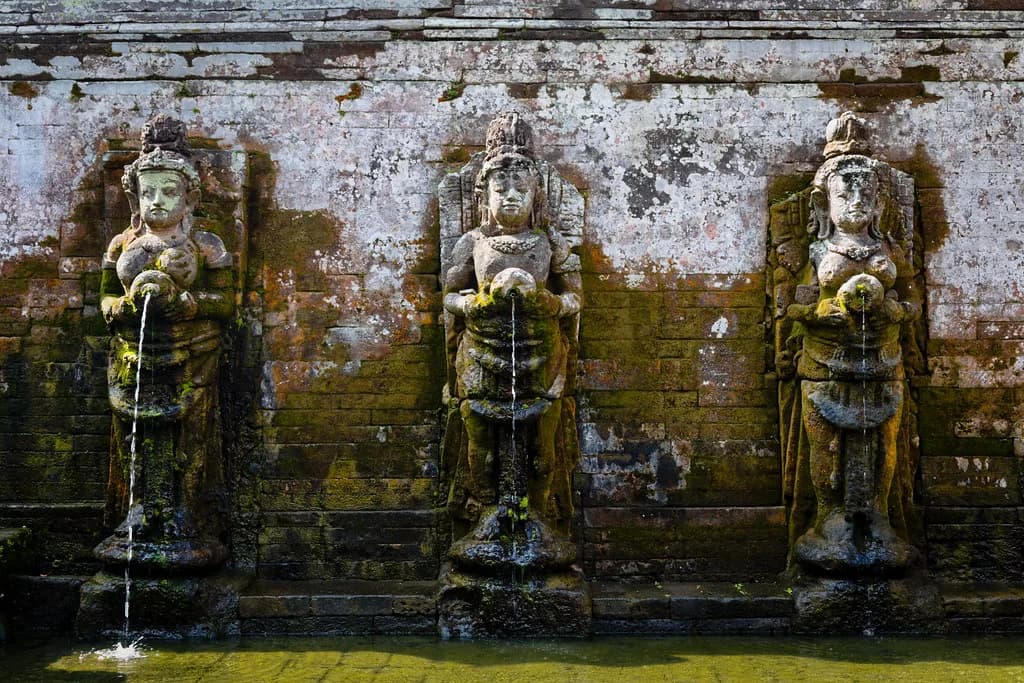
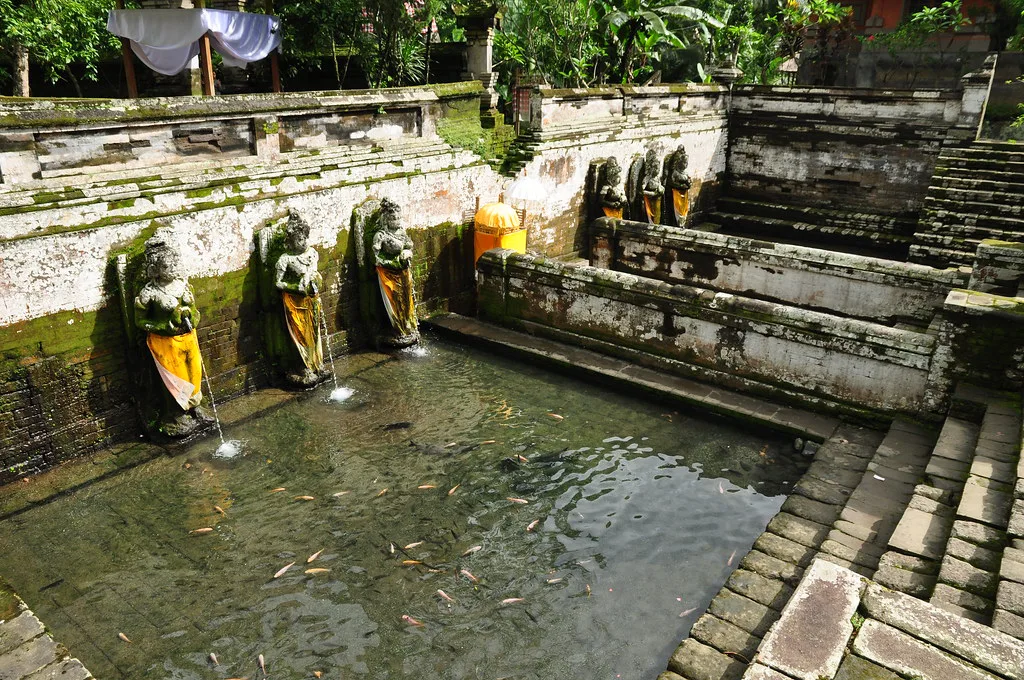
The surprise at Goa Gajah is outside the cave. Two bathing pools fed by water-spouting statues were not excavated until 1954, when matching statue fragments found near the cave were fitted into place. The pools are split by gender, three spouts to each side, with a large sacred tree behind them.
To the left of the cave entrance stands a statue of Hariti, a Buddhist figure who transformed from a child-eating witch into a protector of children, known on Bali as Men Brayut. South of the cave is a small shrine with Buddha figures; one was stolen in 2000, so what you see is partial, and nearby fragments of old reliefs are thought to predate the cave itself.
The Lower Grounds and the Walk Toward Yeh Pulu
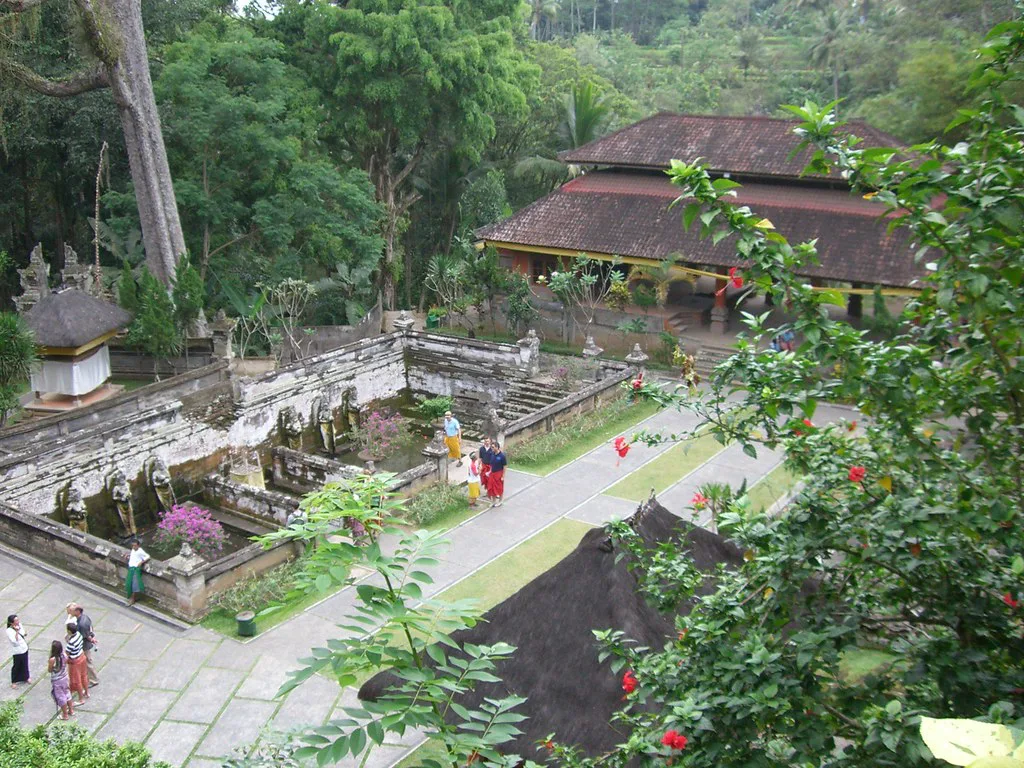
Paths wind down through thick greenery past more stonework, and a second bathing place was found further down the hill with steps leading to it. Most visitors stop at the pools and miss this section, which is why the lower route stays quiet even when the cave entrance is busy. The footing is uneven and can be muddy.
From Goa Gajah it is possible to walk through the rice fields of Bedulu to Yeh Pulu, best done with one of the local guides who offer their services at the site. Agree on a fee first and confirm the return route.
How Long to Allow
The cave alone takes about 20 minutes. The grounds are bigger than they look, and a realistic visit covering the cave, the pools, the Hariti statue and a loop of the forest paths is a solid one to one and a half hours, which matches the one-to-1.5 hour estimate other visitors give. Add more time if you continue to Yeh Pulu on foot.
Tickets and Opening Hours
Entry has been reported by visitors at about 50,000 IDR per adult, with children roughly half, and a sarong loan included in the ticket. Hours are usually quoted as opening around 8 a.m. and closing in the late afternoon, with one listing showing 8 a.m. to 6 p.m. These figures shift, so confirm the current price and closing time at the gate that morning rather than relying on a blog.
Shoulders and knees need to be covered, and a sarong is standard and is provided at the entrance, so wrapping one over your own clothes is normal. Bring cash in small notes for parking, sarong rental offers and the entrance stalls.
When to Arrive
Group tours tend to arrive from about 10 a.m., so aiming for the gate around 8 to 8:30 a.m. gives you the cave and pools with far fewer people and softer heat. Late afternoon is quieter again, but you will be watching the clock against closing time.
Shade is patchy, so midday is sticky, and the stone steps get slippery after overnight rain. Weekends bring more local visitors, so a weekday morning gives the best combination of light, cool air and quiet in the cave chamber.
Nearby Options Along the Same Road
Yeh Pulu, a rock-cut relief a short walk or drive away, is the natural companion and can be reached through the Bedulu rice fields. Pura Samuan Tiga, an important temple in the same village area, is another option if you have a driver and time for a second stop. Both keep you on the Ubud side of the island rather than adding a long transfer.
If you are building a temple day across Bali, Tirta Empul temple in Manukaya village is the usual pairing for a water temple north of Ubud, while Pura Tanah Lot in Beraban Village is a different coastal experience altogether. Read the Tirta Empul temple and Tanah Lot temple guides before you sequence them, since drive times, not distance, decide the order. For a highland alternative on the same loop, Pura Ulun Danu Beratan in Tabanan Regency sits beside its lake and pairs well with a northern drive.
Is Goa Gajah Worth It if You Have Seen Other Temples?
Goa Gajah is not the temple to choose if you want scale, grand gates or big ceremonies. What it offers is a strange, small, dim cave behind a carved face, plus a genuinely interesting excavation story in the pools outside. Visitors who arrive expecting a major complex leave underwhelmed; those who treat it as a 90-minute atmospheric stop tend to enjoy it.
The honest trade-off is size against atmosphere. If you have already seen Bali's larger temples and want one more photogenic stop, this is optional; if you are staying in Ubud and want something close, unusual and quick, it earns the detour.
Should Goa Gajah Be on Your Ubud Shortlist?
Put Goa Gajah on your list if you are based in Ubud, want a temple visit that does not eat a whole morning, and are willing to arrive early. Skip it if your trip is built around big landscapes or if narrow cave rooms and humid stone paths are not your idea of a good stop.
Either way, confirm the day's ticket price, closing time and any ceremony restrictions at the entrance, and settle your driver's rate and waiting time before leaving Ubud.
Explore more Bali guides
Frequently Asked Questions
How much is the entrance fee to the Goa Gajah Elephant Cave?
Visitors have reported adult tickets around 50,000 IDR with a sarong loan included, but no stable official listing fixes the price. Check the figure at the ticket desk on the day, or ask your driver to confirm before you set out, and bring small notes.
Is Goa Gajah the same as the Elephant Cave?
Yes. Goa Gajah translates as Elephant Cave, but there are no elephants at the site. The name likely comes from a confusion over the carved demon face at the entrance, the Ganesha statue inside, or a nearby river mentioned in old Javanese records.
How do I get to Goa Gajah from Ubud?
It is a short drive from Ubud via Teges toward Bedulu, and the site is two kilometers before Bedulu village. A private driver avoids the narrow, busy road; scooter riders should expect traffic, a small parking fee and muddy walkways after rain.
Can I walk from Goa Gajah to Yeh Pulu?
Yes, a route runs through the Bedulu rice fields from Goa Gajah to Yeh Pulu. Hiring one of the local guides who wait at the site is the usual approach, and you should agree the fee and route before you start walking.
How long should I spend at Goa Gajah?
The cave takes about 20 minutes. Allow an hour to 90 minutes for the cave, the bathing pools, the Hariti statue and a loop of the lower paths. Add more if you continue to Yeh Pulu on foot.
Sources
- Goa Gajah Temple Bali: What It’s Really Like Visiting This Ancient Spiritual Spot – Bali car rental with driver — Private cars, English-speaking drivers | TheBaliTravels
- Goa Gajah: The Bali Temple You Enter "Through the Mouth" | Trip.com Bali
- Goa Gajah - The Elephant Cave - Bjorn Grotting Photography