
Tirta Empul Temple: What to See at Bali's Holy Spring

Tirta Empul Temple is worth roughly 90 minutes of your day near Ubud, and more if you intend to take part in the melukat purification rather than only walk the courtyards. The temple is a working Balinese Hindu site in Manukaya village, Tampaksiring, in Gianyar Regency, and it sits just north of Ubud below the Tampaksiring Presidential Palace. This page walks through the layout courtyard by courtyard, how the spring and its water spouts work, what tickets and hours currently look like, and how to solve the return-transport problem that catches out visitors who arrive by ride-hailing app.
What Tirta Empul Temple Is
Pura Tirta Empul is a petirtaan, or bathing temple, built around a spring the Balinese consider holy, and the name translates roughly as water gushing from the earth. It is dedicated to Vishnu, the god of water, and the complex holds shrines to Shiva, Brahma, Indra and Mount Batur as well. Indonesia's tourism board counts it among the five most holy temples on the island, and it is still actively used for worship rather than preserved as a monument.
Sources disagree on the founding year, citing either 926 A.D. (Indonesia's tourism board) or 962 AD (the temple's commercial guide sites), so treat the exact date as contested and lean on the temple's continuous religious use instead. A legend ties the spring to Indra, who is said to have struck the ground to produce healing water after a rival king poisoned the local supply. That story explains why the water, not the architecture, is the reason people queue here.

Where It Sits and How to Get There
The temple entrance is about a 30-minute drive north of central Ubud, and there is a large parking area outside for scooters, cars and buses. If you are not driving yourself, a private driver for the round trip is the simplest arrangement, because online taxi services are limited around Tampaksiring and booking a car out is easier than finding one back. Grab and Gojek can work for the journey up, but do not assume a return vehicle will be waiting when you finish.
Budget for a small parking charge paid at the exit barrier, reported at 2,000 IDR for a scooter and 5,000 IDR for a car, which is worth having in cash before you leave. Sit in the front of the car on the way up if you can, because the road climbs through rice country and the palace grounds appear above the temple as you approach.
The Layout, Courtyard by Courtyard
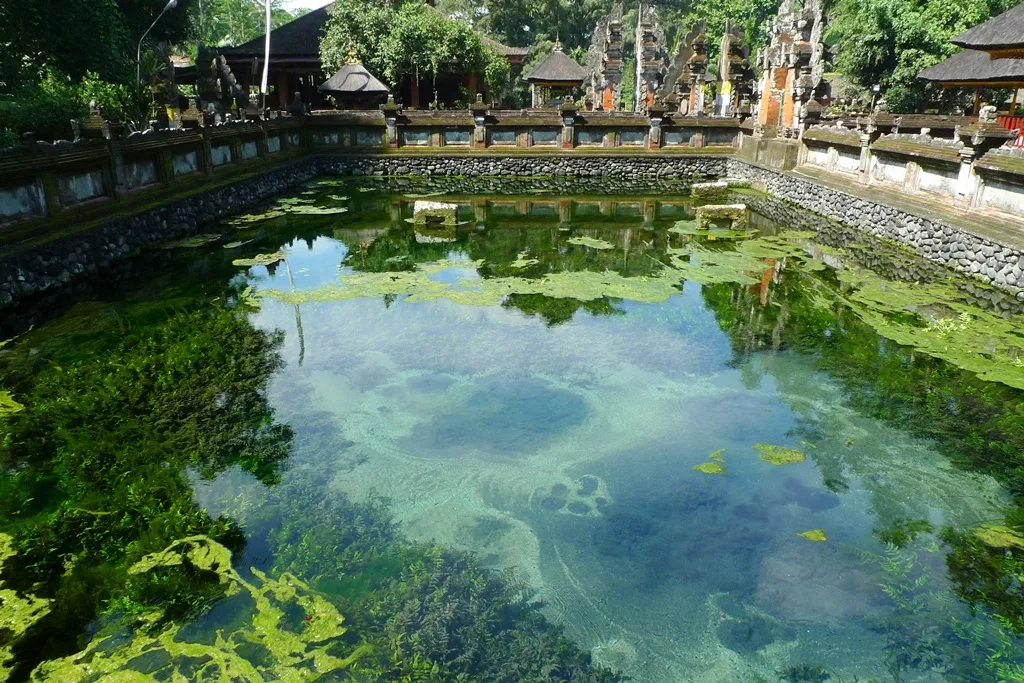
You enter through a candi bentar, the split stone gate, into the outer courtyard known as jaba sisi. A second gate in the far wall, guarded by two gilded Dwarapala statues and topped with a Kala carving with upward fangs, leads to the central courtyard. Moving through in this sequence makes the temple easy to read rather than a jumble of shrines and gates.
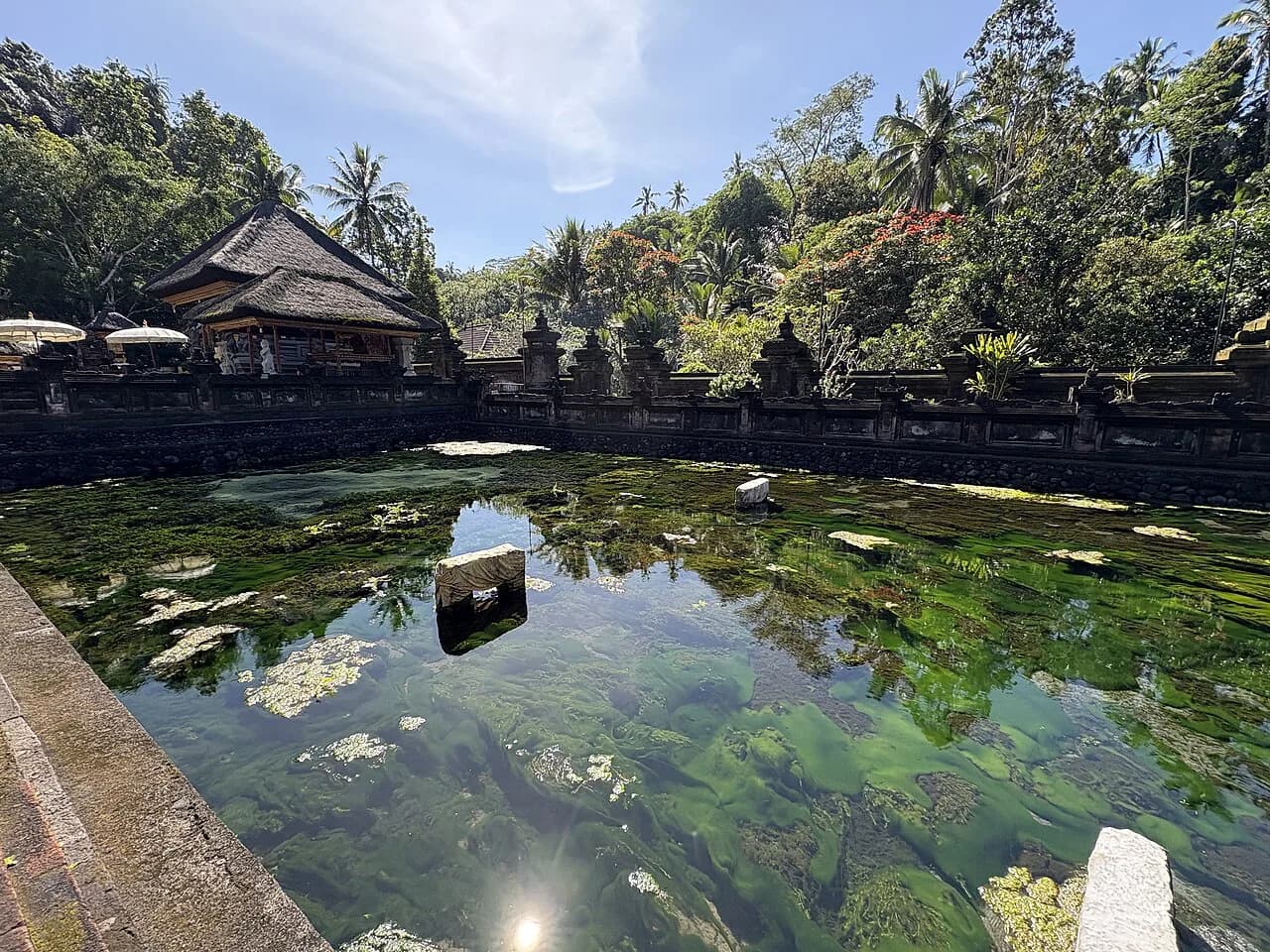
The jaba tengah is the heart of the visit: a clear pool where the spring surfaces, feeding two purification pools through a long row of water spouts. Behind the pools is the jeroan, the inner courtyard where Balinese come to pray, and it is the quietest part of the complex because most visitors stop at the water. Walk through it slowly after the pools rather than turning back at the first gate.
The Holy Spring and the Water Spouts
The spring sends water through 30 spouts into the two pools, and bathers work through them in order rather than choosing a preferred one. You stand waist-deep at the first spout, dip your head under, then join the next queue, repeating until you have passed along the row. Two spouts are reserved for cleansing the dead and are skipped by everyone performing melukat for the living, so watch the line ahead of you before you move.
The ritual is called melukat, and Balinese Hindus typically perform it around the full moon, though visitors are welcome to join at other times provided they are respectful. Locals and tourists share the same pools, so the pace is set by the queue rather than by any guide. That shared use is the reason the temple feels like a place of worship on a busy morning and not a photo set.
Doing Melukat as a Visitor
A melukat session usually starts with a change of clothes, an offering, and prayers before you enter the water, and a local guide can walk you through each stage in the right order. A guide is not required, but one makes the sequence clearer, keeps you from accidentally using a spout reserved for the dead, and can hold a camera while you are in the pool. Guides can be hired at the temple if you have not arranged one in advance.
Inside the temple you pay separately for a ceremonial sarong, a locker and an offering, all in cash; one guide reports 10,000 IDR for the sarong and 15,000 IDR for a locker and suggests sharing a locker between two people. Treat those figures as recent examples rather than fixed prices and carry more rupiah than you think you need. The standard entrance ticket does not cover participation in the ceremony at the pools.
Tickets, Hours and What the Fee Covers
As of an update dated January 1, 2025, entry is 75,000 IDR for adults, 50,000 IDR for children aged 5 to 12, and free for under-fives, payable at the entrance. A sarong is included with entry and is required on the grounds. Bring cash, because the ticket counter and the in-temple payments are cash transactions, and there is an ATM just outside if you arrive short.
The hours reported by third-party ticket sites differ: one lists 7 AM to 6 PM and another 8 AM to 6 PM, while a 2025 visitor reports being let in from 7 AM. Plan to arrive at opening rather than assuming a fixed start, and confirm the day's hours at the ticket window when you get there. This is the one detail on the page that genuinely varies, so check it on your travel day.
The standard ticket is a visit-only product: it gets you into the courtyards, shrines and gardens but not into the purification pools or the melukat ceremony. If the water is the reason you came, budget for the ceremony add-ons as a separate line rather than expecting them to be folded into admission. Read the ticket options at the counter before paying so you buy the version you actually want.
How Long to Allow
Indonesia's tourism board suggests at least 30 minutes to an hour to walk the whole complex, which is a fair minimum for the gates, pools and inner courtyard without stopping. Add time if you want to sit in the jeroan or read the shrines. The site is compact, so the variable is the queue at the pools, not the distance.
One visitor who did the full ceremony and took plenty of photos spent about 90 minutes on site, which is a realistic figure if you plan to get wet and change afterwards. Build in another 30 minutes on either side for the drive from Ubud and the drive back. Anyone squeezing Tirta Empul between two other stops will end up skipping the inner courtyard, which is the part most worth keeping.
Timing Your Visit Around the Crowds
Arriving right at opening is the difference between a calm visit and a shuffle through the gates; one visitor found the temple still quiet at 8 AM but filling up by 9:30 AM. Because the posted opening is inconsistent, aim for the earliest slot you can manage and let the driver know you want to be at the gate before the tour buses. Mid-morning is when the pools develop their longest lines.
If you want melukat without the crowd, smaller sites such as Pura Tirtha Sudamala, Taman Beji Griya and Sebatu Water Temple offer a similar ritual with far fewer people. The trade-off is that Tirta Empul's scale, its 30 spouts and its active congregation are exactly what makes it compelling. Choose based on whether you want atmosphere or elbow room, not on which is more authentic in principle.
What Else Is Inside and Nearby
Beyond the pools, look for the shrines to Vishnu, Shiva and Brahma and the shrine to Mount Batur, which sit within the same complex and are easy to pass without noticing on the way to the water. The Tampaksiring Presidential Palace, built in 1957 under Indonesia's first president, stands on the ridge directly above the temple and is the landmark to watch for as you approach.
Goa Gajah, the Elephant Cave, is the most natural second stop on the same drive back toward Ubud, and it pairs well with a morning at the water temple. Travelers building a longer temple circuit across the island often weigh Tirta Empul against Tanah Lot Temple on the coast and Ulun Danu Beratan Temple in the highlands, both of which need their own half day.
Should Tirta Empul Be on Your Ubud Shortlist?
Yes, if you treat it as a temple visit rather than a photo stop: arrive at opening, allow 90 minutes, and decide in advance whether you are doing melukat so you carry enough cash for the sarong, locker and offering. Skip it if you only have time for a 20-minute walk-through, because the pools and the jeroan are the whole point. Our Bali Attractions: 6 Visitor Guides overview is the place to line up the rest of your temple days.
Explore more Bali guides
Frequently Asked Questions
Can you visit Tirta Empul Temple without doing the purification ritual?
Yes. The standard entrance ticket covers the courtyards, shrines and gardens, and the temple's own ticket information describes it as a visit-only option that does not include the holy spring pools or the melukat ceremony. You decide at the counter whether to add the ceremony, and the extra sarong, locker and offering costs are paid separately in cash inside.
Are there rules about who can join the melukat ceremony?
Visitors are welcome to take part, and the temple's purification is not restricted to Balinese Hindus. In practice, participants follow the sequence at the spouts, skip the two reserved for cleansing the dead, and come prepared to get wet. A local guide hired at the temple can walk you through the offering and prayer steps.
Sources
- Tirta Empul Temple: A Spiritual Sanctuary in Bali | Tirta Empul Temple
- Pura Tirta Empul: Our Guide to Bali's Holy Spring Temple | Bali Untold
- A Guide to the Holy Springs of Tirta Empul: Bali’s Sacred Water Temple - Indonesia Travel
- Tirta Empul Temple - Bali's Sacred Water Destination | Tirta Empul Temple