
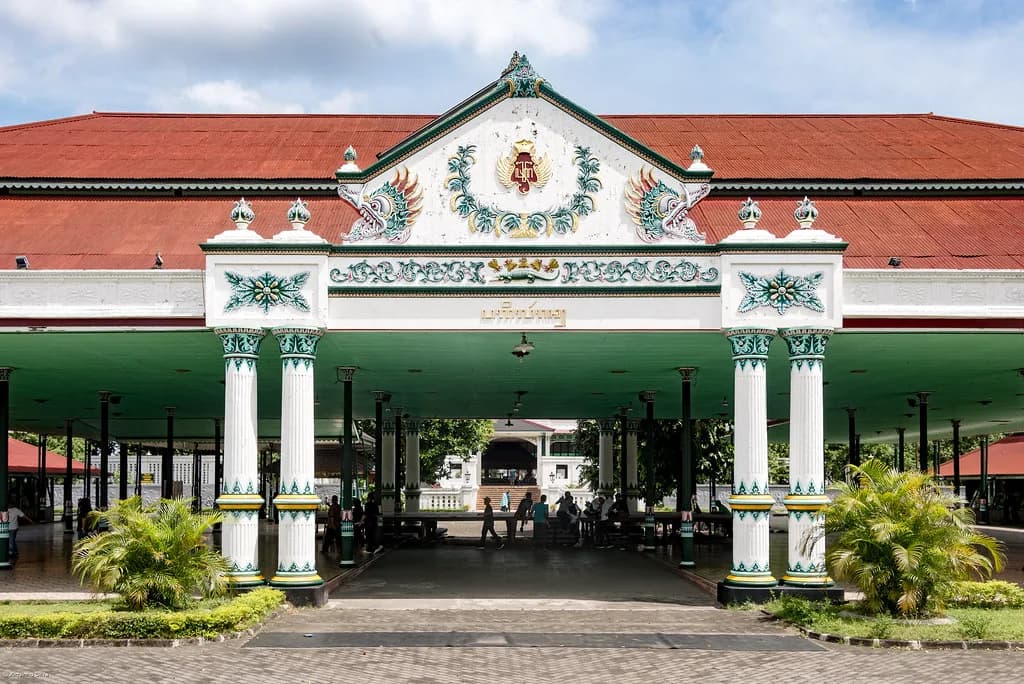
Kraton Yogyakarta: A Practical Guide to the Sultan's Palace
Kraton Yogyakarta deserves roughly two hours, and you should aim to arrive in the morning. The palace, formally Keraton Ngayogyakarta Hadiningrat, is still the Sultan's residence, which means you tour the public parts of a living royal compound rather than a sealed-off historic house. This guide covers where it sits, how to reach the gate, what is inside, how long to allow, and what pairs well with it nearby.
One thing to settle before you go: the palace publishes its own visiting arrangements, and the hours and ticket details circulating on travel blogs are not always current. Treat any figure you read online as a starting point and confirm at the ticket office on the day. The same applies to the performance program, which changes by weekday and occasionally for palace events.
What the Kraton is: a working royal palace, not a museum piece
In Javanese, kraton means royal palace, and this one has anchored the city since 1755, according to published histories. Parts of the complex remain the Sultan's home and the seat of court tradition, so only certain courtyards and pavilions are open to visitors. That split is the key to enjoying it: you are walking through an active institution, and some buildings you can see are not yours to enter.
The architecture blends traditional Javanese forms with Islamic influences, and the layout is arranged around courtyards, pavilions and gardens. Carved wood, batik patterns and symbolic statuary appear throughout, and the complex is aligned with Mount Merapi and the Indian Ocean as a statement of the Sultan's spiritual role. Knowing that symbolism helps: the ornament is not decoration for its own sake, and a guide will point out the pieces you would otherwise walk past.
Photography is allowed in the public areas, and the gates, walls and courtyard greenery are the obvious frames. Keep the camera down where signage restricts it, and do not touch or crowd the museum pieces. If you want softer light and thinner crowds, the early slot after opening is the better bet than midday.
Where it is: Jalan Rotowijayan in the Kraton district
A local guide gives the palace address as Jalan Rotowijayan Block No. 1 in Panembahan, in the Kraton district of Yogyakarta, in the old city. That same write-up notes the ticket office and parking area sit in front of the entrance. Because the palace sits inside a dense neighborhood of lanes, plan your drop-off rather than expecting to glide up to the door.
In front of the palace entrance there is a parking area and a ticket office, and the Museum Wahanarata and the Museum Kereta Keraton sit in the same cluster. If the palace is your only goal, ask to be dropped at the gate directly rather than at the outer parking area. That one instruction saves a walk in the heat.
How to get there: becak, ojek, or a ride-hail drop-off
For most visitors the simplest approach is a ride-hail car or motorbike from Grab or Gojek, with the destination set to the palace gate on Jalan Rotowijayan. Traditional becak and ojek are also part of the local fabric around the Kraton district and work well for short hops from Malioboro. None of these modes is worth quoting a fare for in advance, because pricing shifts with traffic and demand; use the app estimate or agree the price before you get in.
If you are coming from further out, build in slack for Yogyakarta traffic, especially on weekend mornings when the Malioboro area thickens. Drivers can usually pull up close to the entrance, but on busy days you may be waved to the parking area first. Have the Indonesian name, Keraton Ngayogyakarta Hadiningrat, ready to show your driver.
Opening hours and entry ticket: confirm before you go
One local guide lists opening hours of 8:30 AM to 2:30 PM daily and cites a 25,000 rupiah entry fee from a visitor review, but that is a secondary source, not a palace announcement. Treat both numbers as unverified and check them at the ticket office or on the palace's own channels before you build a day around them. Hours can shift for palace events and ceremonies, and the sources here do not document those closures.
The practical consequence is simple: aim to be at the gate in the morning, and leave room in your plan if the palace turns out to close earlier than expected. Have a backup nearby so a change of hours does not cost you the morning. The two adjacent museums are the obvious fallback.
Layout of the complex: courtyards, pavilions, and the museum wing
Expect to move through a sequence of outer courtyards and open pavilions before reaching the more formal interior spaces. The adjoining museum holds exhibits on palace history and court culture, including royal regalia and carriages, which give context to what you saw outside. Budget separate time for it rather than treating it as a corridor on the way out.
Guides from the palace accompany visitors, and their value is in the detail: which pavilion served which function, why a carving carries a particular motif, how the complex's alignment shapes ceremony. If you skip the guide, you will still see beautiful buildings, but much of the meaning stays hidden. Hiring one is the single upgrade worth considering here.
Morning performances: the gamelan, wayang, and dance schedule
Performances are the reason to come early. One tour operator lists Monday as closed, Tuesday for uyon-uyon gamelan, Wednesday for wayang golek puppet theater, Thursday for wayang kulit shadow puppetry, Friday for a poetry reading, and Saturday and Sunday for wayang orang dance theater. That schedule comes from a single non-official source, so confirm the day's program at the ticket office when you arrive.
The gamelan orchestra is the thread running through several of these formats, and the dance and puppet pieces draw on Javanese folklore and the Ramayana. Seating is informal and the performances are short, so you can watch one and still tour the rest of the complex. Arriving after the morning program ends is the most common way visitors miss the best part.
How much time to allow: palace plus museum
Give the palace itself about an hour and the adjoining museum another 30 to 45 minutes, putting a comfortable visit at roughly two hours. If a performance is running, add 20 to 30 minutes to sit through it. Photographers and anyone using a guide will drift toward the longer end.
That makes the Kraton a half-day anchor rather than a full day. Pair it with a short walk or ride to nearby sights instead of trying to stretch the palace visit itself. Going deeper into the complex than the public route allows is not an option, since the residence is not open.
What's nearby: carriage museum, Wahanarata, and Tamansari
The Museum Kereta Keraton, devoted to the court's carriages, and Museum Wahanarata sit right by the entrance, so they are the easiest add-ons and can be folded into the same morning. Both are small enough that an extra half hour each is realistic. Check their individual hours at the gate, since they do not necessarily match the palace's.
Taman Sari, the former royal water garden, is the other natural companion in the same district and rewards a separate short visit. A becak or a ten-minute ride-hail hop connects the two without eating your afternoon. If you have time for one more stop, this is the one that keeps the royal theme intact.
If the court architecture leaves you wanting a temple contrast, the Prambanan temple complex is the other big heritage stop in the region and takes a separate half day, so give it its own slot rather than squeezing it in after the palace. Read the Prambanan Temple Guide before you commit the time.
Practical heads-ups: fake staff at the south gate and respectful behavior
A local source warns about people posing as staff near the south gate, so buy tickets only at the official office and be wary of anyone who intercepts you before you reach it. If someone offers to shortcut the entry process, walk to the counter instead. This is a small precaution that removes most of the annoyance.
Inside, this is a royal residence with court traditions attached, so keep voices low in the pavilions, avoid climbing on structures, and follow signage about where cameras are not welcome. Ask before photographing people rather than assuming. Modest, tidy clothing fits the setting better than beachwear.
Is the Kraton worth a morning of your Yogyakarta trip?
Yes, if you go early and treat it as a two-hour visit with a performance attached rather than a quick photo stop. The combination of a living royal court, a guided walk through the courtyards, and a gamelan or wayang program is hard to replicate elsewhere in the city. Skip it only if you have no interest in Javanese court culture, because the public route is modest in scale.
Build the rest of the morning around what is closest: the carriage museum by the entrance, Taman Sari in the same district, or a slow walk down Malioboro afterward. Confirm hours and ticket prices at the palace ticket office rather than relying on blog figures, and the day will hold together even if something shifts.
Explore more Yogyakarta guides
Frequently Asked Questions
Does Yogyakarta still have a Sultan?
Yes. The Sultan of Yogyakarta remains the palace's occupant, and part of the Kraton complex still functions as the royal residence. That is why visitors see only the public courtyards, pavilions and museum rather than the whole compound.
What does Keraton mean?
Keraton is the Javanese word for royal palace, and the formal name of the Yogyakarta palace is Keraton Ngayogyakarta Hadiningrat. You will see both Kraton and Keraton used in signage and addresses.
Why is Yogyakarta a special region?
Yogyakarta holds special regional status tied to its Sultanate, and the palace remains the symbolic center of that arrangement. For visitors, the practical effect is that the Kraton is an active court, not a heritage site managed purely for tourism.