
Prambanan Temple: A Practical Visitor Guide to Candi Prambanan

Prambanan Temple is worth roughly half a day: plan on two to three hours for the main compound and add about an hour if you walk north to Sewu. It sits on the Yogyakarta–Central Java border, close enough to the city for a morning or an afternoon trip, and it is the largest Hindu temple complex in Indonesia.
This guide sticks to one place. It explains the concentric layout before you arrive, weighs the train against a private driver, splits the time budget between the main platform and the Sewu walk, and points out the carvings and chambers worth slowing down for. It also covers how the Ramayana Ballet reshapes an evening and where to confirm tickets, hours and any temple closures.
What Prambanan Temple is and where it stands
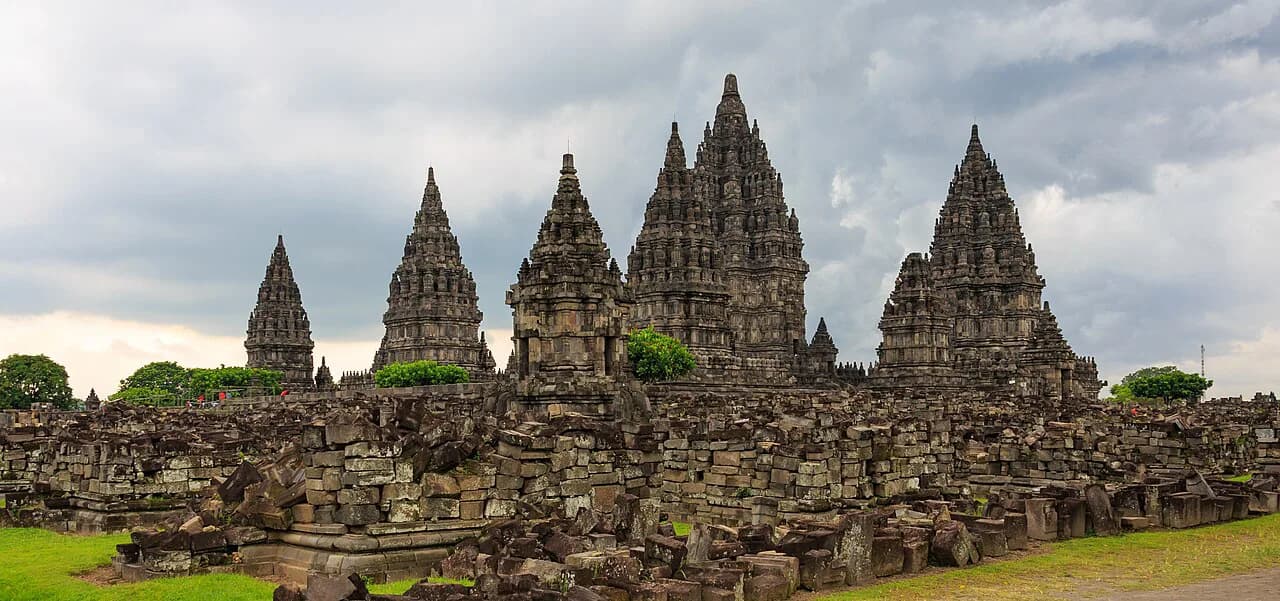
Prambanan is a 9th-century Hindu complex built from about 850 AD during the Mataram Kingdom, and UNESCO lists the Prambanan Temple Compounds as a World Heritage Site. It stands near the border between the Special Region of Yogyakarta and Central Java, which is why day trips run from both sides. The three tallest towers are dedicated to the Trimurti: Shiva, Vishnu and Brahma.
The vertical spires are meant to evoke Mount Meru, the sacred mountain at the center of Hindu cosmology, which is the clearest way to read the site's shape: a tall center rising from flat ground. If you have already seen Borobudur, expect the opposite experience, since Prambanan climbs rather than terraces. The Kraton Ngayogyakarta Hadiningrat in the city covers the later Javanese court story, so the two pair naturally across a trip.
The Shiva temple is the tallest structure, and sources give its height as either 47 meters or 154 feet, so treat those as the same building measured two ways rather than a discrepancy to resolve. Counts of the smaller surrounding shrines vary widely between accounts, listed at 218, 224 and 240 depending on the source, so read any single figure as an approximation. What matters on the ground is the pattern: a few monumental towers ringed by many small ones.
How the compound is laid out
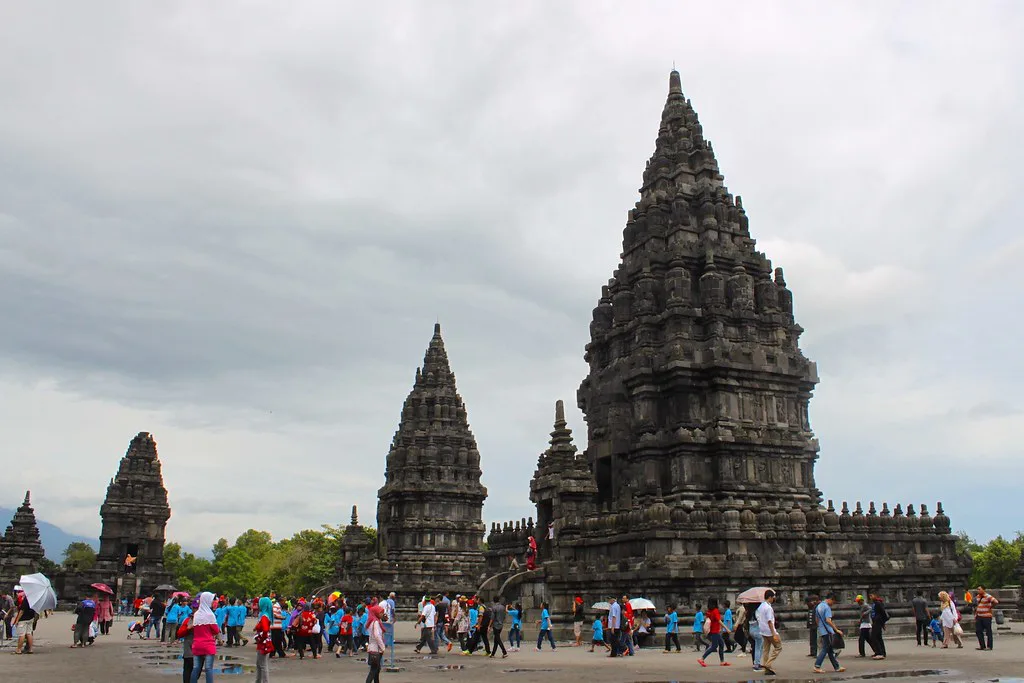
Prambanan is built as concentric platforms, with the most important structures at the center. The inner group holds the three Trimurti temples for Shiva, Vishnu and Brahma, and directly facing each is a slightly smaller temple for that god's vehicle: Nandi the bull for Shiva, Garuda the bird for Vishnu, and Hamsa the goose for Brahma. Garuda also carries weight as a national symbol of Indonesia, which is a useful anchor when you are sorting the six buildings by eye.
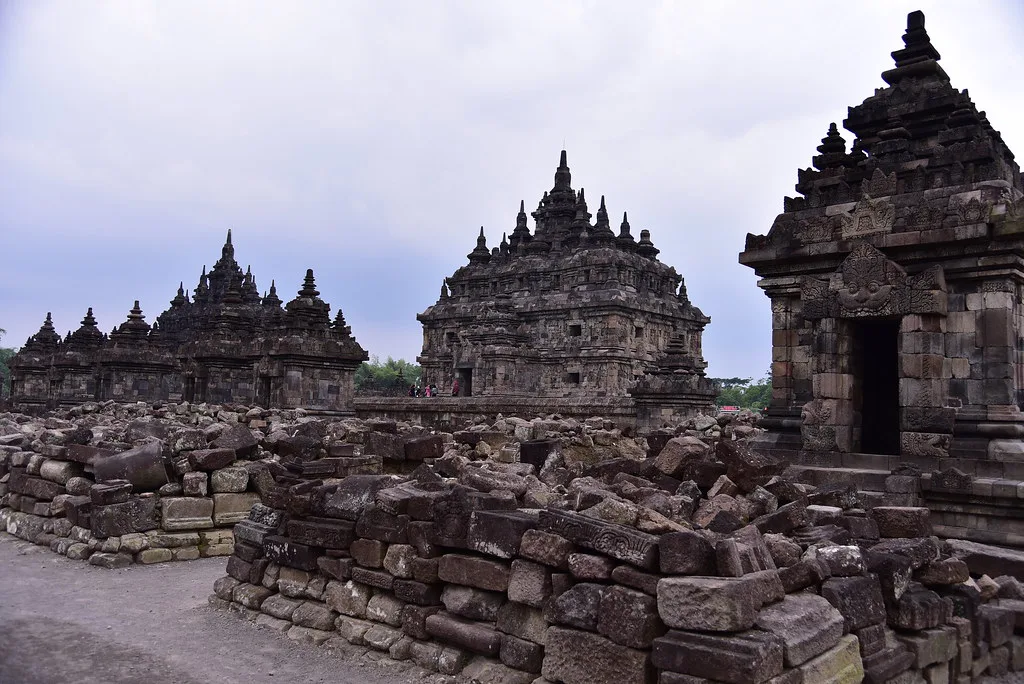
Beyond the central platform, rows of small perwara shrines once encircled the complex, most now reduced to foundations and scattered stone. The reconstruction policy explains what you see: authorities rebuilt only structures with at least 75 percent of their original material available, so many of the little shrines will stay ruined. Walk the outer paths first to register the scale, then step onto the central platform.
The wider compound reaches beyond the ticketed core: accounts describe a temple landscape spreading to roughly a one-mile radius, with outlying structures such as Lumbung and Bubrah that many visitors skip because they are not walkable from the main platform in one easy loop. If you want those, plan transport rather than extra walking. Otherwise, treat the central platform plus Sewu as the practical boundary of a half-day visit.
Getting there from Yogyakarta: train or private car
From the city, the simplest DIY route is the train: board a public train to Prambanan station, then either walk about 20 minutes to the temple or take a short Grab ride. The train removes the traffic variable, but it also strips out flexibility, since you are building your day around departures rather than around how long you actually want at the reliefs. Confirm current departure times at the station or on the operator's site rather than assuming a frequency.
A private car or driver flips that trade-off. You leave from your door, you can reach outlying temples like Lumbung and Bubrah that are impractical on foot, and you can combine Prambanan with stops on the way back into the city. Independent travelers based around Malioboro report using the train successfully, while others book a packaged day tour through a reseller. Both work; pick based on whether you value time control or price control.
Allow for the last stretch on foot. The temple grounds involve a fair amount of walking, and the approach from the station walk adds more, so comfortable shoes matter more than any other planning detail. If you are returning to the city by car in the late afternoon, expect Javanese traffic around the outer roads to eat into your buffer.
How much time to allow on site
Budget two to three hours for the main temples and surrounding compounds; that is the figure first-time visitors consistently cite. The first 30 to 45 minutes usually go to the central platform and a circuit of the six main buildings. The remaining time belongs to the reliefs and the Shiva chamber, which reward slow looking far more than a fast lap.
If you add Sewu Temple, 800 meters north, tack on another 45 to 60 minutes including the walk between the two compounds. Sewu is a Buddhist complex of a central temple surrounded by smaller shrines; it is partly ruined but the shared architectural language with Prambanan makes the comparison worth the legwork. Combine Prambanan with Sewu in one visit rather than treating them as separate trips.
If you also plan the evening Ramayana Ballet, add a meal and a rest to the middle of the day and treat the temple as an afternoon stop rather than a morning sprint. Tickets are sold separately from temple admission, and the organisers publish the performance calendar, so check the official site rather than booking around an assumed nightly show.
What to look at closely
The Ramayana reliefs are the real prize. They run along the walls and walkways of the main temples, telling the epic in carved panels; the inner galleries of the Shiva temple carry the story in sequence, so circling the building in order makes more sense than cutting through. Give yourself at least half an hour to read a stretch of them rather than photographing the first few panels.
Inside the Shiva temple, a staircase leads up to a central chamber with a statue of the deity. It is the most sacred part of the complex but, by most visitors' reckoning, less visually interesting than the exterior carvings, so don't let it crowd out the walls. Take the climb for context, then return to the galleries with the time you have left.
Look for the Lara Jonggrang statue, the "Slender Maiden" of local legend, on the northern side of the Shiva temple. The story says Prince Bandung Bondowoso was asked to build a thousand statues in one night, finished 999, and turned the girl into the final figure when he discovered her trick. Knowing the legend lets you watch guides point it out, though the statue is often the least crowded detail at the site.
When to go: sunrise, daytime or late afternoon
Early morning and late afternoon give you cooler air, softer light and smaller crowds; the site is also known as the sunset temple, which tells you how many visitors time the final hour. Sunset light is flattering on the spires, but the trade-off is that you share that hour with everyone else who read the same advice. Arriving at opening time usually buys you the emptiest version of the central platform.
Midday is the straightforward compromise: it is when tours run and the site is busiest, but the light on the reliefs is readable and you have the most scheduling flexibility if you are combining Prambanan with other stops. If you plan on the ballet in the evening, an afternoon arrival lets the light turn golden without cutting your day short.
Tickets, hours and closures to confirm
Ticket prices, opening hours and any ceremonial closures are not fixed public facts, and they change. The reliable source is the official site at prambanan.id or the on-site ticket desk; check there in the week before you go, and ask about combination tickets if you plan to see Borobudur as well. Do not rely on guidebook prices, which age badly.
The main temples themselves can be temporarily closed for restoration. At least one visitor found the Brahma temple shut for repair while the Shiva and Vishnu temples were open, which is a good reminder that the compound is a working conservation site as well as a monument. Treat the inner platform as a shifting set of access restrictions and adjust your route around whichever buildings are open on the day.
Nearby options around Prambanan
Apart from Sewu, the Prambanan area holds Lumbung and Bubrah, the two smaller temples often mentioned alongside the main compound and usually reached by car or scooter rather than on foot. They suit visitors with their own transport and an extra hour. Back in Yogyakarta, the Kraton and adjacent Taman Sari cover the Javanese court and water palace story, which pairs well with Prambanan if you are working across two days.
For a different half-day in the region, the Gereja Ayam (Chicken Church) near Yogyakarta and the hilltop Tugu Yogyakarta monument are easy add-ons from a private driver, though neither matches Prambanan's historical weight. Use them as filler between temple days, not as substitutes.
The Ramayana Ballet: worth building the day around
The Ramayana Ballet is staged at an outdoor venue near the temple, with the illuminated Prambanan towers as the stage backdrop. It compresses the epic you have been reading in stone into classical Javanese dance, gamelan music and elaborate costumes. That pairing, reliefs in the afternoon and dance in the evening, is what lifts a Prambanan day above a simple monument visit.
Scheduling is the catch. Show dates and times are seasonal and should be confirmed directly with the organisers, so pick a date first and plan the temple visit around the performance rather than the other way. If you only have one full day in the area, an evening show justifies a slower morning and a later temple entry. If your dates cannot be matched, skip the ballet rather than forcing it.
Is Prambanan worth half a day?
Yes. Prambanan delivers a scale and density of carving that few sites in Southeast Asia match, and it fits comfortably into a Yogyakarta itinerary without swallowing an entire day. Plan two to three hours for the core, add an hour if Sewu is part of the plan, and treat the ballet as a separate scheduling decision rather than an assumed evening activity.
Book transport before you go, confirm current hours and prices at prambanan.id or the ticket desk, and check on the day whether any of the main temples are closed for restoration. Everything else, once you are on the platform, you can figure out by walking in circles around the six central buildings.
Explore more Yogyakarta guides
Frequently Asked Questions
Who built Prambanan Temple?
Prambanan is generally attributed to the Mataram Kingdom, built from around 850 AD during a period when a Hindu dynasty replaced a Buddhist one in Central Java. The complex is dedicated to the Trimurti: Shiva, Vishnu and Brahma.
Which is older, Borobudur or Prambanan?
Borobudur is the older of the two, built within roughly a century before Prambanan. Visitors often pair the two across two days, with Prambanan as the later and more vertical counterpart to Borobudur's terraces.
Is there a Vishnu temple in Indonesia?
Yes. The Vishnu temple is one of the three main Trimurti temples inside Prambanan, alongside the Shiva and Brahma temples, with a smaller vahana temple for Garuda facing it.
Can I visit Prambanan and Sewu in one trip?
Yes. Sewu sits 800 meters north of Prambanan, so plan the two together in one visit and allow roughly an extra 45 to 60 minutes for the walk between them and the time at Sewu itself.
Do I need to book Prambanan tickets in advance?
Tickets can usually be bought on arrival or online, but prices and opening hours should be confirmed directly at prambanan.id or the on-site ticket desk before you travel, especially around public holidays.
Sources
- Prambanan Temple - an impossible Hindu structure built in Indonesia 1200 years ago. Hey guys, this is the largest Hindu temple in Indonesia called Prambanan. No, not just this temple with this majestic tower. Not just these 3 temples either. It is these 6 giant temples with 2 minor shrines on the si
- 📍Prambanan Temple, Yogyakarta, Indonesia 🇮🇩 This 9th-century UNESCO World Heritage Site is the largest Hindu temple complex in Indonesia, dedicated to the Trimurti: Shiva, Vishnu, and Brahma. If you’re visiting Yogyakarta, this is an absolute must-see cultural landmark on the island of Java, Indones
- Prambanan Temple Compounds, Indonesia
- Prambanan Temple, Yogyakarta, Indonesia (2026)
- Prambanan Temple Guide: History, Tickets, Ballet & Travel... | HolidaySG