
Taman Sari Yogyakarta: Visiting the Water Castle in the Old City

Taman Sari is worth about an hour of your morning if you want the pools, the gate and the Sumur Gumuling stair, and less if you only want photographs of the archways. It is the surviving fragment of the Keraton Ngayogyakarta Hadiningrat's royal garden and bathing complex, hemmed in by kampung houses about 2 km south of the Kraton itself. This guide covers what the complex is, how to reach it from the Malioboro area, what to look for inside, and how to slot it into a morning with the Kraton or Kota Tua.
What Taman Sari actually is
The Kraton's own account describes Tamansari, meaning beautiful garden, as a garden and pleasure complex built in stages under Sri Sultan Hamengku Buwono I, with construction beginning in 1758 and major parts finished by 1765. The design is credited to the Sultan with technical drawings by a Portuguese figure known as Demang Tegis, and the project was led by Tumenggung Mangundipuro and later Pangeran Notokusumo.
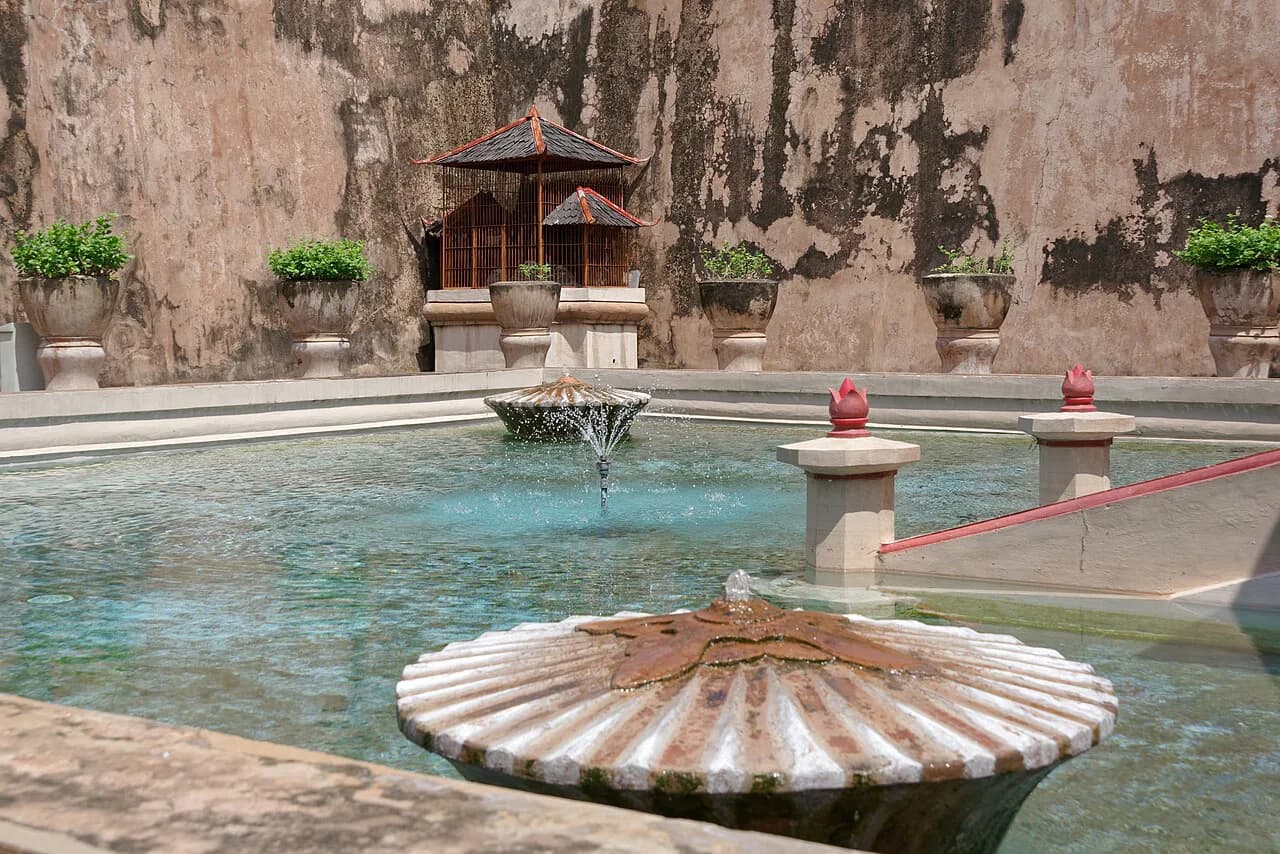
It was never a single building. The same Kraton history counts more than 10 hectares and 57 structures, including halls, bathing pools, suspension bridges, water channels, two artificial lakes, a mosque and underground passages. The pools and surrounding water earned it the nickname Water Castle, while the fragrant trees and flowers planted around the buildings gave it the name Fragrant Garden.
Treat the site as an archaeological remnant rather than a reconstructed palace. Earthquakes in 1867 and again in 2006 caused serious damage, and residents built homes among the ruins and former gardens before serious renovation began in 1977. That history explains the odd layout you walk through today, with waterways threading between houses.
Where it is and why the entrance is on the east
The complex sits roughly 2 km south of the Kraton, inside the old-city kampung near the former western gate of Plengkung Jagabaya. If you are coming from Malioboro, you are crossing the older quarter of the city rather than heading out of town, and Becak and online motorbike taxis handle the last stretch well.
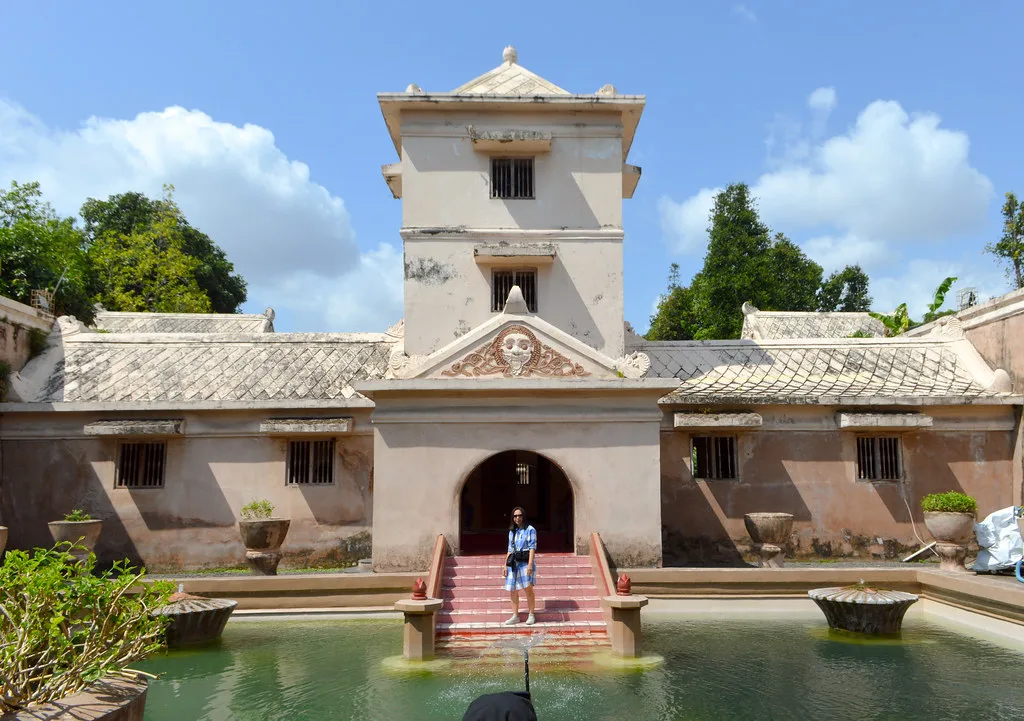
One practical detail trips up first-time visitors: the visitor entrance is now on the east side, using what was originally the rear gate, Gapura Panggung. The garden was designed facing west toward Plengkung Jagabaya, so do not walk to the old frontage expecting a ticket window there.
Roads through this quarter are narrow and shared with pedestrians, becak and parked motorbikes, so allow extra time in the middle of the day and ask your driver to drop you at the east entrance rather than on the nearest main road. Walking from the Kraton is pleasant in the morning but takes longer than the map suggests once you account for the lanes.
What to see inside the walls
Start at Gapura Panggung, the gate that now serves visitors, and note the carved sengkalan chronogram embedded in the archway, which encodes the year in a word puzzle. Inside, the two artificial lakes called Segaran anchor the layout: Pulo Gedhong sits in the eastern lake and Pulo Kenanga in the western one, linked by a canal that cuts through the connecting passages.
The circular Sumur Gumuling, rising from the water, served as a mosque, while Pulo Panembung was used by the Sultan for meditation. Both are among the most photographed spots, and the descent into Sumur Gumuling involves steps that can be slippery after rain, so take them slowly and keep your footing rather than rushing for a photo.
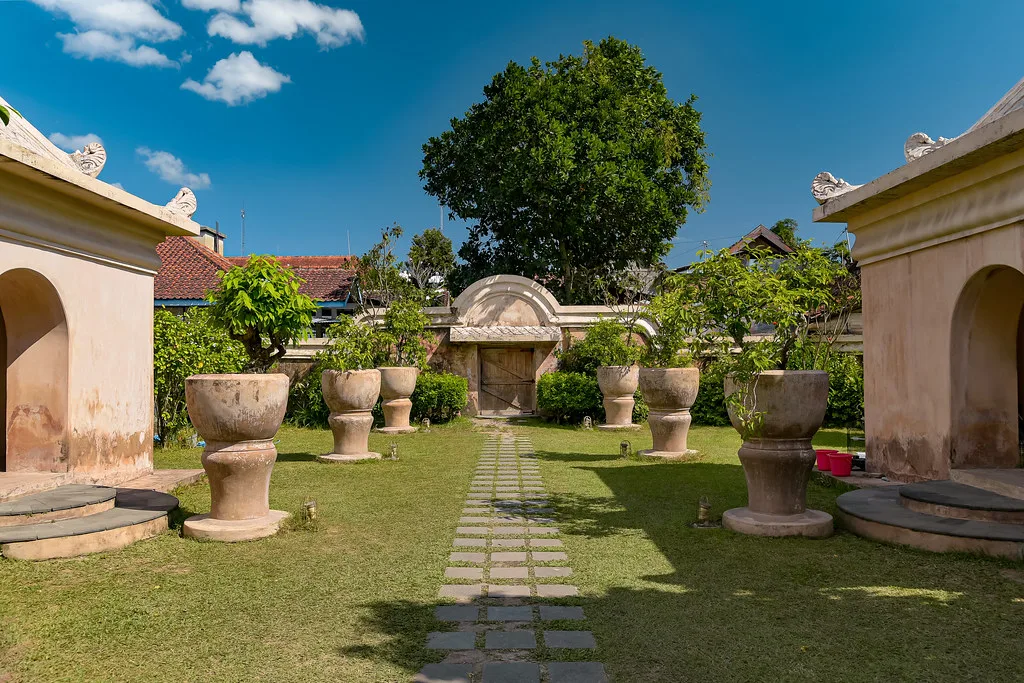
Look also for the urung-urung, the underground passages that once connected parts of the complex, and for the thick perimeter walls, guard posts and bastions that gave the garden a defensive role alongside its recreational and religious ones. Many of these elements are partial, so read them as traces of a larger design rather than complete rooms.
The pools are historic remains and are not for swimming or dipping. The complex is also a lived-in neighborhood, so expect narrow corridors, residents going about their day, and the occasional request from local photographers; if the atmosphere feels crowded, the quieter corners around the canals reward a slower loop.
How much time to allow
Give Taman Sari 45 minutes to an hour and a half, depending on how many of the structures you want to inspect closely. The core route through Gapura Panggung, the Segaran pools and Sumur Gumuling is compact, but the passages and staircases slow you down and the site is spread across more than 10 hectares.
If you are pairing it with the Kraton in the same morning, do Taman Sari second and keep the visit tight: the Kraton needs its own block of time, and the walk or becak ride between them is short but slow in old-city traffic. Adding Kota Tua afterward works only if you start early and skip a long lunch.
Parts of the complex may be closed for conservation work when you visit, so check the condition of specific structures at the ticket window before you commit to a long stay. If a structure you came to see is behind fencing, the surrounding kampung lanes and the Gapura Panggung area still make a short loop worthwhile.
Tickets and opening hours
The Kraton's published history does not list current ticket prices, opening hours or closing days for Taman Sari, and neither does the site's Instagram account, which functions mainly as a photo feed. Check the official Kraton channels and the on-site ticket window for the current entry fee in Indonesian rupiah and the day's hours before you travel.
Hours can shift around public holidays and local events, so treat any figure you see on a blog as a starting point rather than a promise. If you are building a tight schedule, confirm the day before and keep the visit flexible enough to move to another morning.
Nearby sights within walking or becak range
The Kraton Ngayogyakarta Hadiningrat is the natural pairing, since Taman Sari was built as its garden and the two share the same historical thread. Our kraton Yogyakarta guide covers the layout, the pavilions and what to expect from the palace visit, so you can plan them as one morning rather than two separate trips.
Pasar Ngasem, the old bird market, is a short becak ride north and sits on the route back toward Malioboro, making it an easy add-on if you have energy left. For the wider set of sights in the city, our Yogyakarta Attractions: 8 Visitor Guides gives you the full list so you can judge what else fits your day.
If you are weighing a temple trip on another day, Prambanan temple is the usual counterpart to the Kraton and Taman Sari, though it sits well outside the old city and deserves its own half-day. Plan it separately rather than squeezing it into a morning already given to the water castle.
Should you add Taman Sari to your Yogyakarta morning?
Add Taman Sari if you want a compact, atmospheric site that pairs naturally with the Kraton and gives you a sense of how the Sultanate used water, gardens and underground passages. Skip it if your morning is already full or if you expect a restored palace; this is a fragment, and it reads best when you know that going in.
Check the official Kraton channels for current hours and rupiah pricing, then aim to arrive on the east side at Gapura Panggung and give yourself about an hour. From there, the Kraton and Pasar Ngasem are close enough to continue on foot or by becak without a full replan.
Explore more Yogyakarta guides
Frequently Asked Questions
Is Taman Sari the same as the Kraton in Yogyakarta?
No. Taman Sari was the royal garden, bathing and meditation complex of the Kraton, built in the mid-18th century, and it sits about 2 km south of the palace itself. The Kraton is the working palace complex; Taman Sari is the separate water garden site with the Segaran pools and Sumur Gumuling.
How do I get to Taman Sari from Malioboro?
The usual approach is a short becak or online motorbike taxi ride from the Malioboro area into the old-city kampung, with the drop-off at the east entrance at Gapura Panggung. Walking is possible but slower than the distance suggests because the lanes are narrow and shared with traffic.
Do I need to book Taman Sari in advance?
The sources available do not describe an advance booking system for individual visitors, so plan on paying at the ticket window unless the official Kraton channels say otherwise. Check those channels before you go, especially around public holidays when hours can change.