
Jakarta Cathedral: What to See Inside Jakarta's Neo-Gothic Church
Jakarta Cathedral is worth roughly 45 to 60 minutes of your day, and it pairs naturally with the Istiqlal Mosque directly across the road. The Roman Catholic cathedral of the Archdiocese of Jakarta sits on Jalan Katedral in Pasar Baru, Sawah Besar, in Central Jakarta, close to Monas and Pos Bloc. This guide covers where it is, how to reach it, what to look for in the building, how long to allow, and what else fits into the same trip.
What and where Jakarta Cathedral is
Jakarta Cathedral, formally the Cathedral of Our Lady of the Assumption, is the seat of the archbishop of Jakarta and serves a Roman Catholic community that makes up a small share of the capital's population. Its address is Jalan Katedral in Pasar Baru, Sawah Besar, Central Jakarta. If you are working out how the city's sights fit together, the broader collection of Jakarta Attractions: 8 Visitor Guides is a sensible place to start before committing a half day.
The building you see now is the third church on this site. A chapel founded in the early nineteenth century burned down in 1828, its successor collapsed in 1890, and the Neo-Gothic cathedral was built on the same plot. That layered history explains why a European-looking church stands in a district of Dutch colonial warehouses and shophouses.

How to get there
Use Istiqlal Mosque as your landmark: the cathedral faces it across Jalan Katedral, a few minutes' walk from Monas and the Pos Bloc creative hub. Ride-hailing apps such as Grab and Gojek are the simplest way to be dropped at the door, and Bluebird taxis are a reliable metered alternative. Buses on Transjakarta corridors serving the Monas and Pasar Baru area put you within a short walk, but confirm the current corridor and stop with the operator's own map rather than relying on older route lists.
Allow generous slack for the drive. Central Jakarta traffic around Monas, Gambir and Pasar Baru bunches up through the working day and worsens in the late afternoon, so a trip that looks short on the map can take considerably longer. Morning arrivals tend to be calmer, and building the cathedral and mosque into one stop saves a second journey through the same congestion.

The exterior: two towers that were never meant to match
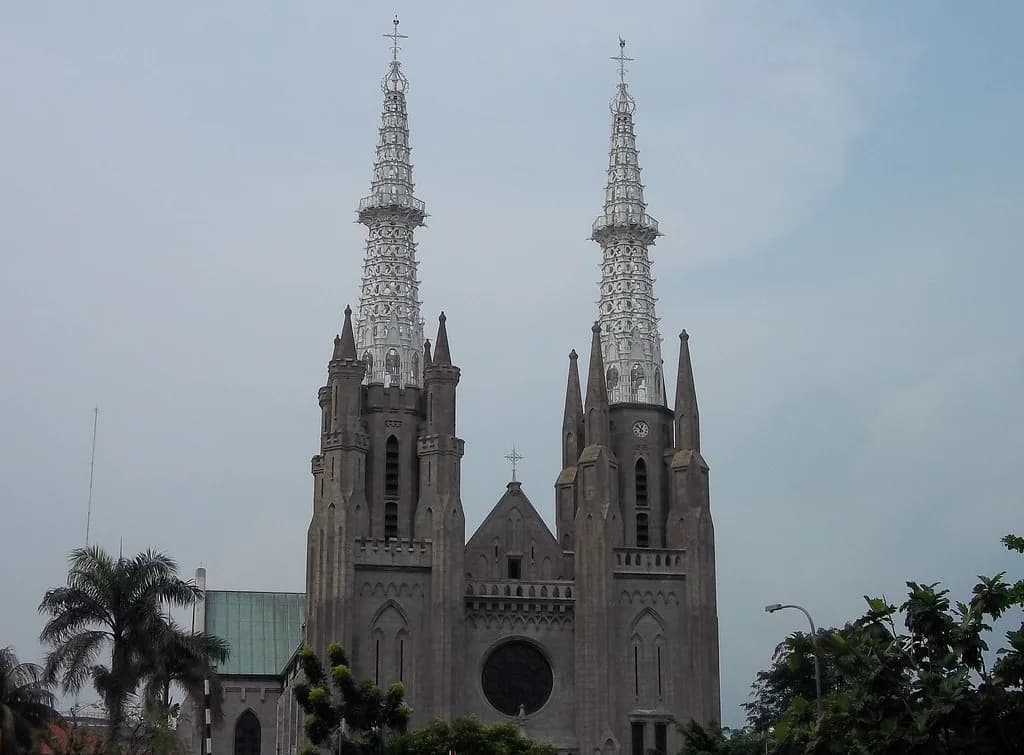
The frontage is deliberately asymmetrical. A central tower stands between two flanking towers of different design, and each has its own reading: the left tower, the Fort of David, is understood as the strength of a king protecting his people, while the right, the Ivory Tower, refers to the purity of the Virgin Mary. Look up before you go in, because most visitors photograph the facade and miss that the two sides differ.
The structure is less European than it looks. Although the cathedral reads as stone, the main body is locally made brick wrapped around an earthquake-resistant steel frame, with Indonesian teak used for the ribbed vault ceiling and roof beams instead of masonry, and steel for the tall wrought-iron spires. That choice of materials is what allows a Neo-Gothic church to stand through tremors in the tropics.
Inside the nave: teak, stained glass, and the altarpiece
Step in and the first thing to notice is the ceiling: ribbed teak vaulting, unusual for a Neo-Gothic interior, which lightens the roof and warms the space. The stained glass follows repetitive floral patterns rather than the scenes of Christ and the saints typical of European cathedrals, so the windows read as pattern and color rather than narrative.
Flanking the altar on columns are sculptures of St Ignatius of Loyola and St Francis Xavier, founders of the Society of Jesus, signalling the cathedral's Jesuit affiliation. Along the walls, the Stations of the Cross are depicted with a gold-coated halo on Christ in each panel. Give the side aisles ten minutes on their own; they reward slow looking more than the central aisle does.
The Indonesian details most visitors walk past
Find the statue of the Virgin Mary dressed in batik, with the Garuda Pancasila national emblem on her chest and two shadow puppets on her robe representing wisdom and prosperity. It is the clearest statement in the building that this is an Indonesian Catholic church, not a transplanted European one. If you see only one interior detail, make it this.
The on-site museum: worth adding?
A small museum on the cathedral grounds preserves religious relics, including a staff associated with Pope Paul VI, a chalice and chasuble connected to Pope John Paul II, and hats and robes worn by priests and cardinals in the colonial era. It suits anyone interested in the church's history rather than in architecture alone.
Access is not guaranteed on every visit and can shift around services and parish activity, so ask at the cathedral reception when you arrive or contact the parish before your trip. If museum access is your priority, phone ahead rather than turning up and hoping. Treat the museum as a bonus rather than the core of the visit.
How much time to allow, and what to trim
For most travelers, 45 to 60 minutes covers the exterior, the nave, the side aisles and a quick look at the museum if it is open. Add 30 to 45 minutes for Istiqlal Mosque next door, which is the more time-consuming of the two because of its scale and the separate visitor arrangements.
If you are short on time, skip the museum and concentrate on the two towers outside, the teak ceiling, the floral windows and the batik-dressed Mary. Those four details carry the story; the rest is atmosphere. Anyone who wants a deeper collection of colonial-era objects should save that appetite for the National Museum of Indonesia in Jakarta, which holds far more than a parish museum can.
Hours, entry, and service timing
There is no reliable published entry fee for the cathedral, so do not budget for a ticket in advance; confirm at the door or through the parish office whether any charge applies on the day of your visit, particularly for the museum. General visiting hours listed on third-party travel sites cluster around the daytime, but these aggregator listings are not authoritative and should not be treated as the cathedral's own schedule.
Masses and ceremonies take priority over sightseeing, and the cathedral does not publish a schedule that outside sources agree on, so check the parish's own channels or call before a long trip across the city. Contact details and directions are published on the parish website and standard listing pages. Plan your arrival outside service times unless you intend to attend one.
Nearby: Istiqlal Mosque and the Tunnel of Friendship
Across Jalan Katedral stands Istiqlal Mosque, Indonesia's largest Muslim house of worship, inaugurated nearly eight decades after the cathedral. Its placement was a deliberate statement of religious tolerance, and the two communities share practical courtesies: churchgoers may use the mosque's parking, and Muslims attending prayers may use the cathedral's. The two stops belong in one visit, not two.
An underground passage called the Tunnel of Friendship, built in 2021, physically connects the two houses of worship. Walking between them through the tunnel rather than along the road is the compact way to see both. Monas and Pos Bloc Jakarta are each a short ride away if you have an afternoon to fill.
If your Jakarta days are limited, weigh this pair against the bigger set-piece sights: Taman Mini Indonesia indah in East Jakarta covers a full half day on its own because of its size and spread-out layout. The cathedral and mosque need far less time but deliver more concentrated architecture and history. Read the wider Jakarta Attractions guide before locking in an order.
Is Jakarta Cathedral worth the detour?
Yes, if you are already in Central Jakarta or want a compact stop that tells you something about how the capital's faiths sit side by side. Pair the cathedral with Istiqlal Mosque, walk the Tunnel of Friendship if it is open, and budget under two hours for both.
Go in the morning, ride-share to Jalan Katedral to avoid parking around Pasar Baru, and check service times, entry arrangements and museum access with the parish before you set out. That is enough preparation; the building does the rest.
Explore more Jakarta guides
Frequently Asked Questions
Who built the Jakarta Cathedral?
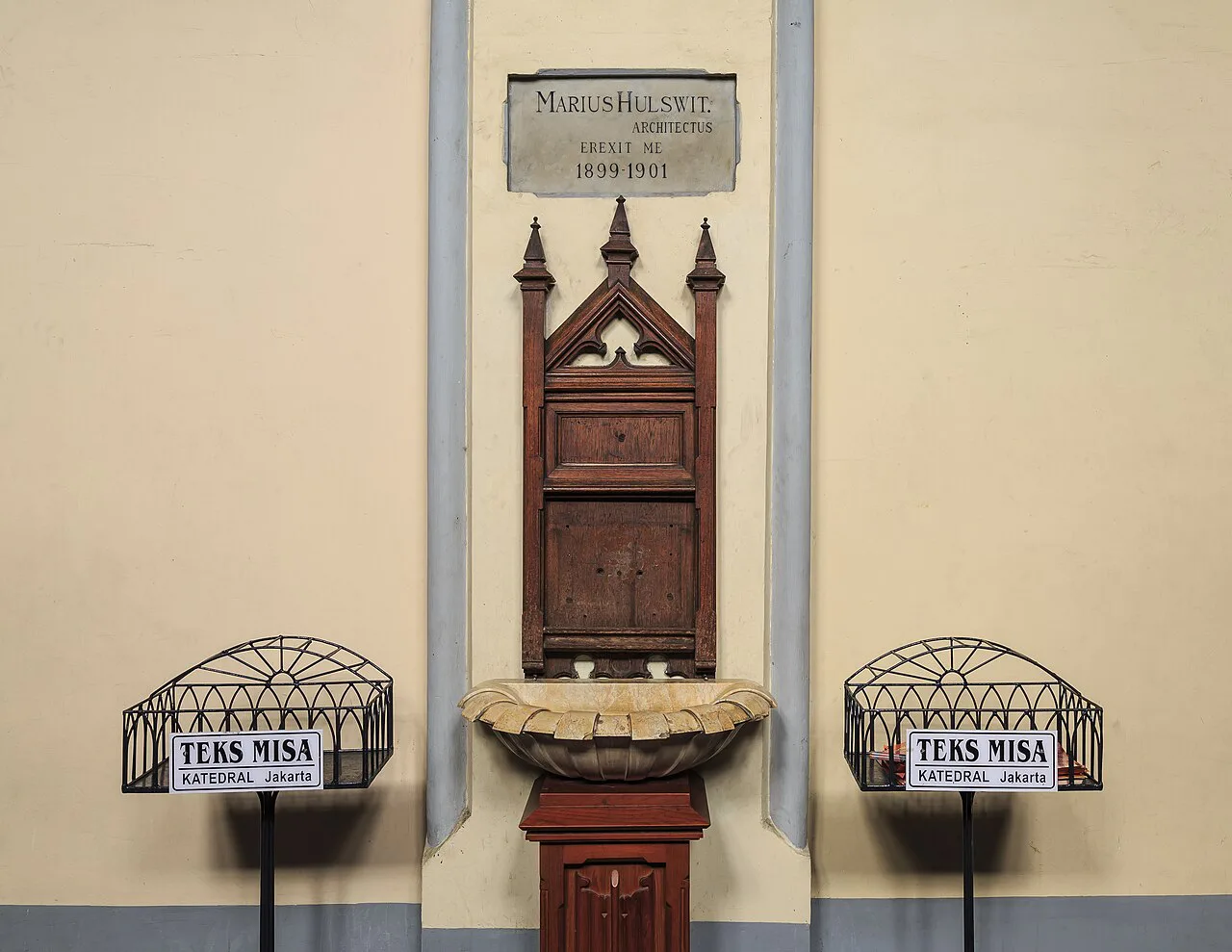
The present Neo-Gothic cathedral replaced two earlier churches on the site: a chapel that burned in 1828 and a Neoclassical church that collapsed in 1890. The design is credited to Dutch Jesuit priest and architect Antonius Dijkmans, whose plan departed from the Neoclassical style then common in Batavia. The cathedral remains the seat of the Archbishop of Jakarta.
Is Catholicism popular in Indonesia?
Roman Catholics are a small minority in Jakarta, which the cathedral serves as the archdiocesan seat, and Christianity overall is a minority faith nationally. Indonesia officially recognises several religions, and the cathedral's placement opposite Istiqlal Mosque is often cited as a symbol of that coexistence.
What is the famous thing of Jakarta?
Monas, the national monument, is the emblem most associated with Jakarta, and it sits within a short ride of the cathedral. Nearby, Pos Bloc Jakarta, a Dutch colonial building turned creative hub, and the Istiqlal Mosque are the sights most naturally combined with a cathedral visit.
What is the biggest cathedral in the world?
That question points outside Indonesia, so check a reference work for the current answer rather than relying on a travel guide. If you are comparing Jakarta's cathedral, note that sources describe it only as the biggest Roman Catholic church in Jakarta, not as a national or regional record-holder.