
Kota Tua Jakarta: A Practical Guide to Old Batavia

Kota Tua Jakarta is the old Batavia district centered on Fatahillah Square in Pinangsia, West Jakarta, and it needs roughly two hours for a fast lap of the cobblestoned core, with museum visits added on top. This guide covers where the district sits, how to reach it, what to see around the square and the museum cluster, the walk west along Kali Besar, and how much time to budget.
What Kota Tua actually is
Kota Tua is the surviving core of Batavia, the colonial port town the Dutch built after taking Jayakarta in 1619. The heritage area sits in Pinangsia in Taman Sari, West Jakarta, and its edges reach Roa Malaka in Tambora and Penjaringan in North Jakarta. What you walk through is a district of 17th- to early 20th-century buildings, not a single museum or a walled site.
Expect two versions of the district side by side. Fatahillah Square and its immediate ring have been tidied and restored, with cafés, galleries and boutiques moving into old merchant houses and warehouses, while blocks a street or two away still show unrestored façades. Judged by the square alone, Kota Tua looks finished; judged by the backstreets, it is a long renovation in progress.

Where it sits and how to arrive
The district's anchor for transit is Stasiun Jakarta Kota, the terminus station at the northern edge of the old town. From the station exit it is a short walk to Fatahillah Square. KRL Commuter Line trains, TransJakarta buses and the MRT, with a connecting ride at the end, all feed into the area.
Leave the station on foot and you will meet a rank of green-jacketed ojek drivers before you reach the square, which is handy if you are carrying bags or arriving in the heat. Ride-hailing apps work here too, though drop-offs close to the square can be slow when the plaza is busy. The city's other headline sights are covered in the guides collected under Jakarta.

How the district is laid out
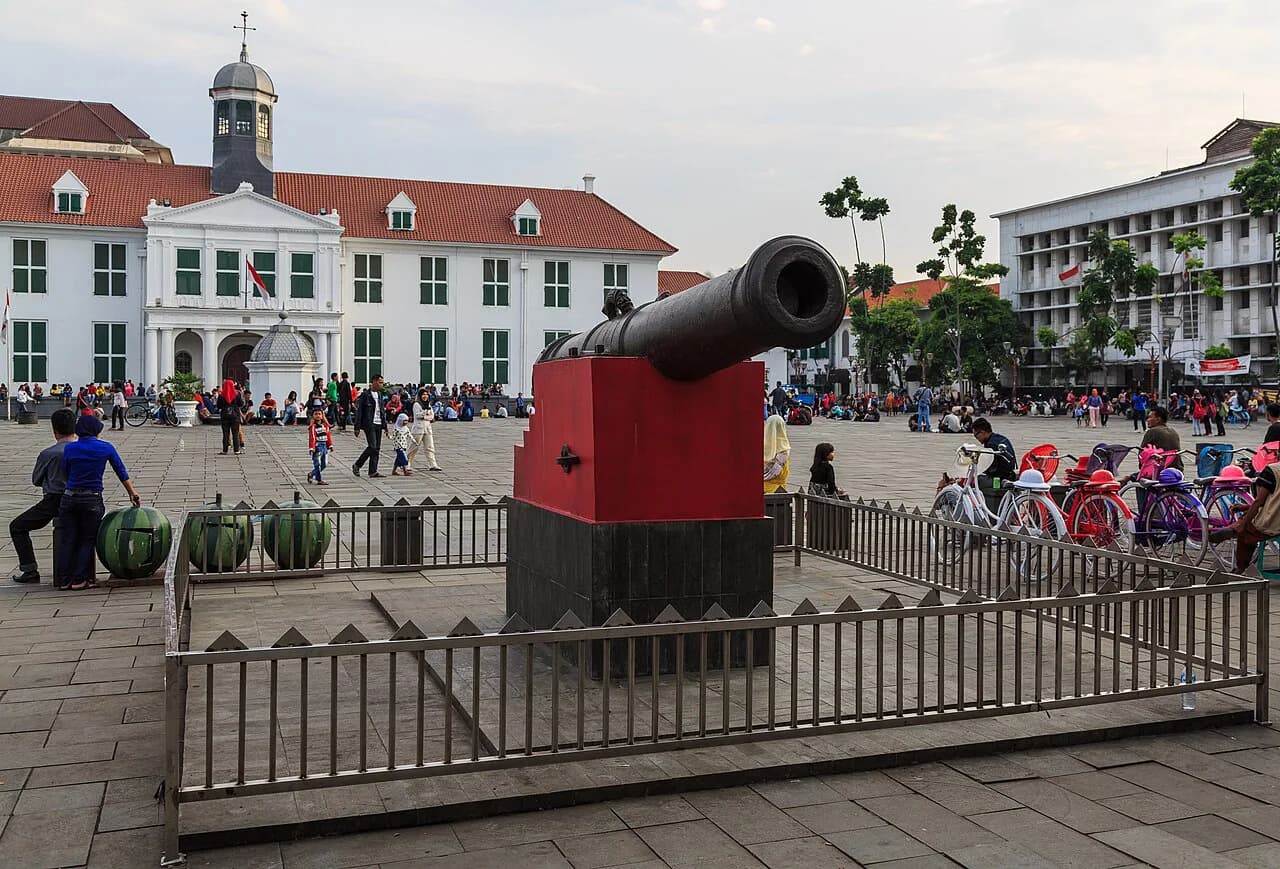
Taman Fatahillah, the old Stadhuisplein, is the center of gravity: a broad open plaza with the former city hall on its south side and the puppet museum next door. The district then runs west and north along the Kali Besar canal and its side streets, where the merchant warehouses and banks stood. Treat the square as your orientation point and the canal as your second loop.
The layout is compact enough to walk in one pass, which is why a mapped heritage route can stitch the main sights together. One published walk covers 26 stops across about 2.5 km and 6,000 steps in a two-hour loop, taking in the square, the museums, Kali Besar, Toko Merah, Gereja Sion and Stasiun Kota. Use that as a template rather than a fixed script.
What to see on and around Fatahillah Square
The former Stadhuis dominates the south side of the square. Built in the early 18th century as Batavia's city hall, it now holds the Museum Sejarah Jakarta, with collections covering the city from prehistory through Sunda Kelapa and Jayakarta to Batavia and independence, plus the old council chamber and a colonial-era underground prison. It is the single best stop for making sense of everything else you see.
Next door, the Wayang Museum occupies a former Dutch church first built in 1640 and displays thousands of puppets, from Javanese wayang kulit shadow figures to dolls from other countries. The building alone justifies the stop even if you skip the galleries, and our guide to the wayang museum Jakarta covers what is inside.
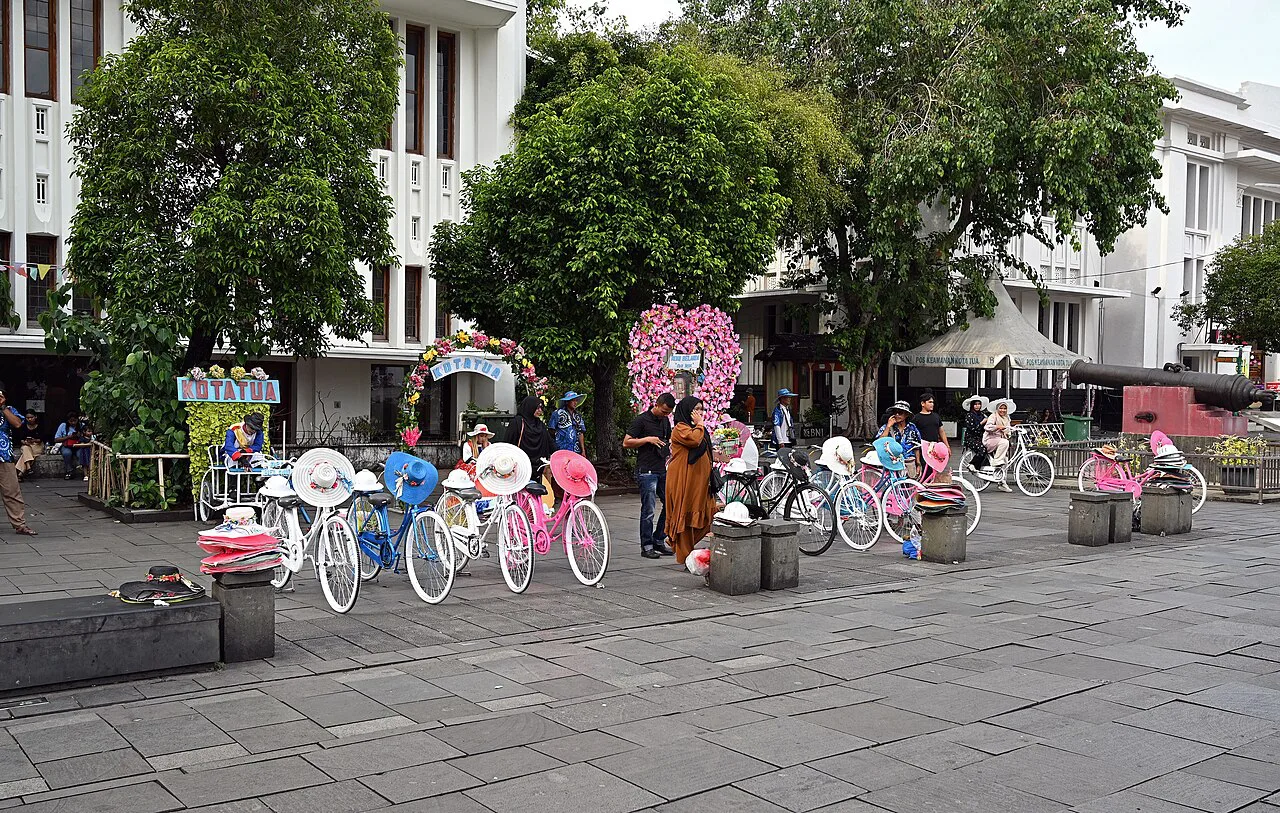
The plaza itself is free to enter and functions as the district's living room: families, school groups, vintage bicycles rented out with oversized sun hats, and food vendors selling kerak telor, the Betawi rice omelette, especially in the evening. It is also the hottest, least shaded part of the district, so many visitors do the square early and save the museum interiors for midday.
The museum cluster worth your time
Around the square and just beyond it, the museums split cleanly by theme, which makes choosing easier than trying to see them all. The Museum Seni Rupa dan Keramik, in the 19th-century former Raad van Justitie building, covers Indonesian painting and ceramics. The Museum Bank Indonesia traces the country's currency from royal coins through company scrip to modern rupiah, and the Museum Bank Mandiri, in the old Factorij Batavia trading post, shows antique safes and banking equipment in a preserved interior.
For a first visit, pick two: the history museum for context plus either the puppet museum or one banking museum. The banking museums are small and quick, so they suit a tight schedule; the fine art and ceramics museum rewards anyone interested in Indonesian painting. Decide before you arrive rather than drifting from ticket desk to ticket desk.
Beyond the square: Kali Besar and the walk north
Walk west from the square and you reach Kali Besar, the canal that once carried spice cargo to Batavia's warehouses, lined with old merchant houses and bank buildings that are steadily being renovated. The quieter stretch along the water contrasts with the crowded plaza, and the light late in the afternoon is why many photographers linger here.
Two structures anchor the northern end. Kota Intan Bridge, a drawbridge dating to the 1620s, was built so ships could pass through the canal, and Toko Merah, a red-painted merchant house from 1730, is among the oldest surviving buildings in the city. Continue north along Jalan Tongkol, a street of workshops and tent makers, and you reach Sunda Kelapa, the old harbor where pinisi sailing ships still moor.
Treat this extension as a separate leg with its own time cost rather than part of the square. The harbor stretch alone is a solid walk each way from Fatahillah, with little shade on the route. If you only have two hours, stay with the core; if you have a half day, add Kali Besar and decide at Kota Intan whether the harbor is worth the extra distance.
A realistic time budget
For the core, plan on about two hours and roughly 2.5 km of walking on a self-guided loop of the square and canal area. That covers the outside of the main buildings, a circuit of the plaza and a look along Kali Besar, without going inside anything. Add 45 to 60 minutes per museum, and expect a half day if you choose two.
Morning is the better window for the plaza, before the heat builds and the open square fills, while late afternoon brings the vendors and street performers out. If your schedule allows only one block, choose the morning and use the air-conditioned museums as your midday break. Evening visits work for atmosphere but leave less time inside the collections.
Tickets and opening hours
Reported hours for the Museum Sejarah Jakarta are Tuesday to Friday from 9 a.m. to 3 p.m. and weekends from 9 a.m. to 8 p.m., closed Mondays, with the published ticket at Rp15,000 for Indonesian adults, Rp5,000 for Indonesian students, and Rp50,000 for foreign visitors. The Wayang Museum is listed as Tuesday to Thursday 9 a.m. to 3 p.m., Friday until 3.30 p.m., weekends until 8 p.m., closed Mondays, at Rp10,000 on weekdays and Rp15,000 on weekends. Verify these figures before you travel.
Other sources give different numbers, including a district-wide opening window of roughly 8 a.m. to 9 p.m. for the outdoor area, so treat any single figure as a starting point rather than a guarantee. The consistency that does hold is the Monday closure of the museums, the one fact worth planning around. Check the individual museum's own listing for the day you intend to visit.
Café Batavia and food stops in the district
Café Batavia, in the north-west corner of Fatahillah Square, is the district's best-known sit-down address, occupying a colonial building with a period interior and a view over the plaza. It is a splurge rather than a budget meal, so treat it as a rest stop and confirm the menu prices when you sit down. It is also the obvious place to wait out a rain shower.
Cheaper options cluster around the square and the side streets, including street stalls selling kerak telor in the evenings and cafés that have moved into the renovated warehouses. The mapped heritage walk also flags drink and eat stops such as Acaraki Jamu and the café at MULA Kota Tua, useful markers when you need a break. Check hours on the day rather than planning around them.
Practical trade-offs
The biggest planning decision is the day of the week: on Mondays the museums close, and a Monday arrival leaves you with the square, the cafés and the streets but no collections. Friday is shorter than the weekend, with several museums closing mid-afternoon. If the museums are the reason you are coming, aim for Tuesday through Thursday or a weekend.
The second is where you walk. The renovated ring around Fatahillah Square is comfortable and photogenic, but step one block back and you find unrestored buildings and open lots, and the contrast grows the further you go from the plaza. That is not a reason to skip the area, just a reason to know what you are looking at.
Nearby options to pair with Kota Tua
Glodok, Jakarta's Chinatown, sits immediately south and east of the old town and is the easiest add-on: walkable from the district, dense with markets and temples, and a completely different street scene. Sunda Kelapa harbor, north along Jalan Tongkol, pairs naturally with the canal walk if you have the legs for it.
If you want a second heritage museum on a different day, the national museum Jakarta in Central Jakarta pairs well with a Monas Jakarta stop around Merdeka Square. For a family-oriented, outdoor alternative across town, Taman Mini Indonesia indah in East Jakarta on Jl Raya Taman Mini compresses the archipelago into one park. Neither is walkable from Kota Tua, so plan transport separately.
Should you give Kota Tua a morning or a full day?
Give Kota Tua a morning if you want the square, the streets and one museum; give it a full day only if you plan to enter two or three collections and walk the Kali Besar and Sunda Kelapa extension. The core loop is short, and the district rewards a slower pace more than a longer checklist.
Before you lock a date, confirm museum hours and ticket rates for the specific day you plan to visit, since published numbers differ between sources and weekday hours are shorter than weekend ones. Then build the day around the square early and the air-conditioned galleries at midday.
Explore more Jakarta guides
Frequently Asked Questions
Is Kota Tua Jakarta open 24 hours?
The outdoor district around Fatahillah Square is generally accessible through most of the day, and one source describes the tourist area as open daily from roughly 8 a.m. to 9 p.m., but that is not a guarantee for individual buildings. Each museum keeps its own schedule, with Monday closures widely reported. Check the museum you want to enter for the day of your visit.
Do you need a ticket to enter Kota Tua?
No ticket is needed to walk the streets, cross Fatahillah Square or stroll along Kali Besar. Tickets apply only to individual museums, and rates differ for Indonesian and foreign visitors, so confirm the current charge at the museum desk or its official listing before you commit.
How long does Kota Tua take to see?
About two hours covers the core on foot, roughly 2.5 km across the square and the canal area. Each museum you enter adds around 45 to 60 minutes, so a half day is realistic if you want two collections plus the walk to Kali Besar.
Which day should you avoid in Kota Tua?
Monday, when the museums are reported closed. Friday is also shorter, with several museums shutting in the afternoon, so aim for Tuesday through Thursday or the weekend if the collections matter to your trip.