
Gereja Kelahiran Santa Perawan Maria in Surabaya: What to See and How Long to Stay

Gereja Kelahiran Santa Perawan Maria is a short stop, not a half-day: most visitors need 20 to 40 minutes for the red-brick exterior, the twin towers and, if the doors are open, a quiet look at the nave. It stands at Jalan Kepanjen No. 4-6 in Kelurahan Krembangan, in Surabaya's old north quarter, and is described as the city's oldest Catholic church, founded in 1811.
This guide covers where the church is, how to reach it by Grab, Gojek or a Bluebird taxi, what is visible outside versus inside, and how the stop fits into a walk through Kota Lama. It also explains the building's colonial-era dates so you do not confuse the current address with the church's earlier site near today's Jalan Cendrawasih.
What and where Gereja Kelahiran Santa Perawan Maria is
This is an active Catholic parish church, locally known as Gereja Kepanjen because of its street, rather than a museum or monument. Its address is Jalan Kepanjen No. 4-6, Kelurahan Krembangan Selatan, Kecamatan Krembangan, a stretch of the old north city that was once called Tempelstraat.
The site sits behind SMA Katolik Frateran and close to Kantor Pos Besar Surabaya, the main post office, which makes it easy to slot into a walking route. That position is the practical reason to visit: it is one stop among several old buildings, not a destination that justifies a cross-city trip on its own.
One point of confusion is worth clearing up early. The parish's history begins in 1811, but the current building on Jalan Kepanjen dates from around 1900, after the congregation moved from its first site near today's Jalan Cendrawasih in the old-town area.
Why travelers stop here: a red-brick facade and twin towers
The draw is architectural: unplastered red brick, a European-style front gable topped with a cross, and two cone-shaped pillars flanking the entrance. The twin towers that give the silhouette its shape were rebuilt in the 1990s, so what you see is a mix of colonial fabric and later restoration rather than a single untouched original.
Photographers get the most from the facade in soft morning or late-afternoon light, when the brick reads warm rather than flat. The street itself is a working north-Surabaya road, so frame the shot from the church side and keep an eye on passing motorbikes rather than stepping into the lane.
How to get there from the rest of Surabaya
Ride-hailing is the simplest option: set your Grab or Gojek pin to Jalan Kepanjen and confirm the driver has the Krembangan address, since the name Kepanjen also appears elsewhere in East Java. A Bluebird taxi works the same way if you prefer a metered car; agree on the destination before setting off.
Driving in from south Surabaya, allow generous time for north-city traffic, which builds through the working day. Many travelers combine the church with the old-town sights around the Kalimas river, where the streets are narrow and better covered on foot once you have parked or been dropped off.
If you are using public transport, the church is a short ride-hailing hop from the nearest stops rather than a door-to-door train or bus drop. Check live routes in the Grab or Gojek app on the day, because Surabaya's angkot and bus corridors change and are not reliably documented for visitors.
What to see outside: brick, gable and towers
Start on the pavement and read the front elevation: the triangular gable with its cross, the two conical pillars, and the dark red brick walls built without plaster. The church measures roughly 47.6 meters along the interior axis and 30.7 meters across, which explains why the facade feels broad rather than tall from the street.
Look up at the towers, each about 15 meters high, and note that they are a late-1990s reconstruction after decades without them. That detail matters if you are comparing the church with other colonial buildings in the city: parts of what stands today are restorations, including work after the damage of November 1945.
What to see inside, if the doors are open
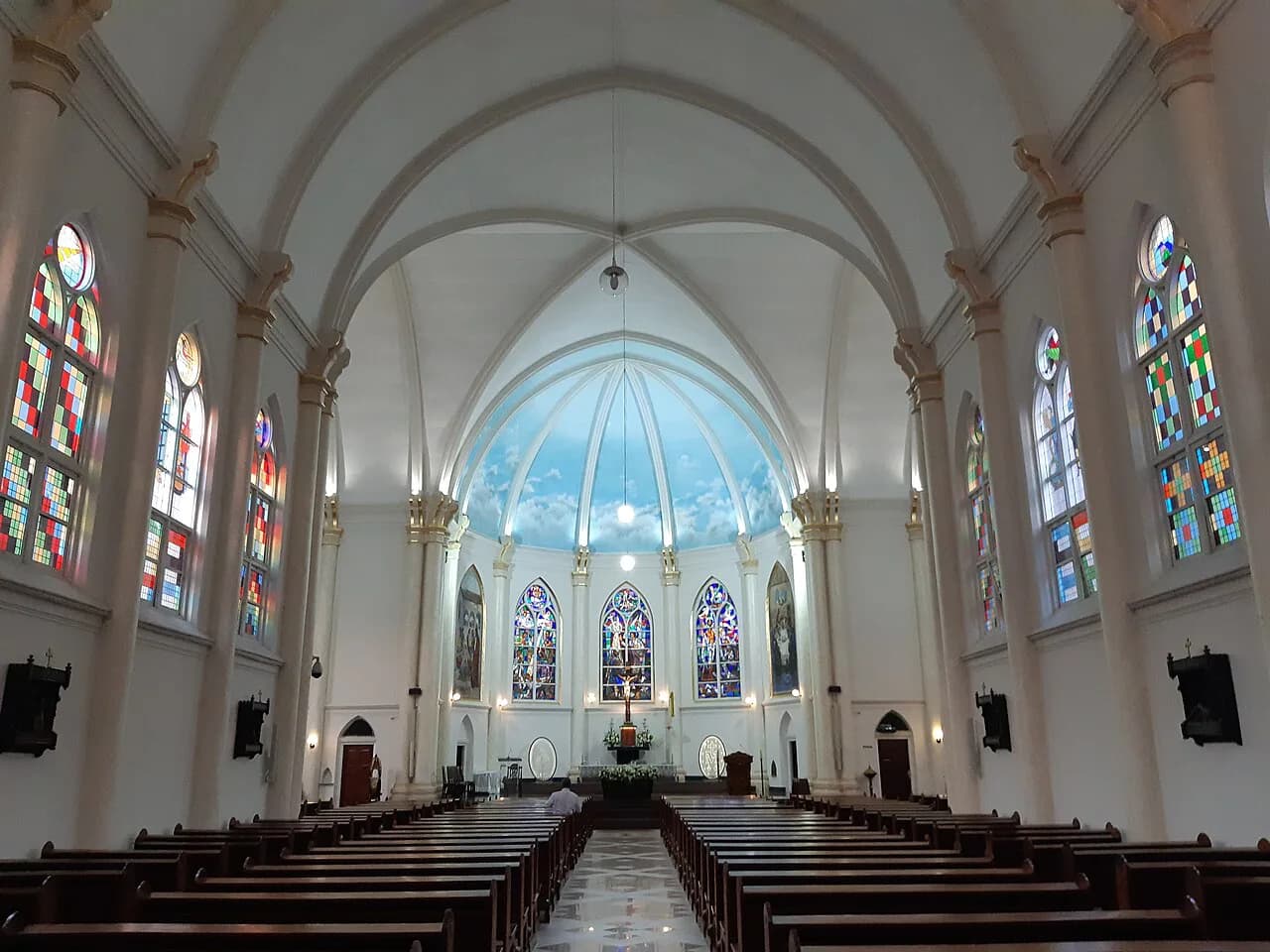
The interior is the reward for timing your visit around parish activity: a long nave, mosaic windows depicting scenes from the life of Christ, and the scale of a colonial-era hall. The windows were reworked in 1960 with glass created by the artist Jacques Verheyen, so the light in the nave is part of the building's story.
Access for casual visitors is not published in any source here, so treat the interior as a maybe rather than a guarantee. Check with the parish office or the Keuskupan Surabaya for current Mass times and whether you can step in between services; if the doors are shut, the exterior alone still justifies the stop.
If you do go in, keep the visit short and quiet, and avoid wandering during a service. Photography inside is a judgment call that depends on what the parish allows on the day, so ask rather than assume.
The colonial story in the building's dates
Two Dutch priests, Hendricus Waanders and Phillipus Wedding, arrived in Surabaya in 1810, and Waanders stayed to lead the Catholic mission here. The first church building went up in the 1820s near what is now Jalan Cendrawasih and Jalan Merak, and it was later dismantled when the city planned a road through the area.
The congregation bought land on Tempelstraat, today's Jalan Kepanjen, in 1889, and the present church was blessed in 1900 under the name Onze Lieve Vrouw Geboorte Kerk. Accounts of the foundation piles differ on the exact count, so treat any specific number you hear as parish lore rather than a fixed fact.
Later renovations in 1950, 1960 and the 1990s layered repairs onto the original structure, which is why the church reads as a working building rather than a preserved museum piece. Keep that in mind when you compare it with the city's older civic architecture.
How long to allow, and when to pair it with the old town
Budget 20 to 40 minutes: enough for the facade, a walk around the outside and a brief look inside if you can get in. There is no garden or interpretive center to stretch the visit, and no reason to build a morning around the church alone.
The better plan is to fold it into a half-day in Surabaya Utara, taking in the old-town streets and the waterfront area near the Kalimas river in the same outing. Do that and the church becomes a pleasant pause; do it as a standalone trip and you will spend more time in traffic than at the site.
Nearby: the post office and the old-town streets
Kantor Pos Besar Surabaya is a few minutes' walk away and pairs naturally with the church for anyone interested in the city's colonial-era civic buildings. The streets around Jalan Cendrawasih, the church's first site, lie within the same old-town area and reward a slow wander on foot.
For the full set of stops across the city, from the old port quarter to the monuments in the center, see this collection of Surabaya Attractions: 15 Visitor Guides. If your interests run to modern history instead, Tugu Pahlawan in Surabaya and its surrounding memorial park make a natural second stop on another day.
Practical check: Mass times and visitor access
Opening hours, Mass times and any visitor rules are not published in a form you can rely on from a general search, so confirm them with the parish or the Keuskupan Surabaya before you go. A quick phone call or message the day before saves a wasted trip across town.
Sunday mornings are busy with services, which means the building is open but the nave may be in use; weekday daytime is likelier to allow a quiet look, though that is a pattern rather than a published guarantee. Plan around the parish's schedule, not the other way round.
Is the church worth the detour?
Yes, if you are already spending time in Surabaya's old north quarter, and no if it means a separate cross-city trip. The red-brick facade, the twin towers and the mosaic-lit nave make a compact, worthwhile stop of under an hour when folded into a Kota Lama walk.
Check Mass times and visitor access with the parish before setting out, pin the Jalan Kepanjen address in Grab or Gojek, and pair the visit with the post office and the old-town streets rather than treating the church as a destination on its own.
Explore more Surabaya guides
Frequently Asked Questions
What is the oldest Catholic church in Surabaya?
Gereja Kelahiran Santa Perawan Maria on Jalan Kepanjen is described as Surabaya's oldest Catholic church, with a parish history dating to 1811. The current building on the site was blessed in 1900 after the congregation moved from its earlier location near today's Jalan Cendrawasih.
Do I need a ticket to go inside?
No ticket scheme is published for this parish church, and it is not run as a visitor attraction. Whether you can step inside depends on services and parish arrangements on the day, so ask the parish office or the Keuskupan Surabaya before you plan around an interior visit.