
Museum Sepuluh Nopember Surabaya: What to See at Tugu Pahlawan's Underground Museum

Museum Sepuluh Nopember needs roughly an hour of your Surabaya day, and it is worth that hour if you care about how Indonesia's independence struggle played out in this city. The museum sits in the Tugu Pahlawan complex on Jl. Pahlawan in Alun-alun Contong, in the middle of Surabaya, so it pairs naturally with the monument standing directly above it. This guide covers where the entrance is, what the two floors hold, how long to budget, and how to confirm tickets and opening times before you go.
Where Museum Sepuluh Nopember sits in the Tugu Pahlawan complex
The museum is part of the Tugu Pahlawan complex on Jl. Pahlawan, Alun-alun Contong, in central Surabaya, and Indonesian tourism authorities describe it as built beside the Heroes Monument rather than as a standalone building. Because the museum is underground, you will see the tall monument first and the museum roof-level entrance second. Treat the monument and the museum as one stop rather than two separate errands.
One commercial travel listing puts the museum on a Keputih-side address well east of the monument, but that conflicts with the Tugu Pahlawan complex location reported by a local news outlet and with Indonesia.travel's description of the museum as built beside the Heroes Monument. Treat the monument-complex address as correct and use a maps app to confirm the pin before you ride over, since the museum's own signage and the plaza entrance are what actually guide you in.

Why the museum is buried and how the layout works
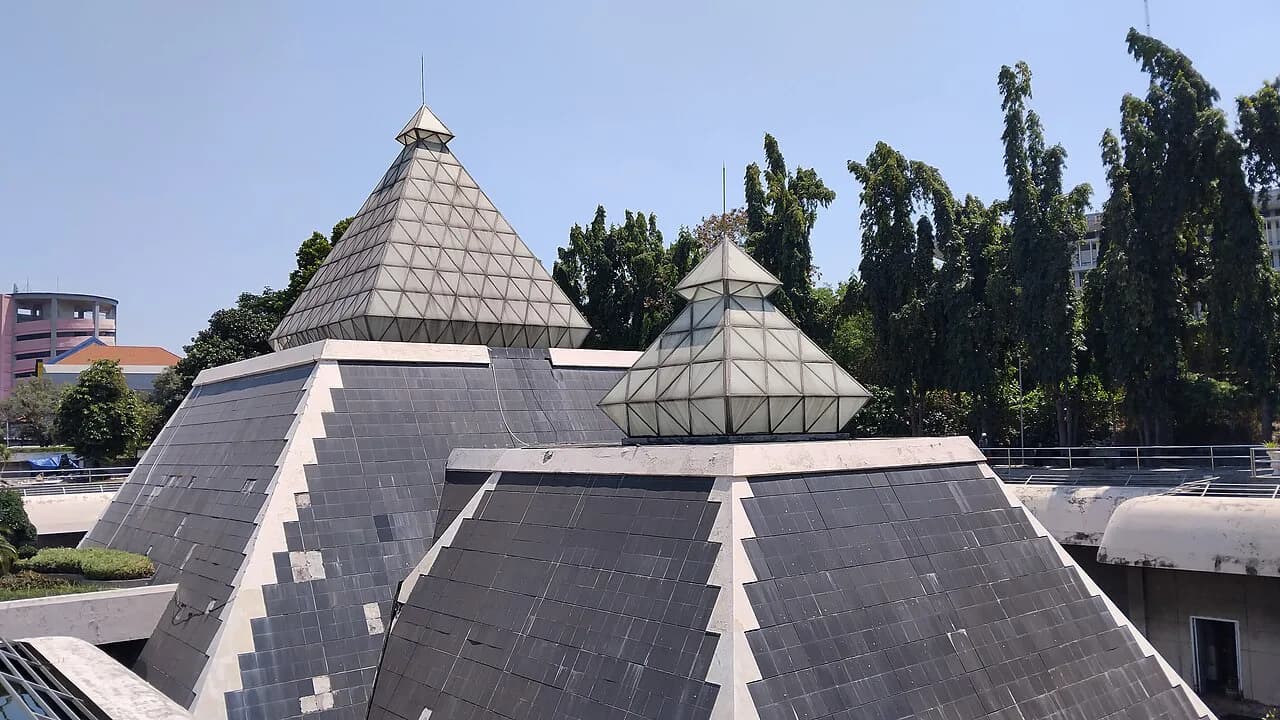
The building was deliberately sunk into the ground so it would not compete with the monument overhead, which is why the plaza looks open and the museum appears as a low structure at its edge. Indonesia.travel describes it as designed underground to preserve the visual prominence of Tugu Pahlawan, and the same source notes it is owned by the Surabaya city government and run by a technical unit responsible for both the monument and the museum.
Inside, the collection is spread across two floors, and one travel write-up describes the shape as a pyramid with only the roof showing above ground. That is a useful mental model: you descend into the story rather than walk through a conventional hall. Plan your circuit as ground floor first, then the upper level, where the documentary material is concentrated.
Floor 1: the fighters' statue and Bung Tomo's voice
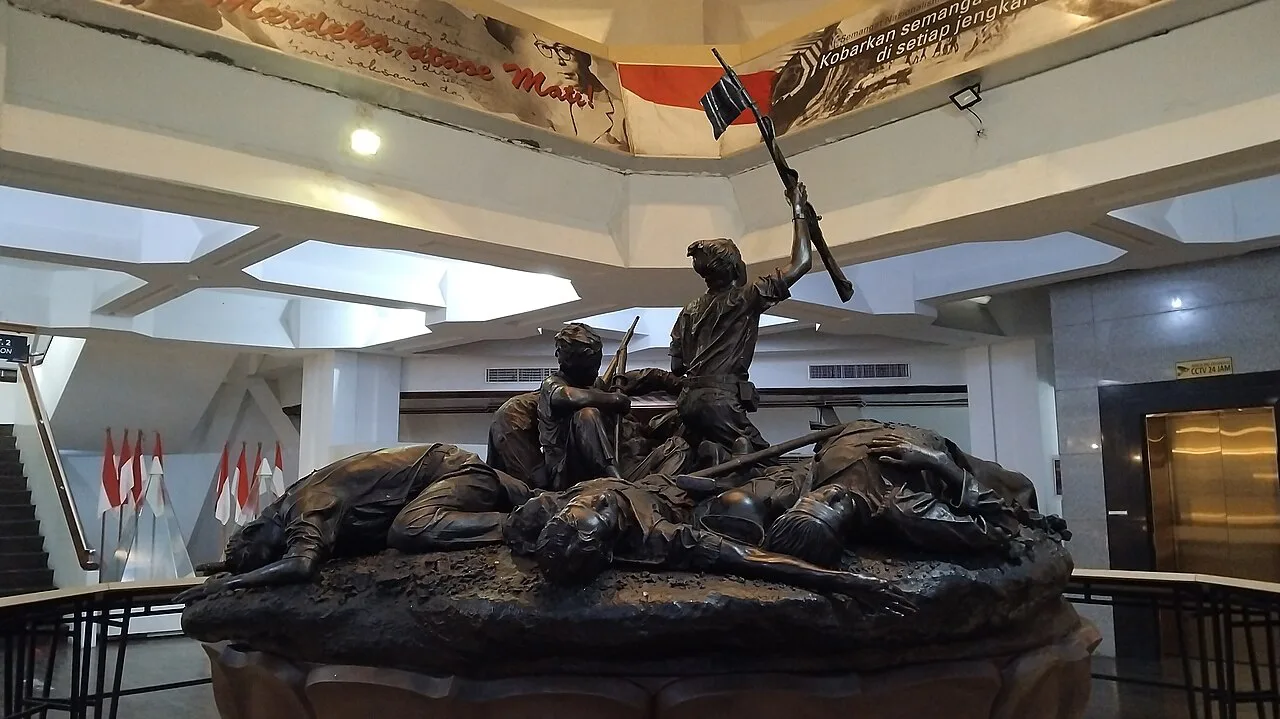
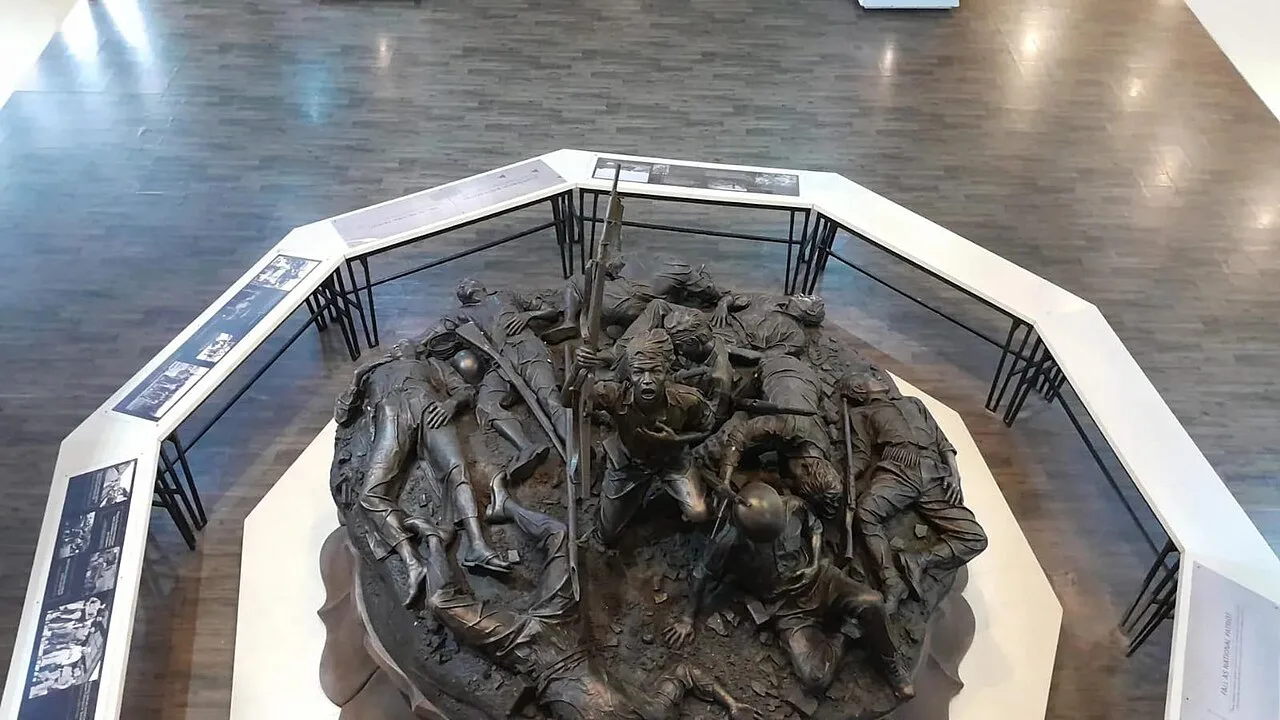
The ground floor opens with a large sculpture group of ten fighters, meant to represent the spirit of the Surabaya struggle, and it reads best from the upper level looking back down at it. Portraits of Sukarno and Hatta sit high on the interior, visible from both floors. Give this space a few minutes before moving on; it sets up the rest of the collection.
An auditorium on this floor is where visitors hear Bung Tomo's oration, the fiery broadcasts that rallied Surabaya's fighters in 1945, and a school-group report describes students listening to his recorded voice through an old radio. This is the part most visitors remember, so look for the auditorium rather than walking straight past it. Screenings of historical films also take place in the museum's auditorium at times, and any schedule is announced separately, so ask at the desk what is running during your visit.
Floor 2: weapons, helmets, radio and electronic dioramas
The upper floor holds documentary photographs, weapons including bamboo runcing, steel helmets, radios and captured equipment, along with electronic dioramas presenting key moments from the battle. Photos of landmark Surabaya buildings such as Gedung Siola, Hotel Majapahit and Gedung Grahadi appear among the displays as period references, not as places the museum expects you to visit afterward.
Indonesia.travel lists at least nine key collections, naming Bung Tomo's radio, his diary, double-layered war helmets, military uniforms and historical firearms. The original audio recording of Bung Tomo's speeches is singled out as the museum's most iconic item. If you only have time for one display case, make it that one.
A news report from a school visit describes a newer wall panel on the west side covering the role of Muslim clerics and East Javanese ulama in the fighting, plus an electronic diorama on the second-floor wall tracing how the monument was built. These additions reward a slower lap, especially if you already know the broad outline of the 1945 battle.
How much time the museum actually takes
For a solo visitor who reads labels selectively, the two floors fit comfortably into about an hour, and the compact scale makes that realistic rather than rushed. If you sit through the Bung Tomo audio and a film segment, add half an hour. School groups move in blocks and can create queues at the entrance, so a mid-morning arrival may mean waiting outside while a batch clears.
Group visits run at a slower pace: a reported school trip had several groups inside at once, with staff managing the door and explaining the site outside while people waited. Independent travelers should build in slack rather than schedule a tight onward transfer. If your Surabaya time is short, see how the museum fits alongside other stops in our Surabaya Attractions guide before you commit.
Tickets and opening hours: conflicting listings
Published hours and prices do not agree, so confirm before traveling. One commercial listing gives Tuesday to Friday 08:00–14:30 and Saturday to Sunday 08:00–13:30, closed Monday and on national holidays, with a ticket price of Rp 5.000. Treat that as a starting point, not a guarantee, because the source is a bus-rental site rather than the museum itself.
The city runs an online ticketing portal at tiketwisata.surabaya.go.id, which a local report names as the booking channel for visits, and which is the sensible place to check current entry rules and any published tariff. Group visitors in that report were told to buy tickets online in advance so they could be served properly. If you are arriving with a family or a school party, book before the day.
Getting there and what to see nearby
The museum address is within the Tugu Pahlawan grounds on Jl. Pahlawan in Alun-alun Contong, so give a driver the monument name rather than the museum name and walk in from the plaza. Ride-hailing apps and metered taxis both work in central Surabaya; cars drop at the complex edge and you continue on foot. Group coaches park on the site itself, according to a report from a school visit.
After the museum, walk the Tugu Pahlawan plaza itself and read the monument as the counterpart to the exhibits below; our Tugu Pahlawan in Surabaya guide covers that separately. If you have another hour and want more colonial-era streets, the old town around the Kalimas river in Surabaya Utara is a short ride north and pairs well with a late-afternoon visit.
For a different tone, Museum Surabaya at Gedung Siola covers the city's civic and commercial history in a building that appears among the photographs inside Museum Sepuluh Nopember. It is a logical second stop if you want context for the street names and buildings you keep seeing.

Is it worth a detour on a short Surabaya stay?
If you have a single day in Surabaya and no particular interest in the 1945 battle, the museum is a reasonable skip; the monument above gives you the outline in ten minutes. If you have half a day and any curiosity about how modern Indonesia narrates its independence, it earns its slot because the Bung Tomo recording is something you cannot get from a plaque. The trade-off is time: the material is text-heavy and in Indonesian, which slows non-Indonesian readers.
Build the museum into a central Surabaya morning
Slot Museum Sepuluh Nopember into a central Surabaya morning: arrive with the opening, do the ground floor first, then the upper floor and the auditorium, and finish outside at the monument. Confirm hours, closure days and tickets on the city portal the day before, since published listings disagree and holidays change the pattern. Keep the visit to about an hour unless the recorded broadcasts pull you in.