
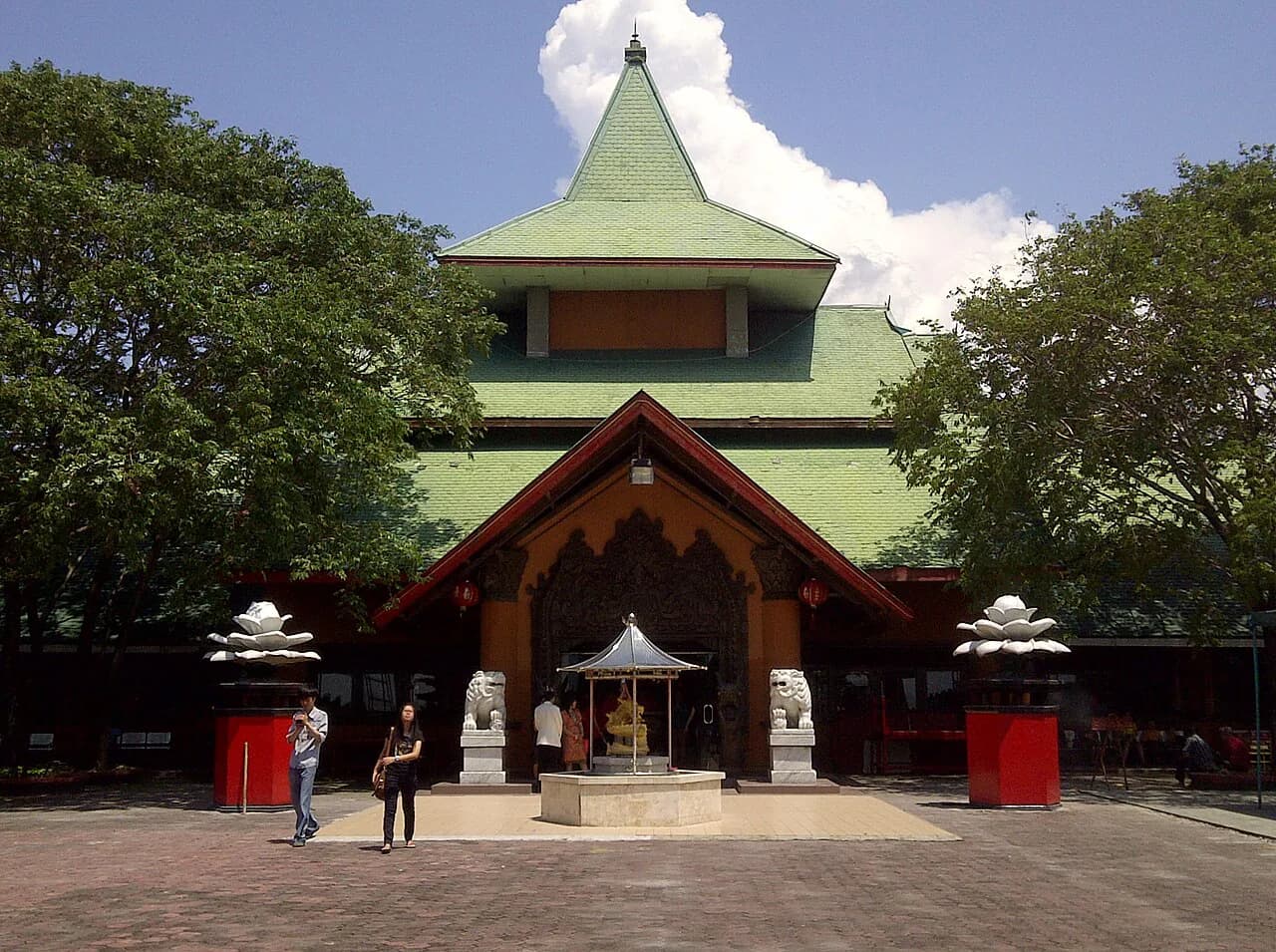
Kelenteng Sanggar Agung in Surabaya: Visiting the Kenjeran Seafront Temple

Kelenteng Sanggar Agung is worth about an hour if you are already on Surabaya's east coast, and it works best as a half-day run out to Kenjeran rather than a stop on a central-city walk. The temple, also called Hong San Tang, is a Tridharma house of worship for Konghucu, Buddhist and Taoist devotees, and its most photographed feature is a 20-meter statue of Dewi Kwan Im at the water's edge. This guide covers where it is, how to reach it, what you see inside and around it, and how to fit it into a Surabaya day.
What Kelenteng Sanggar Agung is
Sanggar Agung serves the Tridharma community, which blends Konghucu, Buddhism and Taoism, so expect active altars rather than a museum display. Sources report that the temple opened to the public in 1999 and occupies a site of roughly 4,000 square meters. It is often listed as Hong San Tang, so if a driver or sign uses that name, you are in the right place.
The institution predates the current building: reporting describes an earlier temple called Kwan Kong Bio dating to 1978, with the present Sanggar Agung dedicated to Nan Hai Guan Shi Yin Pu Sa, the Bodhisattva Kwan Im of the South Sea. That context explains the layout, where the sea goddess faces out over the water rather than sitting in the main hall. Keep it in mind as you walk in, because the seafront setting is the point of the design.

Where it is: Jalan Sukolilo No. 100, Kenjeran
The address is Jalan Sukolilo No. 100 in East Surabaya, in the Kenjeran Beach area on the city's eastern shore. The temple sits directly beside the sea, with a mangrove and coastal backdrop instead of the dense shophouse streets around the older Chinese temples in the center. Treat it as an east-coast destination, well away from the historic core around Kota Lama Surabaya and the Kalimas river.

How to get there from central Surabaya and Juanda
There is no practical rail or rapid-transit link to Kenjeran, so a private car or a ride-hailing app such as Grab or Gojek is the default way to reach the temple. From central Surabaya the route runs east across the city, and from Juanda Airport it is a longer cross-town run, so pair the temple with other east-side stops instead of making a separate round trip. Surabaya traffic is unpredictable, so leave slack rather than fixing a tight arrival time.
Ask your driver to drop you at the temple entrance on Jalan Sukolilo rather than on the beachfront, since the coastal strip clogs up and the walk back can run long. Agree on a pickup point before you go in, because ride-hailing cars struggle to reach the seafront at busy moments. If you are stringing several stops together, a hired car for the afternoon usually beats summoning rides at each stop.
What you see first: the gate and the main hall
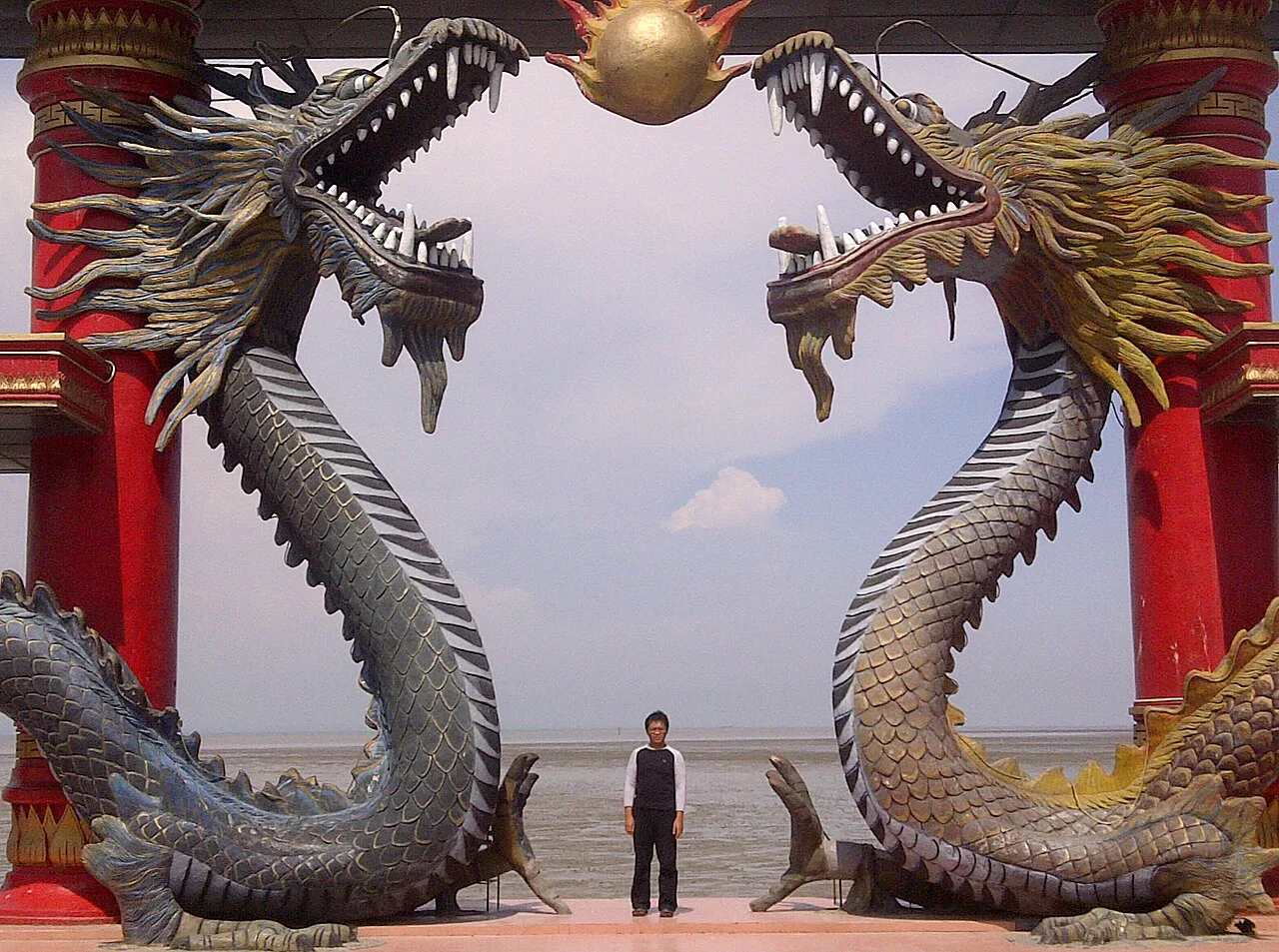
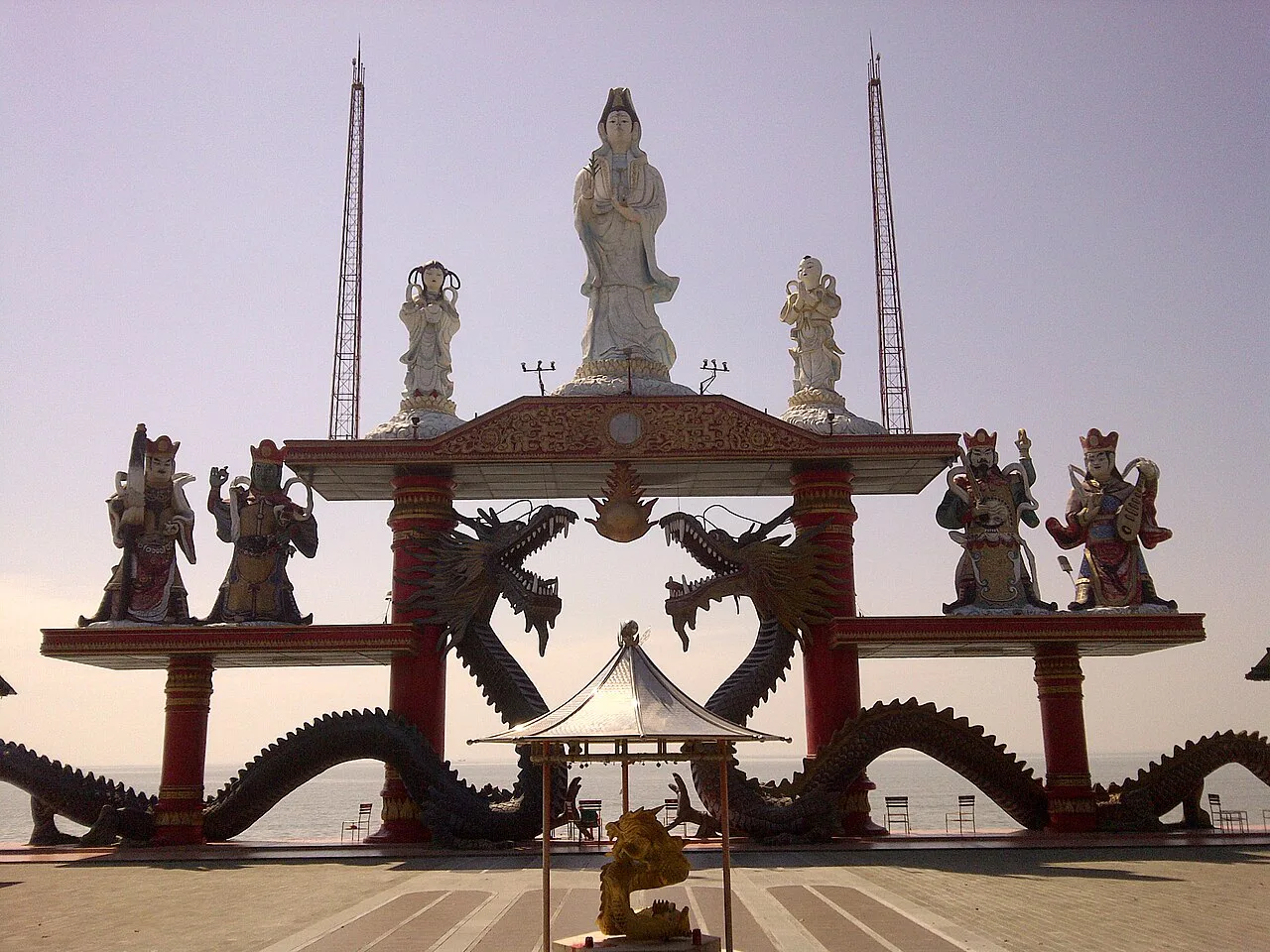
Passing through the main gate, you come face to face with the figure of Dewi Kwan Im, flanked by her two attendants, Sha Nan and Tong Nu. Below them a pair of dragons curls in relief, framing the deities rather than dominating them. This hall is the ceremonial heart of the temple, so slow down and let worshippers move through without stepping into their line of sight.
The 20-meter seafront Kwan Im statue
The signature sight is the Kwan Im statue on the eastern side of the complex, standing at the water's edge at a reported height of 20 meters. She is accompanied by her guardians Shan Nan and Tong Nu and by the four heavenly kings who protect the four directions, and beneath her stands a sky gate guarded by a pair of celestial dragons. Sources describe the dragons as roughly six meters long, and the statues went up within about two years of the temple itself.
Because the statue stands outside on the shoreline rather than inside the hall, walk around it instead of shooting from the entrance gate and leaving. The open sea position means wind and glare, and late-afternoon light is generally kinder for photographs than harsh midday sun.
Altars and the Stupa Maha Brahma
Inside, each deity has its own altar: Cai Shen Ye, the prosperity god; Guang Sen Di Jong or Kwan Kong, the god of war; Fu De Zheng Shen, associated with happiness and longevity; Guan Shi Yi Pu Sa or Kwan Im at the center; Xuan Tiang Shang Di, the god of medicine; Tai Shang Lao Jun, the founder of Taoism; and Tian Shang Sheng Mu, the god mother. Visitors also come to see the Stupa Maha Brahma within the grounds. Knowing the names helps you read the space as a working Tridharma sanctuary rather than as ornament.
Do not expect the incense-heavy, century-old atmosphere of a Chinatown temple. Reporting notes that although Sanggar Agung is a Kelenteng, it does not lean heavily on traditional Chinese architecture, adopting a contemporary design that mixes local and international elements. That is either refreshing or underwhelming depending on what you came for, so set expectations before you arrive.
Visiting around worship
This is an active place of worship, and management has created a dedicated visitor route so tourists do not disturb devotees at prayer, according to reporting. Follow that path, keep your voice low near the altars, and step aside while a ceremony or individual offering is underway. If a section is roped off or in use, treat that as a closed door rather than a photo opportunity.
The temple draws its biggest crowds around Imlek, the Lunar New Year, when the site turns red and the atmosphere is at its most festive. Observances tied to the full moon and to Kwan Im also bring larger numbers, according to tourism listings. Ordinary weekdays are far quieter, which makes a midweek morning the easiest time for an unhurried look.
How long to allow
Allow around an hour for the temple and the seafront statue at a relaxed pace, or less if you only want the main hall and the Kwan Im figure. Add time for the promenade outside if you plan to linger by the water. This is not a site that fills a day on its own, so combine it with Kenjeran Beach and the Four Faces Buddha statue directly in front of the temple.
A quick photo stop and a proper visit are genuinely different here. Twenty minutes covers the 20-meter statue and the sea view. Reading the altars, seeing the stupa and understanding the Tridharma context takes the full hour, so decide which trip you are making before you arrive.
Tickets, opening hours and ceremony days
Current ticket prices and opening hours are not reliably published, and they can change, so confirm before you travel rather than trusting an old listing. The temple's official Instagram account posts directly from the site, including announcements. Failing that, ask your hotel in Surabaya or call ahead on the day you plan to visit.
Ceremonies and major observances can affect access to parts of the complex, and no standing calendar of closures appears in the sources reviewed here. If you are traveling around Imlek or a Kwan Im celebration, check the official account before setting out and be ready to shift your timing. On any day, a short wait while a ritual finishes is normal at an active temple.
Practical trade-offs
The seafront position is the temple's charm and its drawback: the site is exposed, and midday sun on the open shoreline is punishing. Go early or later in the afternoon to stand and look at the statue without squinting. Shelter between the gate and the water's edge is limited, so loop through the shade of the temple buildings.
Kenjeran sits on the far east side of the city, so this is not a stop you fold into a walk between the central sights. Pair it with other east Surabaya stops on the same run and save the city-center attractions, such as Tugu Pahlawan in Surabaya, for a separate half-day. Doing it the other way round means hours in traffic for an hour at the temple.
Nearby options
The Four Faces Buddha statue stands directly in front of the temple, and Kenjeran Beach and its park are on the doorstep, so a walk along the shore is the natural pairing. The Suramadu National Bridge is also in this part of the city if you are continuing east. Back toward the center, Masjid Sunan Ampel in the Ampel area and the historic Gereja Kelahiran Santa Perawan Maria make a logical contrast for travelers interested in the city's layered religious architecture.
Is Sanggar Agung worth the east Surabaya run?
If you are staying in central Surabaya with one free morning, the temple is a reasonable addition only when combined with the Kenjeran seafront and the Four Faces Buddha statue in front of it. Travelers on a tight schedule with no interest in Chinese-Indonesian religious sites can skip it without regret. If you go, budget an hour, arrive outside the midday heat, and check the official Instagram for hours and ceremony days before leaving the hotel.
Explore more Surabaya guides
Frequently Asked Questions
Is Kelenteng Sanggar Agung the same as Hong San Tang?
Yes. Sanggar Agung is also referred to as Hong San Tang, and you may see both names in listings, on signs or when giving directions to a driver. The temple serves the Tridharma community, blending Konghucu, Buddhist and Taoist practice.
How tall is the Kwan Im statue at Sanggar Agung?
Reporting puts the seafront statue of Dewi Kwan Im at about 20 meters, with her attendants Shan Nan and Tong Nu and the four heavenly kings nearby. The statue stands outside on the shoreline rather than inside the main hall, so you will see it as you approach the water's edge.
Do I need to book tickets in advance?
The temple has not published a booking system in the sources reviewed here, and current entry arrangements should be confirmed on the official Instagram or on site. Do not rely on third-party listings for hours, since these can change.
Can I visit during Imlek?
The temple is busiest around Imlek and during Kwan Im celebrations, when crowds and decorations are at their height. Parts of the complex may be in ceremonial use, so check the official account beforehand and be ready to adjust your timing.