
Neka Art Museum in Ubud: A Practical Visitor's Guide

Budget about 90 minutes to two hours for the Neka Art Museum, the private collection turned public museum on Jalan Raya Sanggingan just north of central Ubud. It is the most concentrated look at Balinese painting in town, so it rewards a slower visit than the usual photo stop. This guide covers where the museum sits, how to reach it, what the pavilions hold, how to pace your time inside, and which nearby Ubud sights pair naturally with it.
Where the Neka Art Museum sits in Ubud
The museum stands on Jalan Raya Sanggingan in Kedewatan, part of the Ubud area of Gianyar Regency. That is the road running north out of the town center toward Sayan and the Ayung river valley, a short ride from the palace and market rather than a walk from the beach towns. If you are staying in central Ubud, you are close; if you are based in Canggu, Kuta or Denpasar, plan the museum as a half-day trip. Indonesia's official tourism site lists it as a special museum registered in the national museum system and run by Yayasan Dharma Seni Ubud Gianyar, the foundation that cares for the collection.
Because the museum faces a busy two-lane road with limited roadside space, the entrance is easy to pass if you are watching for a grand gate. Tell your driver the museum name and the Sanggingan address rather than a nearby landmark, and confirm the drop-off point before you set out.
How to get there from central Ubud and south Bali
There is no direct local bus to the museum, so a taxi, ride-hailing car or private driver is the realistic option, especially from south Bali. One travel site estimates roughly 50 minutes from Canggu, about an hour from Kuta and around 50 minutes from Denpasar, but treat those as rough planning figures rather than promises. Traffic between south Bali areas can stretch any of them, so build in slack if you have a timed booking later in the day.
From central Ubud, the ride is short enough that a metered taxi or app car works fine, and a scooter is feasible for confident riders who know the Sanggingan road. If you are stringing the museum together with the Ubud palace and the Ubud market in the town center, a driver for the morning keeps the logistics simple.
What's inside: the pavilions and the collections worth your time
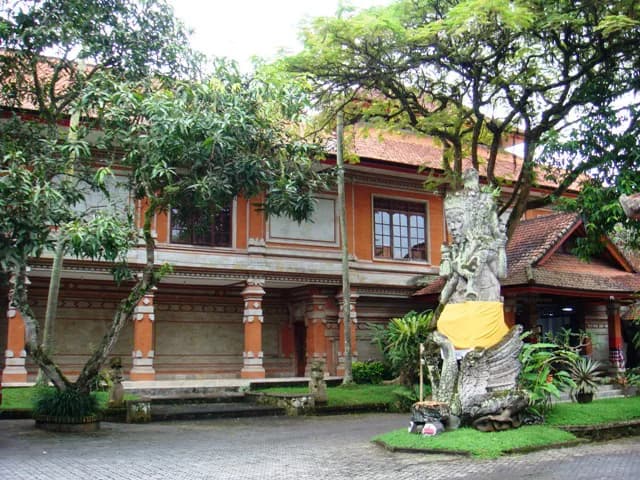
The museum is organized as a compound of pavilions built in traditional Balinese style rather than one long gallery, so you move between buildings as you work through the collection. The Indonesian tourism board describes classical Kamasan paintings that illustrate epic narratives, Ubud and Batuan styles, contemporary Indonesian work, keris daggers and photographic documentation of Bali's art history. Because each pavilion has its own focus, checking the site map at the entrance saves you from doubling back.
For many visitors the highlight is the small pavilion devoted to Gusti Nyoman Lempad, whose fine monochrome drawings tell traditional stories, along with the floor given over to Dutch painter Arie Smit. A travel writer's account of a visit also singles out foreign artists who settled in Bali, among them Rudolf Bonnet, Willem Gerard Hofker, Donald Friend and Theo Meier, plus a contemporary Indonesian hall with works such as Abdul Aziz's paintings. If your taste runs modern rather than classical, head there before your energy dips.
The museum's own site devotes a section to the keris, describing the wavy-bladed dagger as both a ritual object and part of a Balinese man's formal dress, with rules governing its form and meaning. That context makes the display cases more legible than a row of blades would be on its own. Read the panel text before you look at the objects; it changes what you notice.
The founder story in two minutes
Pande Wayan Suteja Neka started collecting high-quality paintings and opened his first gallery in Ubud in the 1960s, encouraged by his connection to Dutch artist Rudolf Bonnet. Travels with Bonnet through European museums in the 1970s solidified the plan for a proper fine arts museum, which was formally inaugurated on 7 July 1982 by Indonesia's Minister of Education and Culture. Knowing that arc helps you read the collection as one collector's argument about Balinese art rather than a neutral survey.
One travel site puts the holdings at nearly 400 works spanning old Balinese paintings, keris, sculptures and photographs, while other descriptions simply call it a broad collection. Treat any specific count as approximate. The final hall reportedly closes with a portrait of Neka and his wife, a fitting end to a museum built around a personal eye.
How long to allow, and how to pace the visit
A casual visitor who reads the main panels and lingers on a few favorites can cover the museum in about an hour. If you care about Balinese painting, give it two hours or more, since the Lempad drawings and the foreign-artist rooms reward close looking and the pavilion layout means some walking between buildings. A workable split is 30 minutes for the classical and Batuan rooms, 30 for Lempad and Arie Smit, and the rest for contemporary work and the keris display.
Pair the museum with one other nearby stop rather than treating it as a standalone day out. It works best as a morning visit followed by the Campuhan Ridge walk or a look at Pura Taman Saraswati in town, both of which are close.
Tickets, opening hours and Nyepi: what is published and what to confirm
The museum's own website lists opening hours of 09.00 to 17.00 for Tuesday through Sunday, with no Monday line published; do not assume Monday means open or closed, and check with the museum directly before you build a Monday around it. One third-party travel site states that the museum is open daily from 09:00 to 17:00 and closed on Nyepi, the Balinese day of silence. Because that is a single source, confirm the Nyepi closure and holiday hours through the museum itself closer to your date.
On admission, the same travel site reports an adult ticket of IDR 100,000 with free entry for children under 12, and says tickets are sold in person only rather than online. That figure has not been corroborated by the museum's own pages, so treat it as an indication and bring enough Indonesian rupiah in case card payment is not accepted. Confirm the current ticket price and payment method at the entrance or by contacting the museum before you travel.
The bookshop and souvenir shop
The museum includes a bookshop and souvenir shop, useful if you want a reference on Balinese painting to read after your visit rather than another generic Bali souvenir. Titles and stock are not published online, so browse in person and ask staff for anything on the artists you saw inside.
Do not assume the museum is the place to buy an original painting. It is a foundation-run institution built around preserving and exhibiting work, and only one travel site mentions purchasing souvenirs and gifts there. If buying art is your goal, visit the museum first to learn the styles and names, then ask about galleries in central Ubud rather than expecting a sales floor.
What's nearby: Campuhan Ridge, Saraswati Temple and the Monkey Forest
Campuhan Ridge is the closest natural add-on, roughly 1.7 km away and a few minutes by car according to one source's estimate, and the same source puts Pura Taman Saraswati at about 2.4 km and the Sacred Monkey Forest Sanctuary around 4 km. Those distances are approximations rather than measured routes. If you only have time for one, the Saraswati temple fits neatly into a town-center wander and sits near the Ubud market.
If you want a second museum to compare against Neka's private-collector viewpoint, the Puri Lukisan museum in central Ubud covers overlapping ground from a different institutional angle. Visiting both on separate days beats stacking them into one afternoon.
Is the Neka Art Museum worth your Ubud time?
Yes, if you want to understand Balinese painting rather than just see a few canvases: two hours here gives you the Lempad drawings, the Arie Smit room, the Batuan and Kamasan traditions and the keris display in one compound. If you are in Ubud only briefly and prioritize temples and the market, it is a reasonable skip. Either way, confirm hours and ticket price through the museum before you go, since published details vary between sources.
Explore more Ubud guides
Frequently Asked Questions
Where is the best place to buy paintings in Ubud?
The Neka Art Museum is built around preserving and showing work rather than selling it, so treat it as a place to learn styles, artists and names first. Ask museum staff or your accommodation about galleries in central Ubud once you know what you like.
Who is a famous artist from Bali?
Gusti Nyoman Lempad is widely described as one of Bali's most celebrated artists, and the Neka Art Museum holds a small pavilion of his fine monochrome drawings. The collection also covers Batuan and Ubud painters and foreign artists who settled on the island.
Does the Neka Art Museum sell tickets online?
One third-party travel site says tickets are bought in person only, but the museum's own pages do not publish a booking policy. Check directly with the museum before you travel, and carry Indonesian rupiah in case card payment is not accepted.