
Ubud Market (Pasar Seni Ubud): A Visitor's Guide to the Art and Traditional Stalls

Ubud Market is worth roughly 45 minutes if you want a look and up to two hours if you plan to buy. It costs nothing to enter, so the only real budget decision is how much you carry in cash and how hard you bargain.
The market sits on Jalan Raya Ubud, the main street through the center of town, directly opposite the royal palace. That position makes it the easiest stop to fold into a half-day walk rather than a separate excursion. This guide covers how the two halves of the market differ, how to arrive, what hours to expect, how bargaining works, and what sits within walking distance.
The Two Halves of Ubud Market
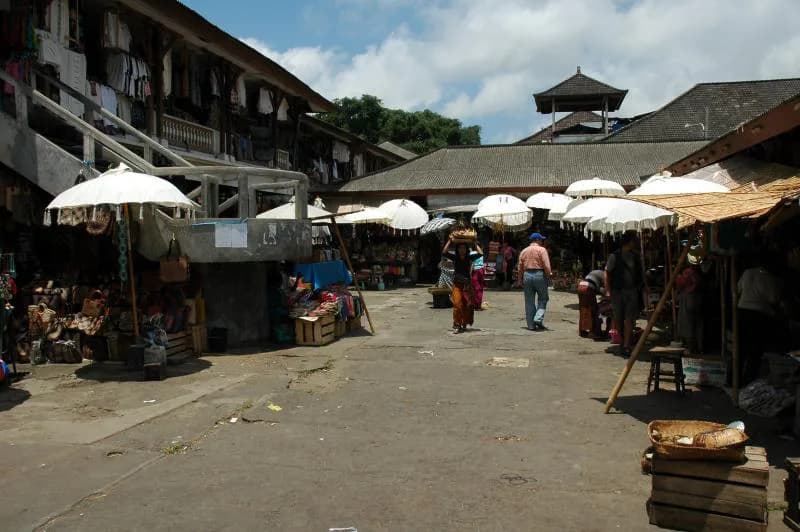
Pasar Seni Ubud is not one market but two, and knowing which half you are standing in changes what you should do there. The block on the western side faces visitors with stalls of handicrafts, textiles, paintings, jewelry and souvenirs. The eastern block works as a traditional neighborhood market where Ubud residents buy fresh produce and everyday goods.
Treat the west side as the shopping stop and the east side as the part you walk through rather than shop. The produce section is quieter and shows how the town actually feeds itself, while the souvenir rows are louder, denser, and built for browsers. If you only have twenty minutes, spend them on the west side and skip the rest.
Some descriptions also split the site into a traditional market and a separate art market, with crafts and produce sitting alongside each other. In practice you will pass from one to the other without a sign or a gate, so scan a full loop before you commit to anything.
Where It Is and How to Walk In
The address is Jalan Raya Ubud No. 35 in Ubud, Gianyar regency, and the market stands directly across the road from Puri Saren Royal Palace. If you can find the palace, you have found the market.
From most guesthouses and restaurants in central Ubud, the market is a short walk, which is usually faster than calling a car for a few hundred meters. Ride-hailing apps and hotel drop-offs work well from further out; ask to be set down on Jalan Raya Ubud near the palace. A private driver makes sense only if you are combining the market with sights outside the center.
Scooters and cars park for a fee, reported by one source as IDR 2,000 for a motorcycle and IDR 10,000 for a car, though those figures are subject to change. Central Ubud traffic is slow and the roadside space near the palace is limited, so arriving on foot or by app drop-off avoids the worst of it.

Hours and What Entry Costs
There is no entrance fee and no obligation to buy anything inside. That part is consistent across published guides, so the market works as a free stop even if you only want to look.
Opening times are where the sources disagree. Several list daily hours of 10 a.m. to 5 p.m., noting that some stalls open earlier and stay later, while another gives 6 a.m. to 6 p.m.
Plan around the 10-to-5 window as the reliable core and treat anything earlier or later as a bonus rather than a promise. If a specific stall matters to you, confirm its hours with your accommodation on the day you go instead of building the morning around a listing.
What to Buy on the Art Side
The souvenir half of the market leans on goods made by hand in Ubud and the villages around it rather than mass-produced imports. Expect silk scarves, woven baskets, hats, kites, painted canvases, Balinese wood carvings, silver jewelry, batik and woven cloth, and light beach clothing.
Textiles are the strongest buy. Endek, the traditional Balinese woven fabric, comes in a wide spread of colors and patterns and can be purchased by the meter or as a finished garment. Woven bamboo and rattan bags pack flat and travel home more easily than a wood carving.
Quality varies sharply between stalls selling the same category, and asking prices vary with it, so compare three or four sellers before you decide. Hold textiles up to the light and turn wood pieces over to check the finish before you agree on a number.
The market has appeared in the film Eat, Pray, Love, which is part of why some visitors arrive expecting a set piece. It remains a working market first, and a couple of rows toward the east side will remind you of that quickly.
The Traditional Side: Produce, Spices, and Everyday Goods
The eastern block is where locals shop for household essentials, and you will see fresh produce, spices, herbs and everyday goods rather than souvenir displays. It is not set up for browsing tourists, so walk through, look, and keep out of the way of people actually buying.
This half is also a reminder that the site predates tourism in Ubud. Accounts of its origins differ, with one placing its roots in the 1800s as a neighborhood hub and another describing it as growing from the early 1900s, when Ubud became a center for arts and crafts.
Small food stalls and simple eateries sit within and around the market, useful if you want a quick plate of nasi goreng or Sate lilit between shopping stops. Prices are not published in any reliable form, so check the board or ask before ordering.
How Bargaining Actually Works
There are no fixed prices on the souvenir side, and vendors expect you to negotiate. A workable sequence is to browse several stalls, ask a price, open well below it, and move up in small steps until you settle. One source suggests opening at roughly half the asking price.
Walking away mid-negotiation is completely acceptable, and vendors will sometimes call you back with a better number. Once you have agreed on a figure, though, you are expected to pay it. Keep the tone friendly; persistent sellers are earning a living, not trying to bother you.
The first sale of the day carries a bit of superstition for some vendors, who treat it as good luck and may accept a lower price because of it. That is the single best argument for shopping soon after the stalls open rather than in the afternoon.
When to Arrive
Mornings are cooler, thinner on crowds and better for prices, and the advantage holds in peak season especially. Mid-afternoon brings the heaviest foot traffic and the least patience on both sides of the counter.
Ubud itself runs cooler than much of Bali, so heat is less of an issue here than in coastal towns, but the covered, two-floor layout still traps warmth later in the day. Arriving near opening gives you room to walk the aisles and photograph the stalls before the tour groups arrive.
How Long to Allow
A quick browse takes about 45 minutes: one loop of the souvenir rows, a walk through the produce side, and out. A serious souvenir run takes closer to two hours, because comparing textiles and carvings across many stalls is what actually produces a good price.
Build in extra time if you plan to buy anything bulky. Large wood carvings and paintings need packing and sometimes shipping arranged, which is a separate errand from the purchase itself. If you are on a tight schedule, buy only what fits in your bag.
Cash, Small Notes, and Inspecting Goods
Cash is the preferred payment method at most stalls, and small denomination notes make transactions far smoother when you are negotiating. ATMs are available in the Ubud town center nearby, but withdrawing before you arrive saves a mid-negotiation detour.
Check every item closely before you pay: seams on textiles, joints on wood, clasps on jewelry. Most vendors will let you examine a piece without complaint, and doing it before agreeing on a price avoids an awkward conversation afterward.
What Is Within Walking Distance
Puri Saren Royal Palace sits directly across Jalan Raya Ubud, so pair the market with a look at the Ubud Palace (Puri Saren Agung) before or after your shopping loop.
Monkey Forest Road and the starting point for the Campuhan Ridge Walk are both close enough to combine with a market visit in the same morning. The Sacred Monkey Forest itself is also within easy walking range of the center.
Pura Taman Saraswati, the lotus-pond temple a short stroll away, makes an easy second stop, and the Saraswati temple Ubud is best visited outside the market's busiest hours. For art beyond the stalls, the Puri Lukisan museum and the Neka art museum Ubud are both in town and reward a slower afternoon.


Fitting the Market Into a Half-Day
The cleanest half-day is market first thing, palace and temple mid-morning, then lunch in the center before the afternoon crowds build. That order keeps you on foot, avoids a driver for the whole morning, and puts the shopping while you are still fresh enough to bargain well.
If you want a wider menu of what to do with the rest of the day, the guide to Ubud Attractions: 12 Visitor Guides lists the town's main sights with practical notes on each. Build the market in as a fixed point and arrange everything else around it rather than the reverse.
Is Ubud Market worth your morning?
Yes, if you go early, carry small notes, and treat the two halves differently. It is free to enter, sits opposite the palace, and takes under an hour if you keep it short, which makes it one of the lowest-risk stops in central Ubud.
Confirm the day's opening times with your accommodation before you set out, since published hours conflict, and skip the market entirely if you dislike crowds and haggling. Otherwise, arrive near opening, walk the whole loop once, then buy.