
Saraswati Temple Ubud: How to Visit Pura Taman Saraswati

Saraswati Temple is worth 20 to 30 minutes of a central Ubud walk, not a half-day trip. The temple, formally Pura Taman Saraswati, sits behind a lotus pond a minute off Jalan Raya Ubud, so you can see it between coffee and the market without a driver.
This guide sticks to the one temple: where it is in Ubud, the two ways in, what the ponds and carvings are, the sarong and dinner-cover rules, and what sits within a short walk afterward.
What and where Pura Taman Saraswati is
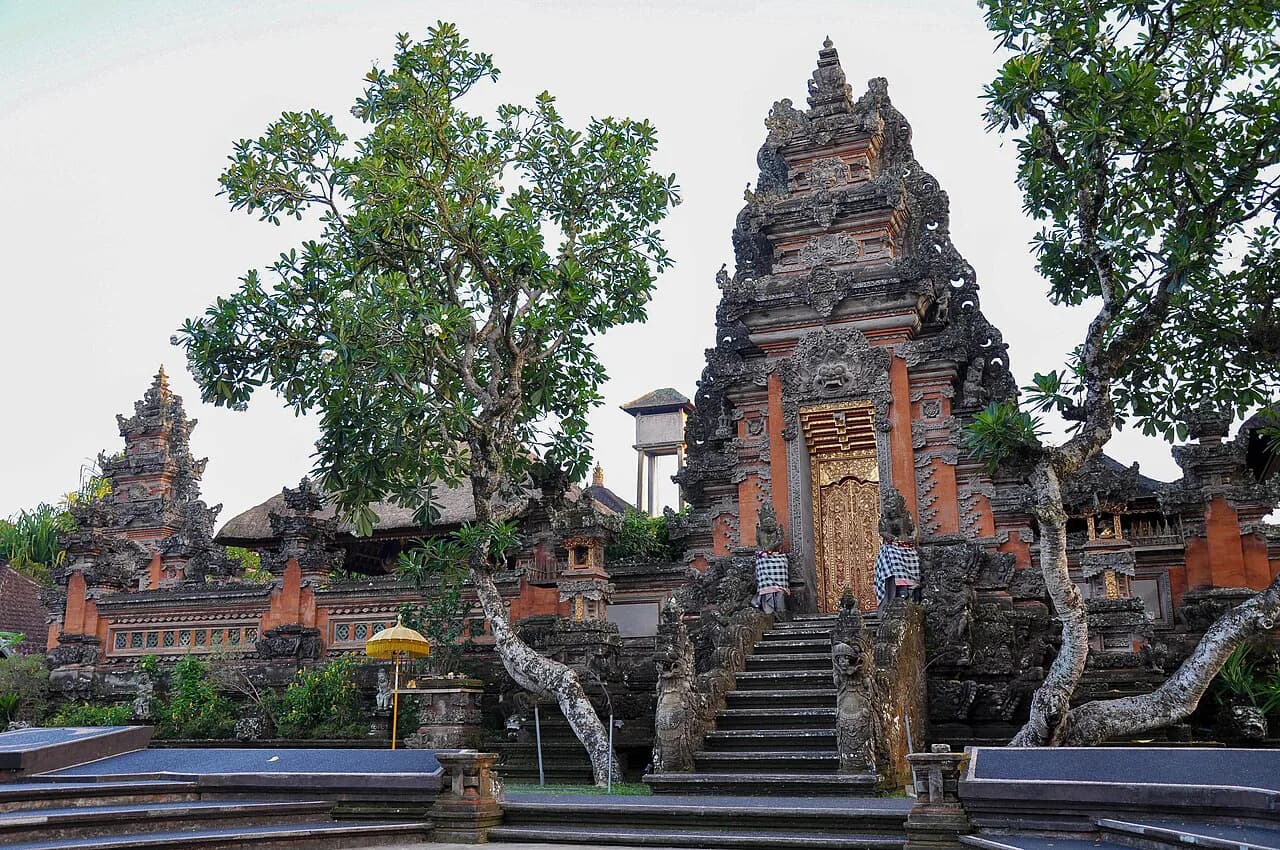
Pura Taman Saraswati is a Balinese Hindu temple in central Ubud, in Gianyar Regency, dedicated to Saraswati, the goddess of knowledge, arts and wisdom. Its name means roughly "temple of the Saraswati garden," and the garden in question is the formal lotus pond that fronts the shrine.
The address is Jalan Kajeng, Ubud, Gianyar, Bali, a narrow side street that branches off the main road through town. Treat Jalan Raya Ubud as your landmark: the temple is reached from the Jalan Kajeng side, not from a gate on the main road itself.
Because it is a working temple rather than a monument, the water palace nickname only tells half the story. It remains an active Balinese Hindu sacred space, so people come to pray as well as to photograph the lotuses.

Getting there on foot from the Ubud center
The simplest approach is on foot. From Jalan Raya Ubud, turn onto Jalan Kajeng and look for the temple entrance within the first stretch of the lane; the pond is set back behind a low wall, so watch for the gateway rather than a large sign.
There is a second way in from behind the amphitheater, which is useful if you are coming from the north end of the center. A third-party guide describes entry from behind the amphitheater at any time of day; treat that as a rough indication rather than an official schedule and confirm the gate is open when you arrive.
Central Ubud traffic is slow and the lanes are tight, so a car or ride-hailing drop-off on Jalan Raya Ubud and a short walk is usually quicker than asking a driver to reach the door. If you are staying a couple of kilometers out, as many Ubud hotels are, budget extra time for the final approach.
What you actually see: ponds, foyer, stage and reliefs
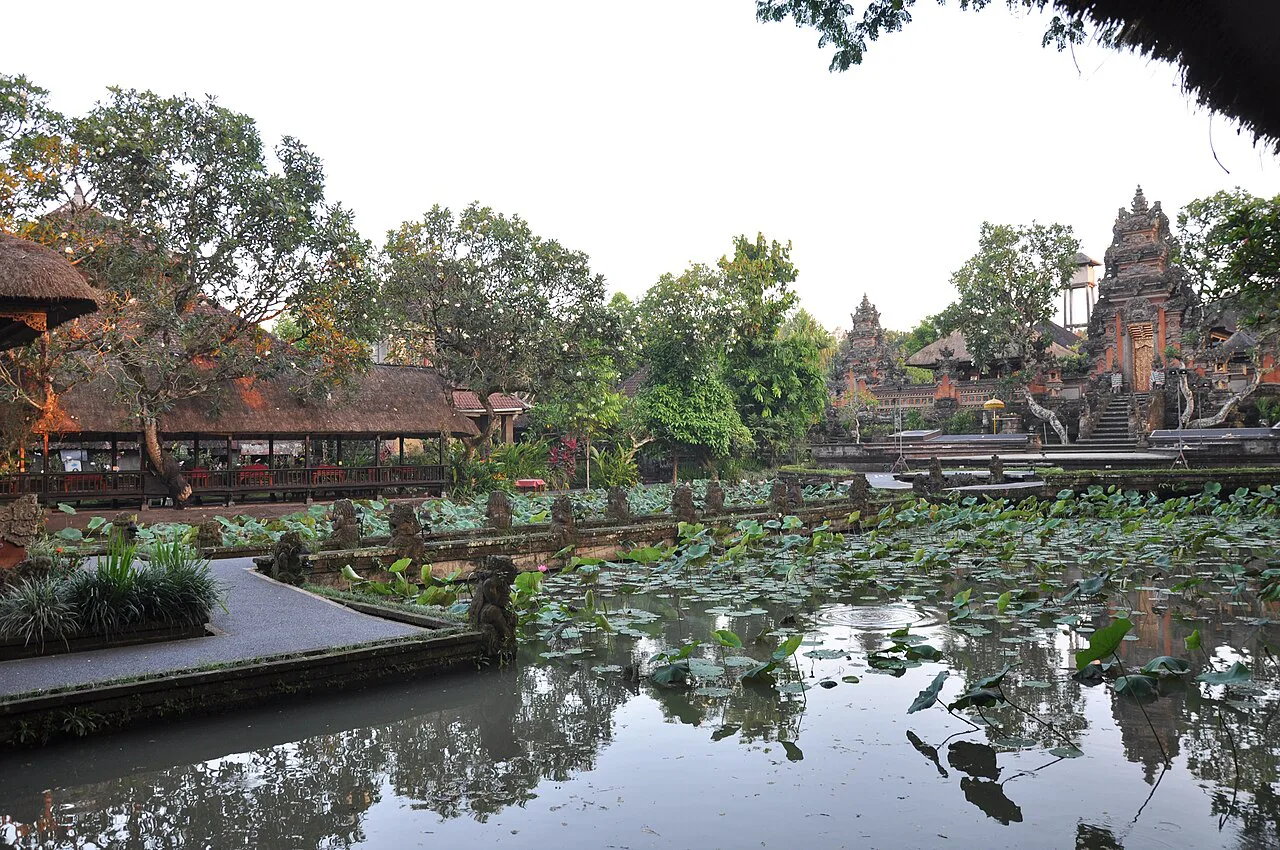
The first thing in view is the pond, filled with blooming pink lotuses in season and framed by classical Balinese temple architecture. The water does the work here: the shrine's reflection and the lotus pads are the image most visitors come for, so give the pond a few minutes before heading to the gate.
Past the water is the temple foyer and, adjoining the pond, an open stage used for performances. The layout is compact: a forecourt, the water, the stage on one side, and the shrine area beyond, which is why the whole visit fits into a short stop.
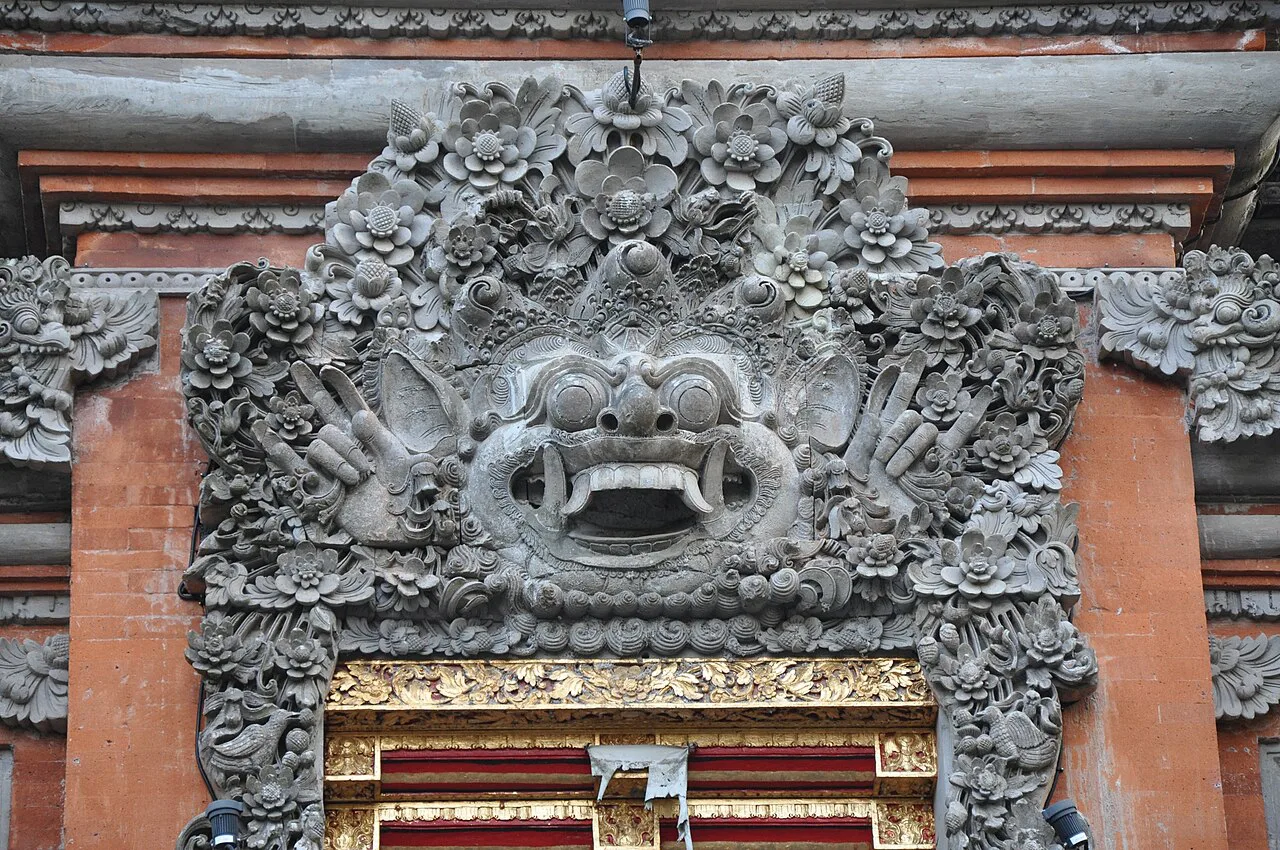
Look closely at the stonework. The sandstone bas-reliefs on the temple structures depict Saraswati, the goddess of knowledge and the arts, and they reward a slow pass rather than a quick photo from the pond edge.
The temple's formal ponds have earned it the Ubud water palace label, and the symmetry is what makes it photogenic. Keep in mind that the inner shrine is not a sight to wander through while worship is underway; stay in the visitor areas and leave the praying space to those using it.
Entry, sarong and sash, and the Café Lotus dinner cover
Entry to Taman Saraswati is free, and visitors are expected to wear a sarong and sash around the waist as at any Balinese temple. Bring or borrow them before you step up to the gate; if you arrive without, ask at the entrance whether loaners are available that day.
The trade-off is the view. Café Lotus, which sits at the pond, charges a minimum dinner cover, and paying it gets you the best outlook over the lotuses and the temple's open stage. So you have two options: free entry with a pond-side view from the public path, or a meal spend for a table facing the water.
The cover amount, the menu and whether the restaurant is open on a given evening are not fixed facts to plan around. Check the posted minimum and the day's hours at the restaurant before you commit to dinner, and treat the temple entry itself as separate from that spend.
Evening dance performances at the temple stage
Traditional dance performances are regularly held at the temple stage in the evenings, which is why the open stage faces the pond. If a performance is the reason for your visit, plan the temple stop for after dark rather than at midday.
What the sources do not give is a fixed timetable, ticket price or list of which nights have shows. Rather than assume a nightly schedule, ask at the temple gate or at Café Lotus earlier in the day, or check the boards along Jalan Raya Ubud where Ubud's evening performances are advertised.
How much time to allow, and when to go
Allow 20 to 30 minutes for the temple itself: a few minutes at the pond, a pass through the forecourt and stage area, and a look at the reliefs. Add another half hour if you stay for a drink or meal at the pond, and longer again for an evening performance.
For a calmer visit, come early in the day, before the tour groups work through central Ubud. The site is small and the path around the pond is narrow, so a handful of other visitors changes the experience more than it would at a large complex.
Opening hours are not published in a form you can rely on in advance, so the practical approach is to check the gate when you pass and plan your Ubud walk around what you find. That is also the moment to confirm sarong loaners and whether the stage has a performance that night.
Nearby in central Ubud: what to add on
Ubud Palace (Puri Saren Agung) is a short walk up Jalan Raya Ubud and makes the natural pairing with Saraswati Temple: both are in the town center and both are compact stops. Seeing them back to back gives you the palace and the water temple in one loop.
Ubud Market (Pasar Seni Ubud) sits on the same main-road stretch, so a morning that starts at the temple, moves through the market and ends at the palace needs no transport at all.
If you want more than temples and shopping, the Puri Lukisan Museum (Museum Puri Lukisan), Ubud is within the central grid and pairs well with a Saraswati stop for an art-focused afternoon.

Water palace or working temple? How to read the place
The water palace framing is useful for finding the temple and understanding its layout, but it can mislead. This is an active sacred space, so the pond is a garden around a shrine, not a decorative set piece.
In practice that means wearing the sarong and sash, keeping voices low near the shrine, and not stepping onto areas set aside for prayer. Those small courtesies are what keep a free, central temple open to visitors.
Is Saraswati Temple worth the stop?
Yes, if you are already in central Ubud. Twenty to thirty minutes gets you the lotus pond, the foyer, the stage and the reliefs, and it costs nothing beyond a sarong and sash if you skip the pond-side dinner.
Build it into a walk along Jalan Raya Ubud with the palace and market, decide on the day whether the Café Lotus cover is worth the view, and check the gate for current hours and any evening performance rather than planning around a fixed schedule.
Explore more Ubud guides
Frequently Asked Questions
Is Saraswati Temple the same as Pura Taman Saraswati?
Yes. Saraswati Temple is the common English name for Pura Taman Saraswati in central Ubud, and the two names appear interchangeably on signs and in listings. The temple is dedicated to Saraswati, the goddess of knowledge and the arts.
Do I need a guide to visit Saraswati Temple?
No. The temple is small and self-explanatory: a pond, a foyer, a stage and carved stonework, all within a couple of minutes of Jalan Raya Ubud. A guide adds context if you want the iconography explained, but the layout itself does not require one.