
Ubud Palace (Puri Saren Agung): A Practical Visitor Guide
Ubud Palace needs 20 to 45 minutes for the daytime courtyards, not a half day. It is the historic Puri Saren Agung compound of the Ubud royal family, sitting on Jalan Raya Ubud in the middle of town, and the public can walk through only its outer sections. This guide covers where it is, how to arrive, what you see inside, which courtyards stay closed, how to check hours and admission, and how the evening dance fits into a Ubud day.
Where Ubud Palace sits in central Ubud
Ubud Palace is on Jalan Raya Ubud, the main street through the center of Ubud, in Gianyar Regency. Sources give its address as Jl. Raya Ubud No. 8, and it sits at the crossroads of central Ubud rather than in a quiet side lane. That position means you will pass it on almost any walk through town, so it works best as a stop between other nearby places.
The palace is also known as Puri Saren Agung locally, so signs and drivers may use either name. It sits beside the Ubud Art Market and the Pura Marajan Agung temple, which makes the block easy to identify even without a map. If you are already wandering central Ubud, you can reach the gate on foot rather than planning a special trip.
What Ubud Palace is: a royal compound, not a museum interior
Ubud Palace is the historic residence of the Ubud royal family, founded in the early 1800s under Ida Tjokorda Putu Kandel. The family still keeps parts of the compound as a residence, which is the single most important thing to understand before you arrive: this is not a palace you tour room by room. What you see is a walled Balinese compound, with ceremonial and cultural use continuing inside it.
That living role is also why the palace is used for dance, music and ceremonies rather than being run as a conventional sight. Expect a working cultural site where your visit is a walk around the public edges of the compound, not a deep interior tour.
How to get there and where to be dropped off
The simplest way to arrive is on foot from the center of Ubud, since Jalan Raya Ubud is the main street and the palace gate opens onto it. Traffic on this street is tight and slow, so ask a Grab or Gojek driver to drop you near the Ubud Art Market rather than at the gate itself, then walk the short distance.
Driving times from outside Ubud depend heavily on traffic, and a villa-operator source gives roughly one hour from Ngurah Rai International Airport, about 35 minutes from Badung, and around 25 minutes from Gianyar. Treat those as rough guideposts, not schedules, and add buffer in the afternoon. If you are coming from south Bali, build the drive around Ubud's central congestion rather than the distance alone.
Which courtyards are open and which stay closed
The compound follows the three-part layout of a traditional Balinese palace: jaba sisi at the front, jaba tengah in the middle, and jeroan at the back. Visitors are admitted to the outer area, the jaba sisi, where cultural activity and performances take place. The middle and inner areas are not open to the public, because they remain sacred and residential.
That boundary is the most common visitor misjudgment: people arrive expecting a large palace interior and find a compact outer courtyard instead. Knowing the limit in advance turns a possible disappointment into a quick, worthwhile stop.
What you actually see inside
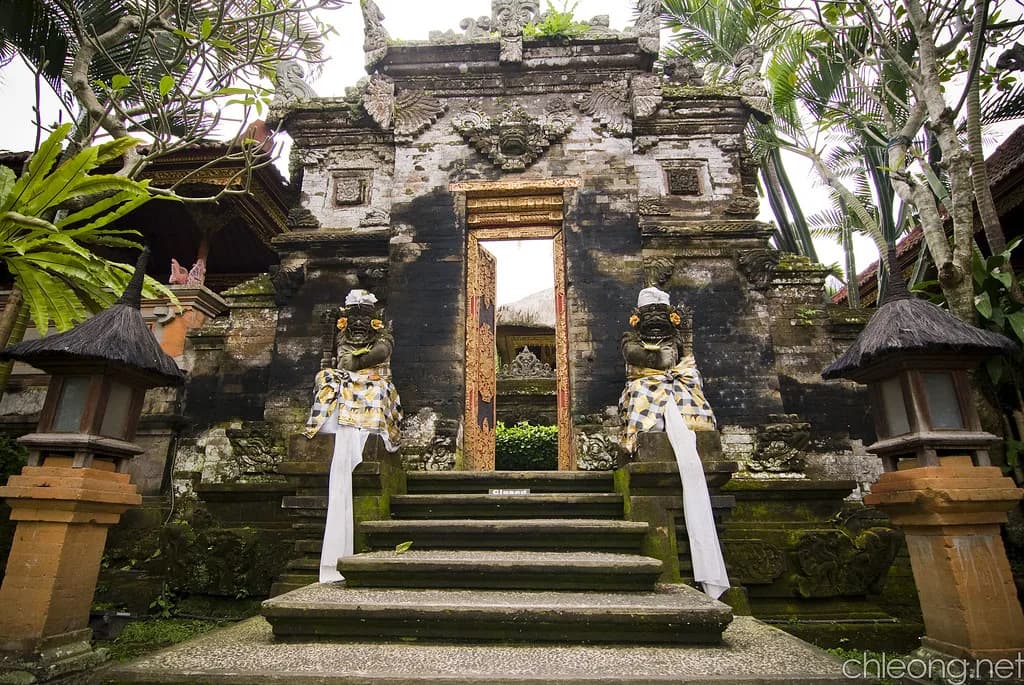
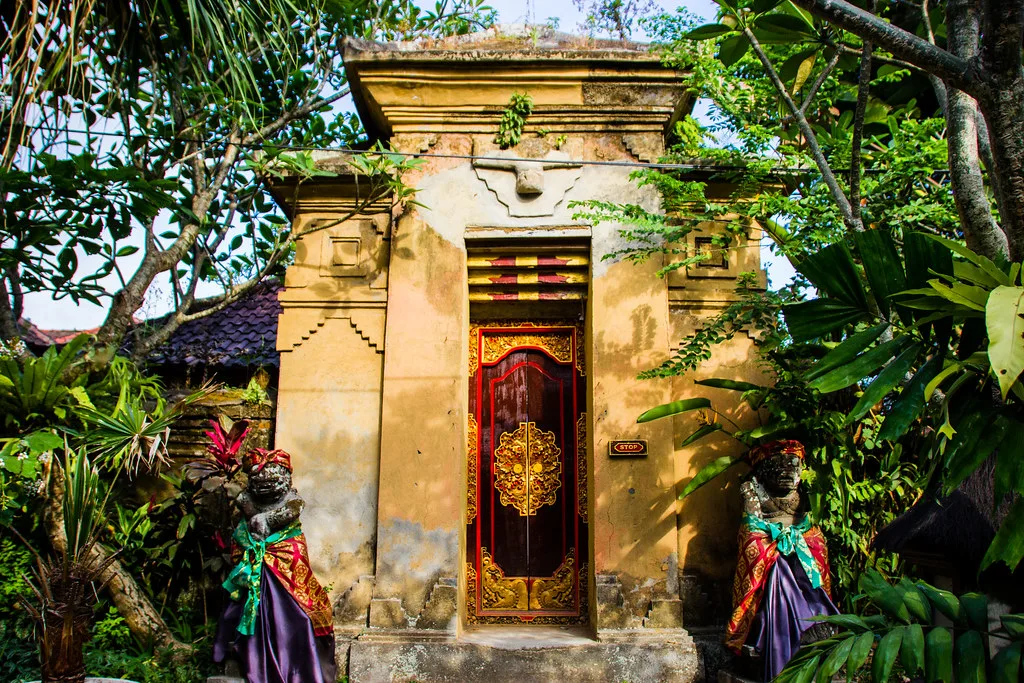
The reward of the palace is its architecture: a carved Balinese gateway, known as an angkul-angkul, stone guardians on either side, gilded wooden doors, pavilions and gardens. The detail is dense, so the stop rewards a slow look rather than a quick photo from the gate. Look up at the carved roofs and down at the doorway guardians, which are the elements most often missed.
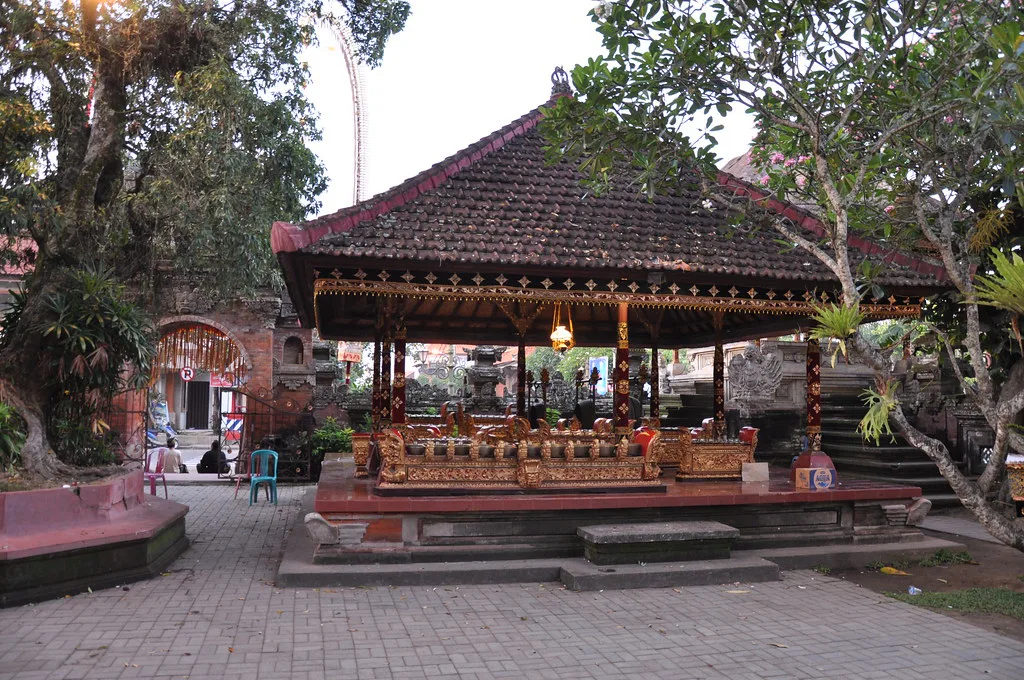
The palace is also a cultural venue, with its halls and stage used for dance, music and events. In the evening the courtyard becomes an open-air performance space with a gamelan orchestra. That shift from daytime architecture to nighttime performance is the reason to consider visiting twice rather than once.
Hours and admission: what is published and what to confirm
Sources disagree on daytime hours, so plan around the range rather than one figure. One operator lists 8:00 AM to 5:00 PM, another gives 8:00 AM to 6:00 PM, and a third lists 7:00 AM to 5:00 PM with free entry. Daytime admission is consistently described as free, but confirm the day's hours at the gate or with your accommodation before making a special trip.
Do not treat any published schedule as fixed, including the evening performance timetable. Old sources list specific dance nights, such as Legong on selected evenings and Barong on others, but those programs change. Check at the palace gate or with your hotel on the day you plan to attend rather than building an itinerary around an outdated listing.
The evening dance in the courtyard
The evening dance is a separate outing from the daytime courtyard visit, and it is the more memorable half of the palace for many travelers. Sources describe performances starting in the evening, with one listing 7:30 PM to 9:00 PM, live gamelan accompaniment, and unreserved seating. Arriving early matters because the front rows fill quickly.
Ticket prices for the dance are quoted inconsistently across sources and in different currencies, so check the price in Indonesian rupiah at the door or through your accommodation rather than relying on a third-party figure. Buy on arrival, or ask your hotel to confirm the evening's program, and treat the cost as something to verify in person rather than budget from a blog.
How long to allow for Ubud Palace
For the daytime courtyards alone, 20 to 45 minutes is realistic: enough time to walk the public area, look closely at the gate carvings and take a few photos. The palace pairs neatly with the Ubud Art Market and Pura Taman Kemuda Saraswati, both within a few minutes' walk, so you can do all three as one loop in a single morning or late afternoon.
If you add the evening dance, budget two hours or more for the whole outing, including arriving early for a good seat. The daytime stop and the evening show are different experiences, so choose one unless you have time to return later.
Nearby within a few minutes' walk
The Ubud Market (Pasar Seni Ubud) sits immediately beside the palace and is the natural next stop after the courtyard. It is a market for crafts and textiles rather than a sight, so give it as much or as little time as your shopping interest warrants. Pairing it with the palace means one drop-off and one walk rather than two separate trips into the center.
Pura Taman Kemuda Saraswati, usually called the Saraswati Temple, is a short walk from the palace and is known for its lotus pond and temple gates. It makes an easy second stop on the same walk through central Ubud. If you want an art museum instead, the Puri Lukisan Museum is also in central Ubud and gives a longer, more structured visit than the palace courtyards alone.
Who should skip Ubud Palace and who should not
Skip the palace if you are expecting a large palace interior or a ticketed museum, because the public area is compact and the inner courtyards are closed. If you mainly want a photo of Balinese architecture without a crowd, an early daytime visit is the easier fit.
Do go if you want a free central stop with strong carved detail and an easy pairing with the market and Saraswati Temple. Do go in the evening if you want a Balinese dance performance with gamelan in an open courtyard. The palace works best as one piece of a central Ubud walk, not as the anchor of a whole day.
Is Ubud Palace worth the stop on your Ubud walk?
Ubud Palace is worth 20 to 45 minutes of your Ubud day if you are already in the center, and worth a separate evening if you want to see a Balinese dance performance. It is not worth a special trip across the island on its own, given the compact public area. Build it into a walk with the Ubud Art Market and Saraswati Temple, and keep the evening show as a second, optional visit.
Explore more Ubud guides
Frequently Asked Questions
Is Ubud Palace the same as Puri Saren Agung?
Yes. Ubud Palace is the common English name, while Puri Saren Agung is the local name for the royal compound on Jalan Raya Ubud. Sources also use Puri Saren Ubud and Puri Saren Ageng, so signs and drivers may use any of these.
How much of Ubud Palace can visitors actually enter?
Visitors are admitted to the outer courtyard, known as jaba sisi. The middle and inner courtyards, jaba tengah and jeroan, are not open to the public because they remain sacred and residential. Expect a compact public area rather than a full palace interior.
Do I need to book Ubud Palace tickets in advance?
Daytime admission is described as free and does not appear to require booking. The evening dance is a separate, ticketed event with unreserved seating, so plan to buy on arrival or ask your accommodation to confirm the program. Check the current price and schedule on site rather than relying on an older listing.