
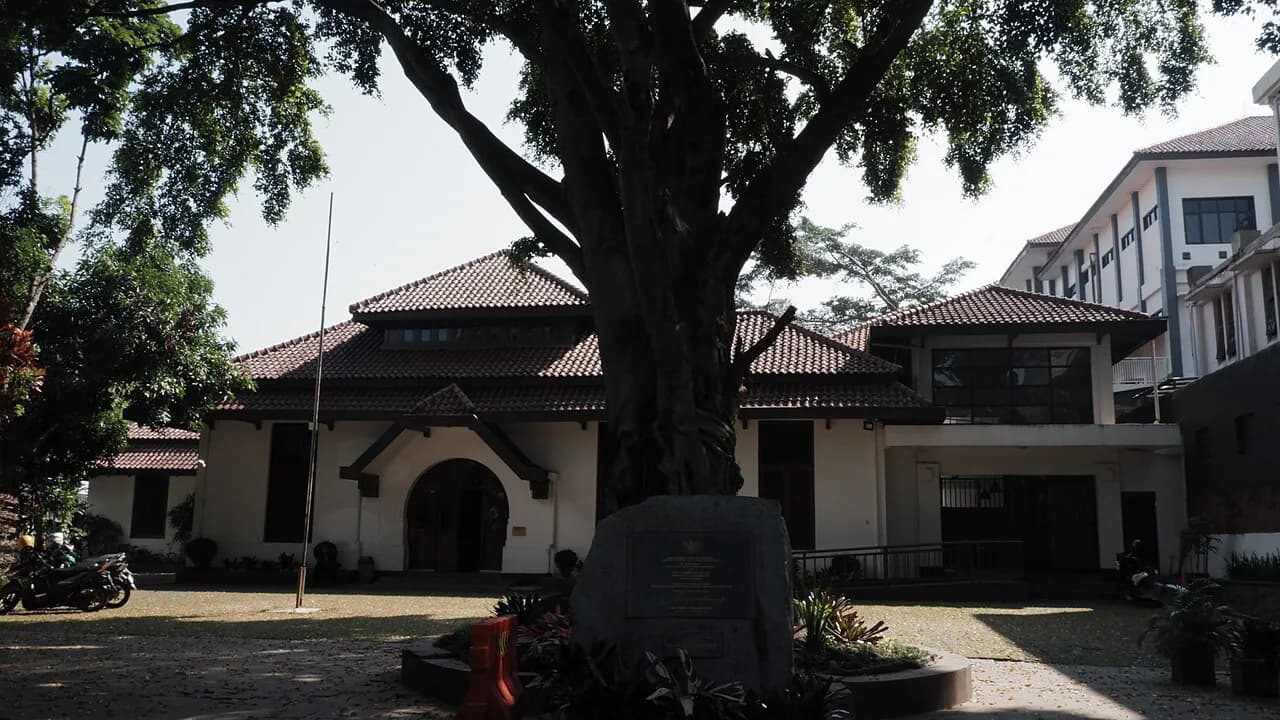
Gedung Indonesia Menggugat: What to See at Bandung's Historic Court Building

Gedung Indonesia Menggugat is a compact former courthouse in central Bandung, best treated as a 30-to-45-minute stop rather than a half-day museum. Its draw is the 1930 trial of Soekarno and three PNI colleagues, which gave the building its name. This page covers where it sits, how to reach it, what the sources actually confirm about the structure, and what to check before you go.
What Gedung Indonesia Menggugat actually is
The building stands at Jalan Perintis Kemerdekaan No. 5 in Babakan Ciamis, Sumur Bandung, a short walk from Balai Kota Bandung. University documentation records a house on the site from 1906, replaced in 1917 by the structure you see today when it became a Landraad, the first-level court that handled indigenous defendants. The same documentation notes an expansion in 1923, which explains why the plan reads larger than a simple residence.
Older accounts date the original house to 1907 rather than 1906, so treat the earliest date as approximate and lean on the 1917 court conversion, which the sources agree on. The street itself was once called Landraadweg, a name that referred directly to the court; today's Jalan Perintis Kemerdekaan is the name to use with drivers and maps. If a local reference mentions Landraadweg, it is describing the same address.
After independence the building cycled through several uses, including a Red Cross post and government offices, before restoration in 2004–2005 returned it to its original form and it was opened for public and community activities. It is a heritage building rather than a formal museum with galleries, so set expectations around architecture and history rather than exhibits.
Why the building carries this name
In 1930 the Landraad here tried four independence figures: Soekarno, Gatot Mangkoepradja, Maskoen Soemadipoetera and Soepriadinata, accused by the Dutch colonial government of plotting to overthrow its authority. The proceedings ran for roughly five months, from 18 August to 22 December 1930, according to building documentation from ISBI Bandung. Soekarno's defense speech, titled Indonesia Menggugat, became famous enough that the building now carries its name.
Kompas reported that the name was formally attached in 2015 by former West Java governor HC Mashudi; treat that as a reported detail rather than something you will find carved on the facade. The book Indonesia Menggugat is usually credited to Soekarno as the text of his defense, though the trial record itself is a colonial court document. Knowing this distinction helps when you read any plaque or display on site.
Where it sits in Bandung
The address falls in the Sumur Bandung district, close enough to Balai Kota Bandung that you can combine the two on foot. Wikipedia's entry places it just off the civic core, which makes it an easy insertion into a downtown walk rather than a separate trip across the city. Use Jalan Perintis Kemerdekaan as your anchor and look for the low neoclassical facade set back behind a front yard.
If you are building a downtown day, the wider Bandung Attractions: 13 Visitor Guides collection covers the surrounding landmarks so you can judge distances before committing. Braga Street (Jalan Braga) in Bandung is the closest well-known walking street, though it is a ride away rather than a stroll. Keep the geography straight: this is a civic-corner building, not part of a museum cluster.
How to get there
Ride-hailing apps and metered taxis are the simplest option, and asking for Jalan Perintis Kemerdekaan No. 5 near Balai Kota gives the driver enough context. Bandung traffic bunches around the civic center during commuting hours, so build in slack if you are slotting the visit between other stops. If you are already downtown, walking from the Balai Kota area avoids the parking problem entirely.
Public transport in Bandung is less predictable than in Jakarta, and the sources here do not document a specific angkot route to the door, so confirm your route locally rather than relying on a fixed plan. Drivers may know the building by its Indonesian name, so say Gedung Indonesia Menggugat rather than an English translation.
What to look for in the building
The building's interest lies in its double identity as a remodeled house turned courtroom. Kompas describes two rooms on the right of the main structure that likely served as principal bedrooms, and two on the left that probably held a dining room and reception room. Look for that residential logic in the window placement and room depth before you read it as a civic building.
The neoclassical styling was adapted to the tropical climate rather than copied wholesale from Europe, which shows in the roof and openings. Wikipedia notes a front yard, or pelataran, that gives the building breathing room from the street; that courtyard is the most photogenic part of a short visit. The 1923 expansion is easiest to spot as the less symmetrical rear and side volumes.
How long to allow and how to pace it
Budget 30 to 45 minutes for the exterior, courtyard and any accessible ground-floor areas, and treat anything longer as a bonus rather than a plan. Because the sources describe community and public activities rather than a ticketed exhibition, what you can enter may vary from one visit to the next. Arriving in the morning gives you softer light on the facade and fewer people in the yard.
Checking access, hours and tickets before you go
No source here publishes opening hours, entry prices or booking rules, so do not assume the building is open daily or free to enter. Check the building's own Instagram account, which posts about activities there, and cross-check with the West Java heritage listing before you travel. If the doors are closed, the exterior and courtyard still justify the detour on a downtown morning.
Nearby stops worth pairing
Gedung Sate, Bandung sits a short ride east along Jalan Diponegoro and makes a natural second stop if you are following the city's colonial-era architecture. The Museum Konferensi Asia Afrika in Bandung is another short hop and pairs well with the 1930 trial story, since both address Indonesia's political history. Pick one of the two rather than both if you are working around a single afternoon.
Is Gedung Indonesia Menggugat worth the stop?
Yes, if you are already downtown and want a specific, compact piece of Bandung's political history rather than a full museum morning. Pair it with Balai Kota or Gedung Sate, keep the visit under an hour, and confirm access through the building's channels before you set out.
Explore more Bandung guides
Frequently Asked Questions
Is Gedung Indonesia Menggugat a museum?
No. The sources describe it as a restored heritage building used for public and community activities, not a formal museum with curated galleries. Expect architecture, a courtyard and historical context rather than exhibition rooms.
Who was tried at Gedung Indonesia Menggugat?
Soekarno, Gatot Mangkoepradja, Maskoen Soemadipoetera and Soepriadinata were tried here by the Dutch colonial government in 1930. Soekarno's defense speech, Indonesia Menggugat, gave the building its later name.
How do I check whether it is open when I visit Bandung?
Check the building's Instagram account and the West Java heritage listing for current activity and access information. No source publishes fixed opening hours or ticket details, so verify shortly before your visit.