
Katedral Santo Petrus Bandung: A Visitor's Guide to the Neo-Gothic Cathedral

Katedral Santo Petrus Bandung needs about 30 to 45 minutes of your day: enough for the neo-Gothic exterior, a quiet walk through the nave, and a few minutes on Jalan Merdeka taking in the surrounding colonial-era streetscape. It is an active Catholic parish rather than a ticketed monument, so the building's rhythm is set by Mass and parish life, not by a visitor turnstile. This guide covers where the cathedral sits, its two-building history, how to arrive on foot or by ride-hailing app, what is worth slowing down for, and which nearby stops fit the same walk.
What Katedral Santo Petrus Bandung is, and why it stands out in central Bandung
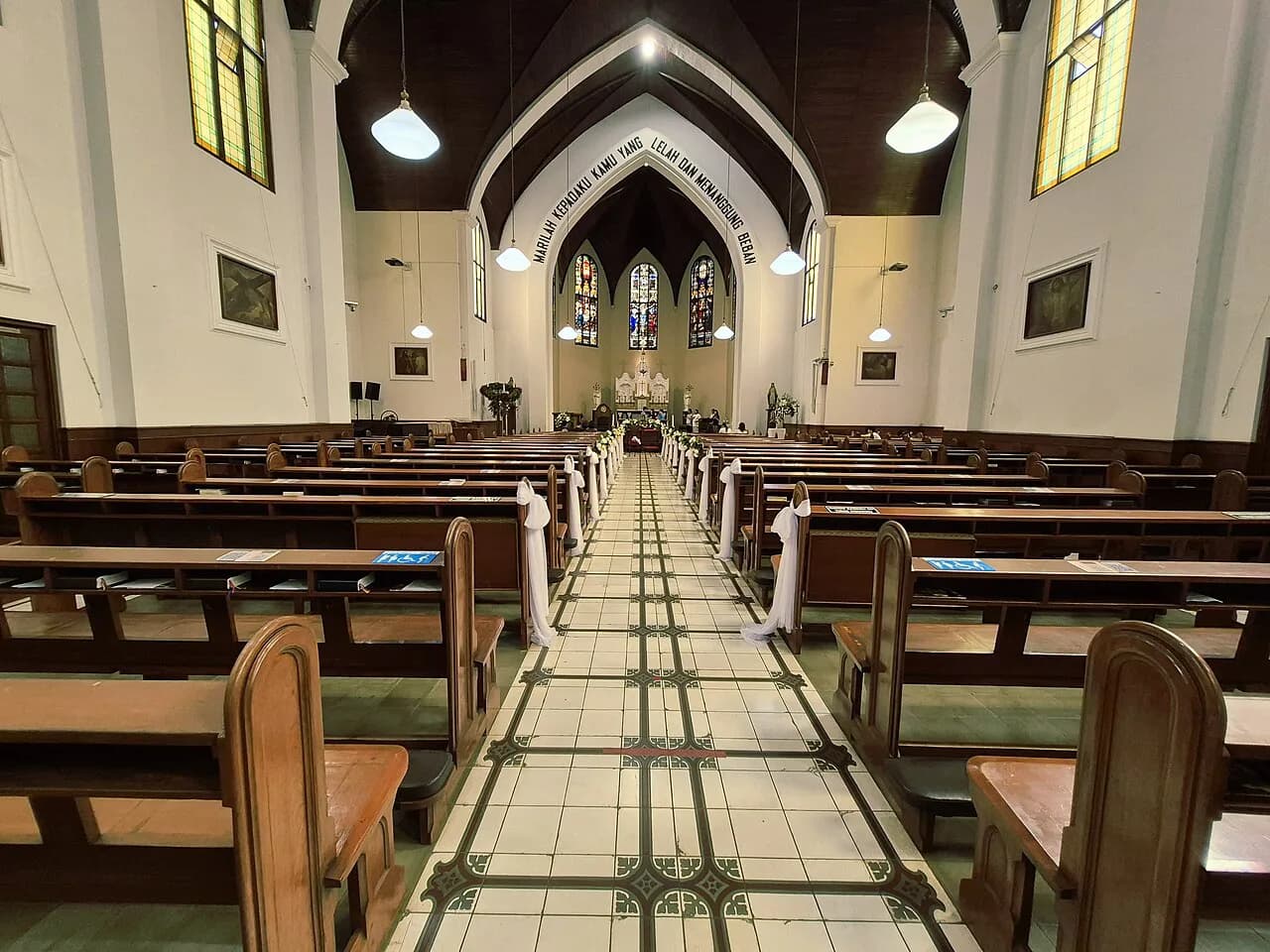
This is the mother church of the Diocese of Bandung, dedicated to Santo Petrus and built in a neo-Gothic style that reads as distinctly European against Bandung's tropical streets. Its silhouette is tall and narrow rather than broad, with strong vertical lines running up the facade. That verticality is deliberate: the architecture is designed around contrasting width and height, with columns and windows pulling the eye upward. For a city better known for Art Deco and tropical modernism, it is an unusual piece of the old colonial townscape.
Where it sits: Jalan Merdeka in the old civic center
The cathedral stands on Jalan Merdeka, the street that was called Merpikaweg in the colonial period, in the civic core the Dutch laid out after Bandung gained gemeente status in 1906. Sources describe that plan as grouping schools, banks, police offices and churches close together, which is why the cathedral sits within a short walk of other old institutional buildings instead of in a residential district. Use Jalan Merdeka as your landmark rather than a street number, since the entrance is easy to spot once you are on the street. If you want the wider set of old-town sights in one place, see the Bandung Attractions: 13 Visitor Guides collection, which puts this cathedral alongside them.
The railway line runs just south of the church complex, a detail that matters when you are orienting yourself: if you are walking from the station side, you approach the cathedral from below the tracks. Keep the church's tall frontage as your visual anchor.
History in brief: two churches, not one
The common mix-up is treating today's cathedral as Bandung's first Catholic church. It is not. The first was Gereja St. Franciscus Regis, a modest 8-by-21-meter building on what was then Schoolweg, now Jalan Merdeka, blessed on 16 June 1895, and it stood near the colonial government's coffee warehouse. The Catholic presence in Bandung itself traces to around 1878, when priests traveled in from Cirebon because the city had no resident clergy of its own.
Growth forced the change. After Bandung was made a separate church station in 1907, the congregation expanded quickly and the small church could no longer hold it, so a new building went up on former livestock land nearby along the same street during 1921. It was blessed on 19 February 1922 and dedicated to Santo Petrus. The AyoBandung account credits the design to Charles Prosper Wolff Schoemaker, the Dutch architect closely associated with colonial Bandung, though that attribution rests on that article rather than on a parish publication.
The status came later still. When the Holy See created the Apostolic Vicariate of Bandung in 1941, the church was explicitly named a cathedral, and the 1961 establishment of Indonesia's Catholic hierarchy confirmed it as the cathedral of the Diocese of Bandung. That makes it the seat of a bishop even though it is not the city's oldest church.
How to get there: walking from Jalan Braga and the city center
On foot is the best way to arrive. From Braga Street (Jalan Braga) in Bandung, the walk to Jalan Merdeka is short and flat enough to combine with the cathedral in one outing; treat it as a 10-to-15-minute stroll and you will not be far off. Walking also lets you see how the colonial civic buildings relate to one another, which is half the point of this part of town.
If you are coming from further out, a Grab or Gojek car is simpler than trying to park, and both apps work normally in central Bandung. Set the drop-off at Jalan Merdeka near the cathedral rather than a generic city-center pin, then walk the last stretch. Traffic in the core builds through the working day and around the afternoon school run, so a morning arrival costs you less time in the car.
The neo-Gothic exterior: where to stand and what to look at
Start across the street so you can take in the whole facade at once; from close up, the vertical proportions that define the building flatten out. Look for the columns and tall windows that create the upward pull, then move in to read the smaller work: moulding, carved detail and stained glass. These elements are what lift the building beyond a plain box with a pointed roof, and they reward a slow second pass.
The building is a working piece of the street, not a fenced monument, so your viewing spot is the public sidewalk. Watch for traffic and parked vehicles as you step back for the wider shot. Light changes through the day, so circle back later in the afternoon if the facade is flat or backlit when you first arrive.
What to look for inside, and how to behave in an active parish
Inside, the same vertical logic carries through the columns and windows, and the stained glass is the element most visitors stop for. Beyond that, published descriptions of the interior are thin, so arrive without a checklist of specific artworks and let the space itself be the attraction. Photography and dress conventions are not published in the sources available here, so follow whatever notices are posted at the doors and the guidance of parish staff.
The practical rule is simple: this is a place of worship first. If a service is under way, wait at the back or return later rather than walking the aisles. Visitors of any faith or none are generally welcome in Catholic churches outside service times, but the parish sets its own expectations, so ask at the entrance if you are unsure.
How long to allow, and how to time a visit around Mass
Budget 30 to 45 minutes for the cathedral itself, plus whatever time you spend on the surrounding streets. That is enough for the exterior, a walk through the nave and a look at the detail without rushing. If you are combining it with Braga Street and one nearby museum, half a day covers the cluster comfortably.
Mass times decide your timing, and they are not consistent enough to repeat from memory. The parish's own channels are the reliable place to check: the Katedral Bandung YouTube channel posts services and parish events, including a daily Mass stream, and a posted daily Mass video shows a 06.00 WIB start on the day it was recorded. Use those as a signal of how the parish communicates schedules, then confirm the current week's times directly with the parish before you build a morning around one.
Entry fees and opening hours are not published in the sources used for this page, so do not plan around a quoted ticket price or a fixed closing time. Check with the parish office or the diocese before a special trip, especially on Sundays and holy days when the building is busiest.
Nearby options to pair with the cathedral on the same walk
Gedung Sate, the landmark government building on Jalan Diponegoro, is a short ride or a longer walk from Jalan Merdeka and makes a natural second stop on the same loop. Its grounds and facade suit the same kind of slow look you gave the cathedral.
For a museum stop, the Museum Konferensi Asia Afrika in Bandung ties directly into the city's mid-century history and sits within the same central district. The museum Geologi Bandung is another option if you would rather head toward Cihaur Geulis and Cibeunying Kaler. Both are fuller visits than the cathedral, so pick one rather than both.
Is the cathedral worth adding to a Bandung day?
Yes, if you are already spending time in central Bandung. It costs little in time, it is one of the few neo-Gothic buildings in the city, and the walk from Braga Street makes it easy to fold into a morning. It is not a reason to cross town on its own, and anyone expecting a museum-style attraction with tickets and fixed hours will be disappointed.
Build the visit around a walk rather than a schedule: arrive on Jalan Merdeka, look at the facade from across the street, step inside if no service is running, then continue to Braga or one nearby museum. Confirm Mass times with the parish before you go, since they shape when the building is open to quiet visitors.